Occupational safety International framework and country guides
Is a safety committee or a worker safety representative required in Australia?
Part of: Occupational safety and health in Australia: law, authorities and employer duties
Short answer
Only on request. Under the model WHS Act, any worker can ask for health and safety representatives to be elected, and the PCBU must set up a health and safety committee within 2 months if an HSR or 5 or more workers ask. Consultation with workers is always required.
Not automatically. Under the model Work Health and Safety (WHS) Act, health and safety representatives (HSRs) are elected when a worker asks for an election, and a health and safety committee (HSC) must be set up within 2 months when an HSR or 5 or more workers at the workplace ask for one. Consulting workers on health and safety is required in every workplace, whatever its size.
Short answer
- Consultation: always required, so far as is reasonably practicable, with workers directly affected by a WHS matter (sections 47 to 49).
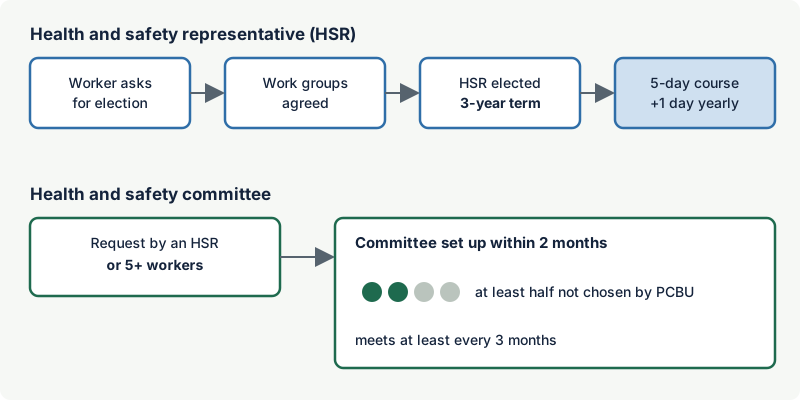
- HSR: any worker may ask the person conducting the business or undertaking (PCBU) to facilitate an election; work groups are negotiated, workers elect the HSR, who serves 3 years and may be re-elected (sections 50 to 64).
- HSR training: on request, a regulator-approved 5-day course chosen by the HSR plus 1 day of refresher training each year, paid by the PCBU, with time off on normal pay as soon as practicable within 3 months of the request (section 72, regulation 21).
- Committee: within 2 months of a request by an HSR or by 5 or more workers; the PCBU may also set one up voluntarily (section 75).
- Victoria: the OHS Act 2004 has its own HSR and committee rules, broadly similar.
Health and safety representatives
When asked, the PCBU must facilitate the determination of work groups by negotiation with the workers, and an election by the members of the work group. The HSR represents the work group, monitors the PCBU's compliance, investigates complaints and inquires into risks (section 68). The HSR may inspect the workplace after reasonable notice (or at any time after an incident or in case of a serious and imminent risk), accompany inspectors, attend interviews with workers' consent and ask for a committee.
Once trained, an HSR can issue a provisional improvement notice after consulting the person concerned (section 90) and can direct workers to cease unsafe work where there is a serious risk from an immediate or imminent hazard (section 85). The PCBU must consult and confer with HSRs, give them access to hazard information, provide reasonable resources and facilities, and allow the necessary time on normal pay (section 70). Personal or medical information about a worker is available to the HSR only with the worker's consent or in a non-identifying form.
Health and safety committees
The PCBU and workers agree the committee's make-up, but any HSR who consents is a member, and at least half of the members must be workers not nominated by the PCBU (section 76). The committee helps the PCBU and workers develop and carry out safety measures and assists in developing workplace rules and procedures (section 77). It meets at least every 3 months and whenever at least half the members reasonably ask (section 78). Members must be given the time needed for meetings and committee functions, on normal pay (section 79). If the parties cannot agree, either may ask the regulator to appoint an inspector to decide.
Example: At a 40-person engineering workshop in Hobart, six machinists ask for a safety committee after several near misses. Because 5 or more workers asked, the PCBU must establish the committee within 2 months. It agrees with the workers on a committee of four: the workshop's existing HSR (who consents to join), one machinist chosen by the workers and two managers nominated by the PCBU. Two of the four members are therefore workers not nominated by the PCBU, which meets the at-least-half rule. The first meeting reviews the near misses and sets dates for the next quarter.
Comparison with Türkiye and the EU
In Türkiye, Law No. 6331 requires an OSH committee (iş sağlığı ve güvenliği kurulu) in every workplace with 50 or more workers where continuous work lasts more than 6 months (Article 22), and from 2 workers upwards at least one worker representative (çalışan temsilcisi), rising to six above 2,000 workers (Article 20). The EU Framework Directive 89/391/EEC requires consultation and balanced participation, with worker representatives under national law. Australia sets no headcount trigger; committees and HSRs depend on worker requests.
Common mistakes
- Appointing the HSR. HSRs are elected by their work group; management cannot choose them.
- Ignoring a written request from 5 workers because the business is small. Size does not matter.
- Treating the committee as a substitute for consultation with all affected workers and HSRs.
Related on excodex
- Occupational safety and health in Australia: law, authorities and employer duties
- What OSH training must employers provide to workers in Australia?
- Worker consultation and participation in OSH
Standards and further reading
- Work Health and Safety Act 2011 (Cth), Part 5 (sections 46 to 103): https://www.legislation.gov.au/C2011A00137/latest/text
- Work Health and Safety Regulations 2011 (Cth), regulation 21: https://www.legislation.gov.au/F2011L02664/latest/text
- Law No. 6331 on Occupational Health and Safety (Türkiye), Articles 20 and 22
This article is general occupational safety and health information prepared by the excodex editorial team. It does not replace the applicable legislation, standards, manufacturers' instructions or the assessment of a competent OSH professional or occupational physician.
More questions on this topic
- What is the main occupational safety and health law in Australia and who enforces it?
- Must an employer in Australia appoint a safety professional or an occupational physician?
- Is a written risk assessment mandatory in Australia, and how often must it be reviewed?
- How and within what time must a workplace accident be reported in Australia?
- What OSH training must employers provide to workers in Australia?
- Are pre-employment and periodic medical examinations required for workers in Australia?
- What are the penalties for breaking occupational safety rules in Australia?
- How are explosive atmospheres and Ex equipment regulated in Australia?
Part of: Occupational safety and health in Australia: law, authorities and employer duties