Occupational safety International framework and country guides
Which rules apply to major-hazard chemical sites in Azerbaijan?
Part of: Occupational safety and health in Azerbaijan: law, authorities and employer duties
Short answer
The 1999 Law on Technical Safety. Sites handling hazardous substances are hazard-potential facilities that must register, use certified equipment, pass expertise and insure; at Annex 2 thresholds (chlorine 25 t, ammonia 500 t) a technical safety declaration is required.
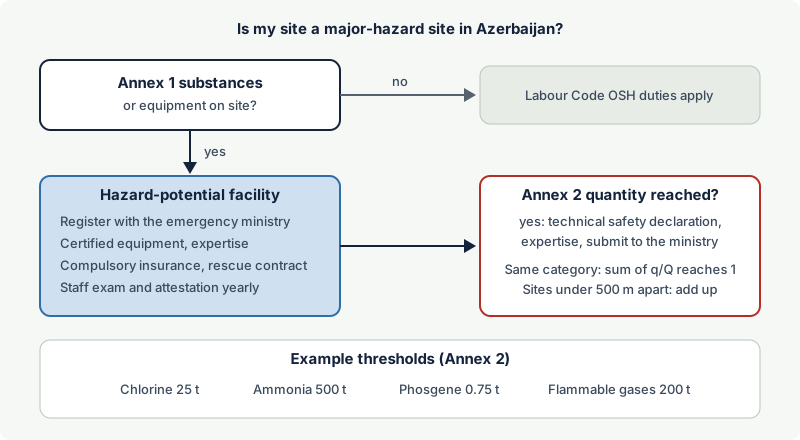
Major-hazard chemical sites in Azerbaijan are governed by the Law on Technical Safety of 2 November 1999 (No. 733-IQ), not by a Seveso-type regulation. Facilities that handle the hazardous substances listed in its Annex 1 are hazard-potential facilities: they must be registered, use certified equipment, pass technical safety expertise, hold compulsory insurance and be supervised by the Ministry of Emergency Situations. Where quantities reach the thresholds of Annex 2, the operator must also prepare a technical safety declaration.
Short answer
- Scope: sites that obtain, produce, process, store, transport, use or dispose of flammable, oxidising, explosive, toxic, highly toxic or environmentally hazardous substances, plus oil and gas, refining, petrochemicals and other Annex 1 activities.
- Register: hazard-potential facilities must be entered in the single state register (Art. 2.3 as amended by Law No. 139-VIIQD of 14 February 2025).
- Declaration: compulsory where quantities reach the Annex 2 thresholds; it assesses accident risks and preparedness, passes technical safety expertise and goes to the ministry and local authorities.
- Operator duties: certified equipment, expertise of designs and buildings, internal production control, staff training and attestation, contracts with professional rescue services, reserves for accident response, compulsory insurance (Arts. 7 to 16).
- Supervisor: the emergency ministry's State Agency for Control of Safe Work in Industry and Mining; its inspections are an exception to the business inspection moratorium.
Declaration thresholds
| Named substance (Annex 2, Table 1, selection) | Threshold |
|---|---|
| Ammonia | 500 t |
| Ammonium nitrate (high-nitrogen grades) | 2,500 t |
| Ammonium nitrate fertilisers | 10,000 t |
| Acrylonitrile | 200 t |
| Chlorine | 25 t |
| Ethylene oxide | 50 t |
| Hydrogen cyanide | 20 t |
| Hydrogen fluoride and hydrogen sulfide | 50 t each |
| Sulfur dioxide | 250 t |
| Sulfur trioxide | 75 t |
| Phosgene | 0.75 t |
| Methyl isocyanate | 0.15 t |
For other substances, Table 2 sets thresholds by category, for example 200 t for flammable gases, toxic or oxidising substances, 20 t for highly toxic substances, 50 t for explosives, 200 t for flammable substances used in a process or carried by trunk pipelines and 50,000 t for flammable liquids in storage depots. Table 2 applies to substances not named in Table 1. If facilities are less than 500 m apart, their quantities are added, and where several substances of the same category are used they are combined by summing the ratio of each quantity to its threshold (the declaration is needed when the sum reaches 1).
The declaration and the accident chain
The technical safety declaration (Art. 15) must contain a comprehensive assessment of possible accidents and their hazards, an analysis of whether prevention measures are sufficient, the operator's readiness to contain an accident and remove its consequences, and measures to reduce consequences and damage. It is based on the design documents, approved by the operator, which is liable for its accuracy, and revised when data or safety requirements change or when the operator applies for a permit.
Note: Art. 9 lists preparing a technical safety declaration among the duties of every operator, and Art. 15.3 requires operators to submit a declaration on the state of technical safety, while Art. 15.2 makes developing a declaration compulsory where Annex 2 quantities are reached. Below the thresholds, ask the State Agency what it expects from your site.
After an accident at a hazard-potential facility, a special commission of the emergency ministry carries out a technical investigation and records the causes, damage and breaches in an act; the operator pays its costs (Art. 13). If workers are injured, the operator must also report to the labour inspectorate and the emergency ministry on the same day under the accident investigation rules.
Example: A water treatment chemicals depot near Sumgait stores 18 t of chlorine and 120 t of ammonia. Neither named threshold is reached alone (25 t and 500 t). Both are toxic gases, and if the same-category summation rule is applied, 18/25 + 120/500 = 0.72 + 0.24 = 0.96: still below 1, but a further 1 t of chlorine (19/25 + 0.24 = 1.00) would reach it. Whether the summation note covers substances named in Table 1 is not spelled out, so the operator should agree the method with its expertise organisation and keep a margin. The site is in any case a hazard-potential facility: it must be registered, use certified equipment, insure the property and third-party liability, and have a rescue contract.
Common mistakes
- Looking for a "Seveso" or "major accident" regulation: the rules are in the Law on Technical Safety.
- Checking only named substances and forgetting the category thresholds and the 500 m aggregation.
- Treating the declaration as a one-off: it must be updated when data or requirements change.
Related on excodex
- Occupational safety and health in Azerbaijan: law, authorities and employer duties
- Explosive atmospheres and Ex equipment in Azerbaijan
- Seveso III: major-accident prevention, tiers and duties
- BEKRA in Türkiye
Standards and further reading
- Law on Technical Safety No. 733-IQ of 2 November 1999, Arts. 2 and 7 to 17, Annexes 1 and 2: https://e-qanun.az/framework/21
- Law No. 139-VIIQD of 14 February 2025 amending the Law on Technical Safety: https://e-qanun.az/framework/59123
- Statute of the State Agency for Control of Safe Work in Industry and Mining (Decree No. 695, 2007): https://e-qanun.az/framework/14328
- Cabinet of Ministers Decision No. 27 of 28 February 2000, accident investigation rules: https://e-qanun.az/framework/232
- Criminal Code, Art. 223: https://e-qanun.az/framework/46947
- Law No. 1410-IVQ on suspension of inspections (exceptions): https://e-qanun.az/framework/31093
This article is general occupational safety and health information prepared by the excodex editorial team. It does not replace the applicable legislation, standards, manufacturers' instructions or the assessment of a competent OSH professional or occupational physician.
More questions on this topic
- What is the main occupational safety and health law in Azerbaijan and who enforces it?
- Must an employer in Azerbaijan appoint a safety professional or an occupational physician?
- Is a written risk assessment mandatory in Azerbaijan, and how often must it be reviewed?
- How and within what time must a workplace accident be reported in Azerbaijan?
- What OSH training must employers provide to workers in Azerbaijan?
- Are pre-employment and periodic medical examinations required for workers in Azerbaijan?
- What are the penalties for breaking occupational safety rules in Azerbaijan?
- Is a safety committee or a worker safety representative required in Azerbaijan?
Part of: Occupational safety and health in Azerbaijan: law, authorities and employer duties