Occupational safety International framework and country guides
Occupational safety and health in Azerbaijan: law, authorities and employer duties
Abstract
Azerbaijan regulates OSH mainly through Part IX of the 1999 Labour Code, enforced by the State Labour Inspection Service; the Ministry of Emergency Situations supervises hazard-potential facilities. Accidents must be reported the same day; firms over 50 workers need an OSH service.
Azerbaijan has no separate occupational safety and health (OSH) act: the main rules are in Part IX "Labour protection" (Əməyin mühafizəsi) of the Labour Code of 1999, Articles 207 to 239, supported by Cabinet of Ministers decisions and ministry rules. The State Labour Inspection Service under the Ministry of Labour and Social Protection of the Population enforces them, while the Ministry of Emergency Situations supervises technical (industrial) safety at hazard-potential facilities under the 1999 Law on Technical Safety. Every workplace accident must be reported to the labour inspectorate on the day it happens.
This guide covers the legal framework, authorities, duties, OSH services, training, medical examinations, accidents, penalties, chemicals, Ex equipment and major hazards, with a comparison to the EU and Türkiye. It is based on the texts on the official legal portal e-qanun.az and amending laws up to November 2026.
Key points
- The core OSH law is Part IX of the Labour Code (Əmək Məcəlləsi), Articles 207 to 239; the 1992 Law on Labour Protection is repealed. Law No. 332-VIIQD (in force 16 January 2026) changed training intervals, OSH services and OSH spending.
- Employers with more than 50 workers must set up an OSH service with an OSH engineer, adding a deputy head for OSH above 500 workers and an industrial sanitary laboratory and occupational hygiene doctor above 1,000. Below 50, a worker with OSH knowledge or an OSH specialist takes on OSH work.
- Every industrial accident, whatever its severity, must be reported on the same day to the State Labour Inspection Service; the investigation commission normally works for 20 days, and the employer draws up the "İZ" form accident act no later than one day after the investigation ends.
- Since 16 January 2026, workers in harmful, heavy or high-hazard jobs must receive OSH instruction at least every 3 months and other workers at least once a year; employers and managers need OSH training and a knowledge check at least every 3 years.
- Pre-employment and periodic medical examinations at the employer's expense are compulsory for heavy, harmful and hazardous work (Labour Code Art. 226).
- Hazard-potential facilities must be registered, and sites holding hazardous substances above the thresholds of the Law on Technical Safety (for example 25 t of chlorine or 500 t of ammonia) must prepare a technical safety declaration.
- Most inspections of businesses are suspended until 1 January 2027 by the inspection moratorium law, but accident duties remain, and fines for failing to report an accident on the day were set at AZN 1,000 to 2,200 in 2025.
The legal framework: the Labour Code and supporting acts
The Labour Code was adopted on 1 February 1999 and took effect in July 1999. Part IX covers safe-work rights, employer and worker duties, accidents, OSH services, insurance, medical examinations, refusal of dangerous work, control and liability. It also protects trainees on placements, military personnel assigned to enterprises and people engaged in disaster relief (Art. 208).
| Act (official name) | English name | What it covers |
|---|---|---|
| Azərbaycan Respublikasının Əmək Məcəlləsi (1999), Arts. 207 to 239 | Labour Code, Part IX | General OSH duties, services, training, medical examinations, accidents |
| "Texniki təhlükəsizlik haqqında" Qanun No. 733-IQ, 2 November 1999 | Law on Technical Safety | Hazard-potential facilities, declarations, expertise, certification of equipment |
| Cabinet of Ministers Decision No. 27, 28 February 2000 | Rules on investigation and recording of industrial accidents | Who reports, to whom, commission, İZ act, records |
| Cabinet of Ministers Decision No. 38, 6 March 2000 | Rules on attestation of workplaces | Measurement and assessment of working conditions |
| Cabinet of Ministers Decision No. 1, 3 January 2000 | List of jobs requiring a medical certificate at hiring | Heavy, harmful and hazardous jobs, food and health sectors |
| Ministry collegium decision No. 19-3, 26 August 1999 | Model regulation on OSH training and testing of knowledge | Knowledge checks, commissions, certificates, instruction log |
| Law No. 999-IIIQ, 11 May 2010 | Law on compulsory insurance against loss of occupational capacity from industrial accidents and occupational diseases | Employer-paid accident and disease insurance |
| İnzibati Xətalar Məcəlləsi (2015) and Cinayət Məcəlləsi (1999) | Code of Administrative Offences, Criminal Code | Fines and criminal penalties |
Azerbaijan approved ILO Convention No. 155 on OSH by Law No. 800-VIQ of 1 February 2023 and Convention No. 187 (promotional framework for OSH) by Law No. 347-VIIQ of 2 February 2026. With the C187 ratification deposited on 3 June 2026, the ILO reports that Azerbaijan has ratified all fundamental conventions, a group that since 2022 includes C155 and C187.
Who enforces OSH: labour inspectorate, emergency ministry and trade unions
State Labour Inspection Service (Dövlət Əmək Müfəttişliyi Xidməti), under the Ministry of Labour and Social Protection of the Population. It enforces labour law including labour protection (Art. 235); its decisions are binding and can be appealed administratively or in court. It chairs accident investigation commissions, can stop work that endangers life or health (Arts. 218 and 229), and issues the "certificate-passport" (sertifikat-pasport) without which a new or rebuilt enterprise, facility or means of production may not be put into operation (Art. 218.5). It has regional divisions and stationary and mobile labour protection laboratories.
Ministry of Emergency Situations (Fövqəladə Hallar Nazirliyi), through its State Agency for Control of Safe Work in Industry and Mining. It supervises technical safety at hazard-potential facilities and mines, keeps the facility register, receives technical safety declarations, organises certification of technical devices used there and forms the technical investigation commission after accidents there.
Trade unions and worker representatives. Public control over OSH is exercised by persons authorised by the workforce and by trade union representatives (Art. 236). Trade unions take part in accident investigations and acceptance commissions and may run their own labour inspectorate (Art. 237).
Note: The Law on Suspension of Inspections in Entrepreneurship (No. 1410-IVQ of 20 October 2015) suspends most inspections of businesses; Law No. 348-VIIQD of 2 February 2026 extended the suspension until 1 January 2027. Exceptions include fire supervision, construction control, supervision of the safe operation of hazard-potential facilities and mines, radiation safety and situations on a government list of serious threats to life and health. The moratorium does not suspend any employer duty.
Employer and worker duties
The owner and the employer are directly responsible for meeting OSH norms at the workplace (Art. 215). They must, among other things:
- comply with OSH standards, norms and rules and keep buildings, structures, processes and equipment safe;
- bring workplaces into line with sanitary and OSH norms and organise sanitary, welfare and preventive medical services;
- supply special clothing, footwear and other personal protective equipment (PPE) free of charge, and clean, repair and store them (Arts. 215 and 222);
- organise OSH education, instruction and knowledge checks, include OSH in the collective agreement and submit OSH statistical reports;
- organise control of hazardous and harmful production factors and inform workers of changes, and prepare long-term and annual OSH improvement plans (Art. 222);
- state in each employment contract the employer's commitment to safe and healthy conditions and warn a worker about the expected time to an occupational disease where the job carries a high risk (Art. 224).
Since 16 January 2026, annual OSH spending must be at least 2 % of the wage bill for enterprises and individual employers that directly produce goods and have production sites, and at least 1 % for others (Art. 220.4). Workers bear no OSH costs.
Every employer must also insure each worker against loss of occupational capacity from industrial accidents and occupational diseases (Art. 225 and Law No. 999-IIIQ). Since 1 January 2026 (Law No. 297-VIIQD of 9 December 2025), staff of state bodies, municipalities, state-owned companies and budget organisations, trainees and volunteers are insured through a state body designated by the government; other workers are insured with licensed commercial insurers.
Workers must learn and follow OSH, hygiene and fire rules, use the PPE provided, not work on installations or explosive or otherwise dangerous sources without personal authorisation, and report violations, accidents and incidents to the employer at once (Art. 216). Where safe conditions are not provided and there is a danger to life or health, a worker may refuse to perform the work without liability (Art. 230.2), and keeps job and average pay while work is stopped for OSH breaches that are not the worker's fault (Art. 230.1).
A national specific is the weather rule (Art. 233 and Annex 2 of the Code). Above 41 °C, all work outdoors and in enclosed premises without cooling stops and workers get cooling breaks; in the cold season, work outdoors in low temperatures and strong wind, or in unheated buildings below +14 °C, brings paid warming breaks or a stoppage. Annex 2 also stops crane work on land at wind force 6 or more and sets wind limits for construction and offshore work.
OSH services, physicians, risk assessment and workplace attestation
OSH service thresholds
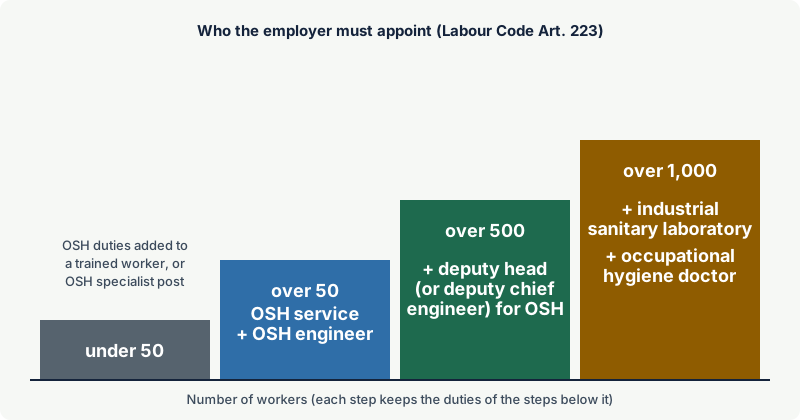
Article 223 requires employers in all sectors with more than 50 workers to establish an OSH service staffed by specialists who know labour law and OSH norms. The service must include an OSH engineer; above 500 workers a deputy head (or deputy chief engineer) for OSH is added, and above 1,000 workers an industrial sanitary laboratory and an occupational hygiene doctor. Since 16 January 2026, where there are fewer than 50 workers, OSH work is added, with consent and a contract change, to the duties of a worker who has OSH knowledge; if that is not possible, the employer creates an OSH specialist post. The amended text speaks of "more than 50" and "fewer than 50", so an employer with exactly 50 workers should confirm its position with the inspectorate.
OSH specialists can give binding instructions to managers to remove violations and may not be given unrelated work (Art. 223.4); the service may be reorganised or abolished only with the labour inspectorate's consent (Art. 223.5). The ministry's 1999 recommendations make it an independent unit reporting directly to the employer.
Occupational physicians
Apart from the occupational hygiene doctor above 1,000 workers, the Labour Code does not oblige employers to appoint an occupational physician; health institutions carry out the medical examinations at the employer's expense.
Risk assessment and workplace attestation
The Labour Code contains no general duty to keep a written risk assessment for every workplace in the sense of the EU Framework Directive 89/391/EEC. The closest legal instruments are:
- Attestation of workplaces (iş yerlərinin attestasiyası, Art. 222.5 and Decision No. 38 of 2000): all workplaces must be assessed for hazardous and harmful factors and conformity with OSH norms, at least once every 5 years and again after new equipment, process changes or changes to collective protection. Since a December 2023 amendment, the employer must send copies of the attestation result documents to the labour inspectorate within 10 working days.
- Technical safety declaration for hazard-potential facilities above the thresholds of the Law on Technical Safety, which must contain a comprehensive assessment of accident risks.
Many employers in oil and gas, construction and international projects also keep ISO 45001 style risk assessments because clients and lenders require them; that is good practice, not a statutory form.
Training and medical examinations
Article 219 requires induction instruction for new and transferred workers, training in safe methods and first aid, and prior OSH instruction before anyone starts work in harmful or heavy production or on high-hazard machinery. Law No. 332-VIIQD of 30 December 2025 (in force 16 January 2026) added Art. 219.6: such workers must be instructed at least once every 3 months, and all other workers at least once a year; within these limits the actual interval is fixed by the collective agreement, the employment contract or an agreement with the trade union or workforce. Records are kept in the electronic information system (special journals in the cases allowed by the Code). Employers and managers must attend OSH refresher courses and have their knowledge checked at least once every 3 years (Art. 219.3).
The 1999 model regulation on OSH training adds detail: new staff have their knowledge checked within one month, then at least every 3 years, by a commission of at least three people; extraordinary checks follow new rules, process changes, accidents, breaches or a break of more than one year; the certificate is valid throughout the country.
For health surveillance, Art. 226 requires a pre-employment and then periodic compulsory medical examinations, at the employer's expense, for heavy, harmful and hazardous work; a worker who refuses may be removed from work. Decision No. 1 of 3 January 2000 lists jobs that need a medical certificate at hiring, including work at height and on lifting equipment, oil and gas work including offshore drilling, underground work, work with explosives or in explosion and fire hazardous areas, and pressure vessel operators. Staff of hazard-potential facilities need a medical examination and attestation at least once a year (Law on Technical Safety, Art. 10). Since 19 May 2026 (Law No. 394-VIIQD), Art. 226.1-1 also makes the employer pay for pre-employment, periodic and for-cause drug and alcohol examinations for posts on the official list of jobs restricted for people with such dependence.
Accident reporting and investigation
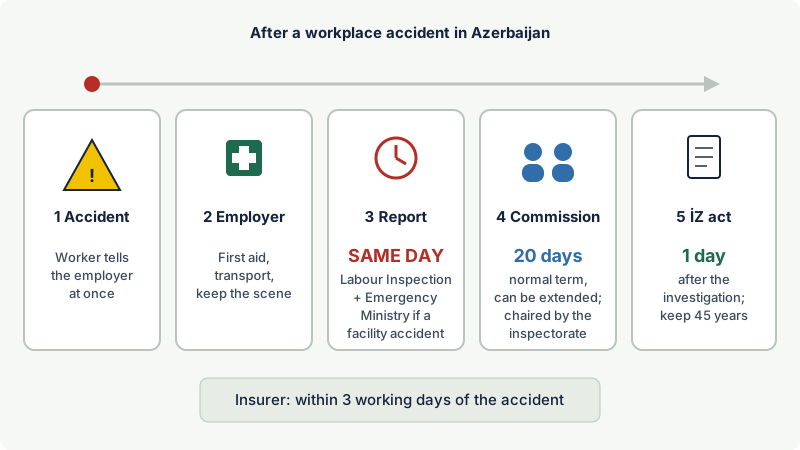
- The injured worker or a witness informs the employer immediately. The employer arranges first aid and transport to a medical facility and keeps the scene as it was, unless that endangers others.
- On the same day, the employer reports the accident, whatever its severity, to the State Labour Inspection Service (local division or head office), and to the Ministry of Emergency Situations if an accident at a hazard-potential facility caused it. The superior central authority (if any) and the trade union confederation (if the workers are members) are informed at the same time, and the insurer within 3 working days. The e-social.gov.az portal offers an electronic reporting service.
- The inspectorate sets up an investigation commission chaired by its official, with employer and trade union representatives. Accidents with two to four deaths, and accidents with five or more deaths, are investigated by a commission formed by order of the Minister. At hazard-potential facilities and mines, the Ministry of Emergency Situations forms a special commission for the technical investigation.
- The commission normally completes its work within 20 days; the body that formed it may extend this on a reasoned request.
- No later than one day after the investigation ends, the employer draws up the İZ form act and gives a copy to the injured worker (Art. 217.3). Accidents causing incapacity for more than one day are recorded with an İZ act and in the accident register. The investigation file must be kept for 45 years.
Example: A fabrication yard near Baku with 320 workers has a fall at 15:40 on a Tuesday. The site manager arranges first aid, cordons off the scaffold and reports to the regional labour inspection division the same afternoon, by telephone or through the e-social.gov.az service, with the details required by Annex 3 of the accident rules. The insurer is notified by Friday (3 working days). The yard's OSH engineer, who exists because the yard has more than 50 workers, collects training records, the scaffold inspection log and witness statements for the commission. When the commission ends its work, the employer issues the İZ act the next day at the latest.
Inspections, penalties and liability
Employers face administrative and criminal liability for failing to provide safe conditions (Art. 238) and must compensate injury caused by their fault in full, except where the worker is covered by the compulsory accident insurance (Art. 239). Key sanctions are below; amounts are those in force in November 2026, after Law No. 178-VIIQD of 11 April 2025 (in force 30 May 2025) rewrote the accident-reporting offences.
| Offence | Article | Sanction |
|---|---|---|
| Breach of labour protection rules (standards, safe equipment, PPE, training, guards on moving parts, statistics) | Administrative Code 198.1 | Fine AZN 500 to 1,000 |
| Not providing healthy and safe conditions or collective agreement OSH measures | Administrative Code 199 | Fine AZN 700 to 1,500 |
| Giving OSH service staff unrelated work | Administrative Code 200 | Fine AZN 1,200 |
| Concealing an accident or not reporting it the same day (2025 wording) | Administrative Code 555.1 | Fine AZN 1,000 to 2,200 |
| Not drawing up the accident act within one day, or evading it (2025 wording) | Administrative Code 555.2 | Fine AZN 1,500 to 2,200 |
| Commissioning a facility without the certificate-passport | Administrative Code 556.3 | Officials AZN 1,500 to 2,500; legal entities AZN 3,000 to 4,000 |
| Breach of OSH rules causing serious or less serious harm by negligence | Criminal Code 162.1 | Fine AZN 2,000 to 3,000, correctional work up to 2 years, restriction of liberty up to 1 year or imprisonment up to 6 months |
| Same causing death | Criminal Code 162.2 | Imprisonment up to 5 years, with or without a 3 to 5 year ban from certain posts |
| Same causing two or more deaths | Criminal Code 162.3 | Imprisonment 3 to 7 years, with or without a ban of up to 3 years |
| Breach of safety rules at explosion-hazardous facilities or workshops causing death or other grave consequences | Criminal Code 223.2 | Imprisonment 3 to 6 years, with or without a ban of up to 3 years |
| Same causing two or more deaths | Criminal Code 223.3 | Imprisonment 5 to 10 years and a ban of up to 3 years |
Chemicals, explosive atmospheres, major hazards and product conformity
Chemicals. The government approves lists of prohibited hazardous substances (Art. 211), and harmful substances that have not passed sanitary and other expertise may not be used (Art. 218.4). No national act implementing the UN Globally Harmonized System (GHS) of classification and labelling could be found on e-qanun.az, so employers should confirm labelling and safety data sheet requirements with the authorities. Azerbaijan acceded to the Rotterdam Convention by Law No. 262-VIIQ of 30 September 2025.
Explosive atmospheres and Ex equipment. Facilities that handle flammable, explosive, oxidising or toxic substances are hazard-potential facilities. Devices, machines and mechanisms used there must be certified against standards and technical regulations by accredited conformity assessment bodies; the emergency ministry agency organises certification and approves the list of certified devices (Law on Technical Safety, Art. 7). There is no national ATEX-type technical regulation for Ex equipment on e-qanun.az (November 2026). Azerbaijan is not a member of the Eurasian Economic Union, so the EAC mark is not a legal requirement in itself; the October 2026 rules on recognising foreign conformity documents apply only to goods covered by a national technical regulation.
Major hazards. Annex 2 of the Law on Technical Safety sets thresholds that make a technical safety declaration compulsory, for example chlorine 25 t, ammonia 500 t, hydrogen sulfide 50 t, phosgene 0.75 t, and 200 t for flammable gases. Operators must register the facility, prepare and submit the declaration, pass technical safety expertise, hold compulsory insurance and have rescue arrangements.
PPE and work equipment. National technical regulations under the 2019 Law on Technical Regulation (No. 1669-VQ) so far cover only gas-burning appliances (TR 001/2026/AZ, in force from 6 November 2026) and toys (TR 002/2026/AZ, from 7 April 2027). None covers PPE, so buyers should specify the required standards and certificates in contracts and check with the conformity assessment bodies.
Azerbaijan compared with the EU framework and Türkiye
| Topic | Azerbaijan | EU framework | Türkiye |
|---|---|---|---|
| Main law | Labour Code Part IX (1999) | Directive 89/391/EEC plus national laws | Law No. 6331 (2012) |
| Safety professional | OSH service over 50 workers; trained worker or specialist below | Competent persons or services, any size | OSH specialist for every employer (in-house or external service; under conditions the employer) |
| Occupational physician | Hygiene doctor over 1,000 workers | Health surveillance as national law sets | Workplace physician for every employer (in-house or external service) |
| Written risk assessment | No general duty found; workplace attestation every 5 years | Required for all employers | Required; renewal 2, 4 or 6 years by hazard class |
| Accident report | Same day to labour inspectorate | National deadlines vary | Within 3 working days to SGK |
| Major hazards | Technical safety declaration above Annex 2 thresholds | Seveso III Directive 2012/18/EU | Seveso-based BEKRA regulation |
| Ex equipment | Certification under the Law on Technical Safety | ATEX 2014/34/EU and 1999/92/EC | ATEX transposed |
Common mistakes
- Looking for a stand-alone "OSH law". The duties are in the Labour Code Part IX and its regulations; the 1992 Law on Labour Protection is repealed.
- Reporting an accident days later. The Labour Code requires a report on the day of the accident, regardless of severity.
- Treating the inspection moratorium as a holiday from OSH duties. It suspends most inspections only; accident duties and liability remain, and supervision of hazard-potential facilities and mines is among the exceptions.
- Using annual training for high-hazard jobs. Since 16 January 2026 the minimum is instruction every 3 months for harmful, heavy and high-hazard work.
- Assuming an EU or EAC certificate is automatically accepted for Ex equipment at a hazard-potential facility. Confirm the certification route with the accredited body and the emergency ministry agency first.
Frequently asked questions
Do foreign contractors have to follow Azerbaijani OSH law?
Yes. The Labour Code and the accident rules apply to all workplaces in the country, including those set up by foreign companies. The accident rules exclude foreigners whose employment contract is with a foreign company in their own country while they work at its branch or office in Azerbaijan, and people working under civil-law contracts, so check the contract basis of every worker on site.
Who pays for medical examinations and PPE?
The employer. PPE, special clothing and footwear must be free of charge, and compulsory medical examinations for heavy, harmful and hazardous work are at the employer's expense.
Is a safety committee required?
The Labour Code does not require a joint OSH committee. It provides for OSH representatives authorised by the workforce, who must get at least two paid hours a week, and for trade union control. Collective agreements may set up OSH commissions.
Which authority handles accidents at oil and gas or chemical plants?
The labour inspectorate investigates the injury, and the Ministry of Emergency Situations forms a special commission for the technical investigation of accidents at hazard-potential facilities and mines.
Related on excodex
- Main OSH law and enforcement in Azerbaijan
- How to report a workplace accident in Azerbaijan
- Safety professional and physician requirements in Azerbaijan
- Major-hazard chemical sites in Azerbaijan
- OSH law compared: appointments, committees and reporting deadlines
- Ex certification in other markets
Standards and further reading
- Labour Code of the Republic of Azerbaijan (Əmək Məcəlləsi), 1 February 1999, Part IX, Arts. 207 to 239, consolidated text: https://e-qanun.az/framework/46943
- Law No. 332-VIIQD of 30 December 2025 amending the Labour Code and other laws (in force 16 January 2026): https://e-qanun.az/framework/61202
- Law No. 394-VIIQD of 27 April 2026 amending the Labour Code (medical checks for posts restricted for narcological patients): https://e-qanun.az/framework/61866
- Law No. 297-VIIQD of 9 December 2025 amending the Tax Code and other laws, including the occupational accident insurance law (in force 1 January 2026): https://e-qanun.az/framework/61117
- Law No. 800-VIQ of 1 February 2023 approving ILO Convention No. 155: https://e-qanun.az/framework/53457, and Law No. 347-VIIQ of 2 February 2026 approving ILO Convention No. 187: https://e-qanun.az/framework/61368
- Law on Technical Safety (Texniki təhlükəsizlik haqqında) No. 733-IQ, 2 November 1999: https://e-qanun.az/framework/21, amended by Law No. 139-VIIQD of 14 February 2025: https://e-qanun.az/framework/59123
- Cabinet of Ministers Decision No. 27 of 28 February 2000, Rules on investigation and recording of industrial accidents: https://e-qanun.az/framework/232
- Cabinet of Ministers Decision No. 38 of 6 March 2000, Rules on attestation of workplaces: https://e-qanun.az/framework/873, and Decision No. 440 of 7 December 2023: https://e-qanun.az/framework/55727
- Cabinet of Ministers Decision No. 1 of 3 January 2000, list of jobs requiring a medical certificate at hiring: https://e-qanun.az/framework/309
- Model regulation on OSH training and knowledge testing, ministry collegium decision No. 19-3 of 26 August 1999: https://e-qanun.az/framework/10514
- Recommendations on organising the OSH service, ministry collegium decision No. 6-2 of 16 February 1999: https://e-qanun.az/framework/11166
- Code of Administrative Offences (2015): https://e-qanun.az/framework/46960, amended by Law No. 178-VIIQD of 11 April 2025: https://e-qanun.az/framework/59769
- Criminal Code (1999), Arts. 162 and 223: https://e-qanun.az/framework/46947
- Law on Suspension of Inspections in Entrepreneurship No. 1410-IVQ (2015): https://e-qanun.az/framework/31093, and Law No. 348-VIIQD of 2 February 2026: https://e-qanun.az/framework/61328
- Law on compulsory insurance against occupational accidents and diseases No. 999-IIIQ (2010): https://e-qanun.az/framework/19789
- Statute of the emergency ministry's State Agency for Control of Safe Work in Industry and Mining, Presidential Decree No. 695 of 28 December 2007: https://e-qanun.az/framework/14328
- Law on Technical Regulation No. 1669-VQ (2019): https://e-qanun.az/framework/43689, and Decision No. 352 of 23 October 2026 on recognition of foreign conformity documents: https://e-qanun.az/framework/62822
- Technical regulations TR 001/2026/AZ (gas-burning appliances): https://e-qanun.az/framework/61789, and TR 002/2026/AZ (toys): https://e-qanun.az/framework/62731
- Law No. 262-VIIQ of 30 September 2025 on accession to the Rotterdam Convention: https://e-qanun.az/framework/60743
- State Labour Inspection Service: https://sosial.gov.az/en/ministry/state-labour-inspection-service
- Electronic accident report service: https://e-social.gov.az/en/e-services/receipt-and-investigation-of-reports-on-occupational-accidents-55
- ILO, Azerbaijan ratifies all fundamental conventions (5 June 2026): https://www.ilo.org/resource/news/azerbaijan-ratifies-all-fundamental-conventions
This article is general occupational safety and health information prepared by the excodex editorial team. It does not replace the applicable legislation, standards, manufacturers' instructions or the assessment of a competent OSH professional or occupational physician.
Questions on this topic
- What is the main occupational safety and health law in Azerbaijan and who enforces it?
- Must an employer in Azerbaijan appoint a safety professional or an occupational physician?
- Is a written risk assessment mandatory in Azerbaijan, and how often must it be reviewed?
- How and within what time must a workplace accident be reported in Azerbaijan?
- What OSH training must employers provide to workers in Azerbaijan?
- Are pre-employment and periodic medical examinations required for workers in Azerbaijan?
- What are the penalties for breaking occupational safety rules in Azerbaijan?
- Is a safety committee or a worker safety representative required in Azerbaijan?
- How are explosive atmospheres and Ex equipment regulated in Azerbaijan?
- Which rules apply to major-hazard chemical sites in Azerbaijan?