Occupational safety International framework and country guides
Which rules apply to major-hazard chemical sites in Turkmenistan?
Part of: Occupational safety and health in Turkmenistan: law, authorities and employer duties
Short answer
The 2017 Law on Industrial Safety of Hazardous Production Facilities applies: sites are registered and classed I to IV; classes I and II need a safety management system and, above legal substance quantities, an industrial safety declaration renewed at least every 10 years.
Major-hazard chemical sites in Turkmenistan are governed by Law No. 495-V on Industrial Safety of Hazardous Production Facilities, signed on 4 February 2017, rather than by an equivalent of the EU Seveso directive. Sites are registered in the State Register of Hazardous Production Facilities and placed in hazard classes I (extremely high) to IV (low); classes I and II must run a safety management system and, where hazardous substances exceed the quantities in the law, prepare an industrial safety declaration.
Short answer
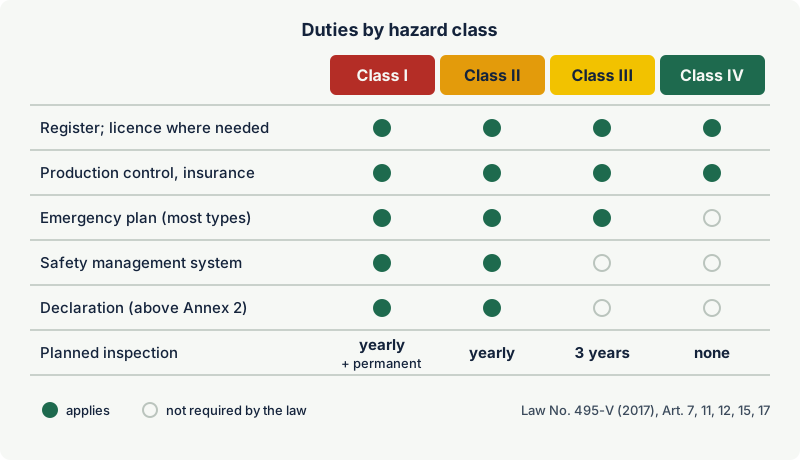
- Scope: facilities that produce, use, process, store, transport or destroy flammable, oxidising, combustible, explosive, toxic, highly toxic or environmentally hazardous substances in the quantities of Annex 2, plus pressure equipment, lifting equipment, molten metals, mining and dust-forming grain facilities (Annex 1).
- Registration and class: in the State Register; class assigned at registration (Article 2).
- Licence for the activities that licensing legislation covers, including operation of hazardous facilities (Article 7).
- Production control of industrial safety; information to the authority every year by 1 April (Article 12).
- Safety management system: mandatory for classes I and II (Article 12(3)).
- Industrial safety declaration: mandatory for classes I and II with hazardous substances in the Annex 2 quantities; renewed after ten years, after process changes, after an increase of more than 20 % in hazardous substances, after new requirements or on the authority's order (Article 15).
- Emergency preparedness: all operators need rescue service contracts, financial reserves, warning systems and training; classes I to III facilities handling hazardous substances, molten metal, mining or grain also need plans for localising and eliminating accidents (Article 11).
- Insurance: compulsory liability insurance for harm from an accident (Articles 10 and 16).
- Inspections: planned at least yearly for classes I and II, at least once every three years for class III, none planned for class IV; class I facilities are also under permanent state supervision (Article 17).
How the classes are set
Classes for chemical sites depend on the maximum quantity of each hazardous substance that is or can be present at the same time, using tables in Annex 2. Specific rules apply to other types: for oil and gas drilling and production, hydrogen sulphide content above 6 % gives class II and 1 to 6 % class III; gas networks above 1.2 MPa (natural gas) or 1.6 MPa (LPG) are class II; storage of chemicals usable for chemical weapons is class I. If different criteria give different classes, the highest applies, and facilities in protected areas, on the continental shelf or in Turkmen waters move one class higher.
The law excludes electricity network facilities and gas distribution and consumption networks up to 0.005 MPa.
Comparison with the EU Seveso III directive
| Element | EU Seveso III (Directive 2012/18/EU) | Turkmenistan (Law No. 495-V of 2017) |
|---|---|---|
| Scope | Dangerous substances above qualifying quantities, lower and upper tier | Hazardous substances plus pressure, lifting, molten metal, mining and grain facilities |
| Tiers | Lower and upper tier | Classes I to IV |
| Prevention document | Major-accident prevention policy (all), safety report (upper tier) | Safety management system (I, II), industrial safety declaration (I, II above Annex 2 quantities) |
| Review | Safety report at least every five years | Declaration renewed at least every ten years or on change |
| Emergency planning | Internal and external emergency plans (upper tier) | Plans for localising and eliminating accidents (classes I to III) |
| Inspection | Upper tier yearly, lower tier every three years, unless risk-based | Classes I and II yearly, class III every three years, class IV none |
| Accident investigation | Competent authority analysis, reporting to the Commission | Technical investigation commission led by the authority, at the operator's cost |
Accidents and investigation
After an accident (авария: destruction of structures or devices, uncontrolled explosion or release of hazardous substances) a technical investigation commission led by a representative of the authorised industrial safety body is formed, with local authorities, the operator and the insurer; the Cabinet of Ministers may create a state commission (Article 13). The act states causes, damage, breaches, responsible persons and preventive measures. The operator must inform the authority, other state bodies, local government and the population in the established order, and record all accidents and incidents. Wider emergencies also fall under the emergency situations legislation.
Example: A new LPG storage and bottling terminal with pressure vessels and a large propane inventory is registered as a hazardous production facility. If its inventory places it in class II, the operator must obtain a licence, prepare an industrial safety declaration within the project documentation, set up a safety management system and production control, insure its liability, plan for localising accidents and expect a planned inspection every year.
What to confirm locally
Implementing acts are still being added: a presidential decree of January 2023 approved the registration procedure and the requirements for accident localisation plans, and a resolution of April 2025 the procedure for industrial safety norms and rules. The Annex 2 quantity tables did not appear in the text we could open, and the authorised industrial safety body for each sector is designated by the Cabinet of Ministers (Article 5); the 2013 Code of Administrative Offences gives Türkmenstandartlary officials the cases of the industrial safety bodies (Article 481). Confirm the tables, the authority and the format of the declaration and plans before design starts.
Related on excodex
- Occupational safety and health in Turkmenistan: law, authorities and employer duties
- How are explosive atmospheres and Ex equipment regulated in Turkmenistan?
- Seveso III: major-accident prevention, tiers and duties
- Is a written risk assessment mandatory in Turkmenistan?
Standards and further reading
- Law of Turkmenistan No. 495-V on Industrial Safety of Hazardous Production Facilities, 4 February 2017 (FAOLEX, Russian translation): https://faolex.fao.org/docs/pdf/tuk184581.pdf
- FAOLEX/LEAP record of Law No. 495-V: https://leap.unep.org/en/countries/tm/national-legislation/law-no-495-v-industrial-safety-hazardous-production-facilities
- Labour Code of Turkmenistan, Law No. 29-IV of 18 April 2009: https://faolex.fao.org/docs/pdf/tuk243144.pdf
- State News Agency of Turkmenistan (TDH), decree on registration of hazardous production facilities and accident localisation plans (19 January 2023): https://www.tdh.gov.tm/en/post/34408/measures-have-been-determined-ensure-safe-operation-hazardous-production-facilities
- Directive 2012/18/EU (Seveso III) on the control of major-accident hazards involving dangerous substances, for comparison.
This article is general occupational safety and health information prepared by the excodex editorial team. It does not replace the applicable legislation, standards, manufacturers' instructions or the assessment of a competent OSH professional or occupational physician.
More questions on this topic
- What is the main occupational safety and health law in Turkmenistan and who enforces it?
- Must an employer in Turkmenistan appoint a safety professional or an occupational physician?
- Is a written risk assessment mandatory in Turkmenistan, and how often must it be reviewed?
- How and within what time must a workplace accident be reported in Turkmenistan?
- What OSH training must employers provide to workers in Turkmenistan?
- Are pre-employment and periodic medical examinations required for workers in Turkmenistan?
- What are the penalties for breaking occupational safety rules in Turkmenistan?
- Is a safety committee or a worker safety representative required in Turkmenistan?
Part of: Occupational safety and health in Turkmenistan: law, authorities and employer duties