Occupational safety International framework and country guides
Occupational safety and health in Turkmenistan: law, authorities and employer duties
Abstract
Labour protection in Turkmenistan is governed mainly by Section XI of the 2009 Labour Code and, for hazardous facilities, the 2017 Industrial Safety Law. Türkmenstandartlary supervises OSH, investigates accidents and can fine and stop work; trade unions add their own inspections.
Occupational safety and health in Turkmenistan is called "labour protection" (Turkmen zähmeti goramak, Russian охрана труда) and is regulated mainly by Section XI of the Labour Code of Turkmenistan (Türkmenistanyň Zähmet kodeksi), in force since 1 July 2009. The Code places the duty to ensure safe and healthy work on the employer and names the Main State Service "Türkmenstandartlary" as the executive body that supervises labour protection, investigates accidents and can fine managers and stop unsafe work. Hazardous production facilities are covered in addition by the 2017 Law on Industrial Safety of Hazardous Production Facilities.
This guide covers the law, authorities, duties, services, training, medical examinations, accidents, committees, penalties, chemicals, Ex equipment and major hazards, compares them with the EU and Türkiye, and says which details must be confirmed locally.
Key points
- The main OSH law is the Labour Code of Turkmenistan, approved by Law No. 29-IV of 18 April 2009 and in force since 1 July 2009; its Section XI (Articles 171 to 205) is the labour protection chapter. The separate 1993 Law on Labour Protection was repealed when the Code entered into force.
- Türkmenstandartlary is named in Article 182 of the Code as the executive body for labour protection: it supervises, investigates accidents and breakdowns, issues binding orders, suspends work and imposes fines.
- Every enterprise carrying out production activity with more than 50 workers must create a labour protection service or appoint a labour protection specialist (engineer), who reports to the head of the enterprise (Article 185).
- The employer must provide training, briefings, on-the-job training and knowledge testing, and must not admit untrained workers (Articles 178, 193 and 194).
- The employer pays for pre-employment and periodic medical examinations for the categories listed in Article 187 and must keep workers with medical contraindications away from the work.
- After an accident the employer must notify the relevant bodies in good time, investigate under the procedure set by the Cabinet of Ministers, and give the victim or the family a copy of the accident act no later than three days after the investigation ends (Articles 178 and 200).
- Hazardous production facilities are registered and placed in hazard classes I to IV; every class I and II facility needs a safety management system, and those holding hazardous substances in the quantities of Annex 2 also need an industrial safety declaration (2017 Industrial Safety Law, Articles 2, 12 and 15).
The legal framework: Labour Code, Industrial Safety Law and related acts
Turkmenistan has no stand-alone OSH act today. The Law "On Labour Protection" of 1 October 1993 was expressly repealed by the law that brought the Labour Code into force, so references to it are out of date. Official texts are adopted in Turkmen; the Russian versions in circulation are translations.
| Instrument | What it covers for OSH |
|---|---|
| Labour Code of Turkmenistan (Türkmenistanyň Zähmet kodeksi), Law No. 29-IV of 18 April 2009, in force 1 July 2009, amended many times up to 22 November 2025 | Section XI: rights, employer and worker duties, authorities, OSH service, committees, medical examinations, PPE, training, accident investigation, liability. Article 320: attestation of workplaces. Section XIX: labour inspection |
| Law of Turkmenistan on Industrial Safety of Hazardous Production Facilities (Russian О промышленной безопасности опасных производственных объектов), No. 495-V, signed 4 February 2017 | Registration and hazard classes I to IV, licensing, industrial safety expertise, production control, safety management systems, declarations, emergency plans, technical investigation of breakdowns, state supervision |
| Order No. 106-Ö of the Minister of Labour and Social Protection of the Population, 30 November 2012 | Model regulations on the enterprise labour protection service, the duties of the labour protection specialist (engineer) and the labour protection room |
| Code of Administrative Offences of Turkmenistan, adopted 29 August 2013, in force 1 January 2014 | Administrative fines, including for breaches of labour protection legislation (Article 305) and of rules on safe conduct of work (Article 180) |
| Legislation on standardisation, metrology and certification of products | Certificates of conformity for equipment, PPE, chemicals and imported goods; Türkmenstandartlary is the national standards and certification body |
| Fire safety legislation | Fire prevention duties and state fire supervision |
Detailed rules (accident investigation procedure, medical examination lists, PPE norms, sector rules) are set by Cabinet resolutions and ministerial or Türkmenstandartlary acts, many of which are not available online: the main practical difficulty for foreign employers.
ILO conventions
According to the ILO (2019) and the Government of Turkmenistan (2021), Turkmenistan had ratified 10 ILO conventions: the eight conventions that were fundamental before 2022, Convention No. 144 on tripartite consultation and Convention No. 122 on employment policy. None of the OSH conventions (No. 155, No. 161 or No. 187) was among them, although No. 155 and No. 187 have counted as fundamental conventions since 2022. Later ratifications, if any, appear on the ILO NORMLEX country profile; check it before relying on this list.
Who enforces labour protection, and with what powers
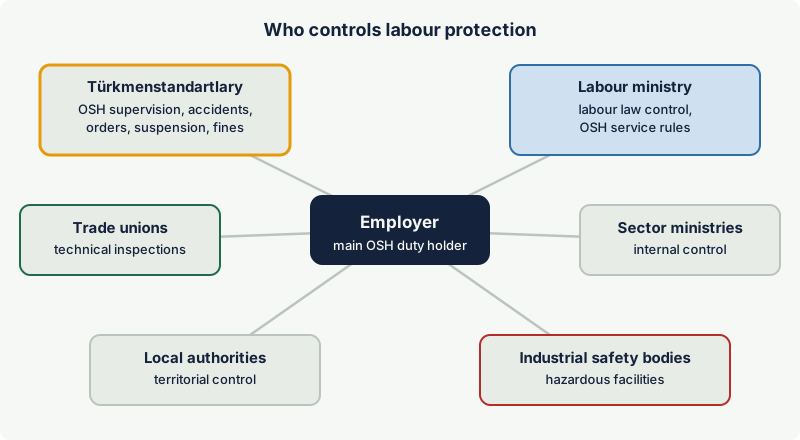
The enforcement structure is unusual compared with the EU: the state standards and certification service is also the OSH authority.
- Türkmenstandartlary (Main State Service "Türkmenstandartlary", Russian Главная государственная служба «Туркменстандартлары»). Under Article 182 of the Labour Code it manages labour protection at state level, sets OSH requirements, carries out state supervision and the state expertise of working conditions, and investigates accidents and breakdowns. Its OSH decisions bind all ministries and enterprises. It also prepared the procedure for industrial safety norms, approved by presidential decree.
- The specially authorised labour inspection body (Article 404). A state body specially authorised by the Cabinet of Ministers controls compliance with labour law, including labour protection. The OSH service regulation that Article 185 assigns to this body was issued by the Ministry of Labour and Social Protection of the Population (Türkmenistanyň Zähmet we ilaty durmuş taýdan goramak ministrligi), so in practice it is that Ministry.
- Trade unions. Under Article 406 unions run technical and legal labour inspections, take part in or carry out accident investigations, demand suspension of work in direct danger and issue orders the employer must consider and answer within one week.
- Sector ministries and local authorities carry out internal and territorial control (Articles 183, 184, 407 and 408).
- Industrial safety authorities. For hazardous production facilities the Cabinet of Ministers designates the authorised bodies (Industrial Safety Law, Article 5).
The executive OSH bodies may visit enterprises at any time, demand information, give binding orders to managers, suspend or prohibit the operation of enterprises, workshops, workplaces or equipment, fine managers, officials and workers, propose dismissal of officials and send files to the prosecutor (Article 182(3)). Workers keep their job and average pay during a suspension that is not their fault (Article 174).
Penalties
Under Article 203, officials and workers who break labour protection law bear disciplinary, material (financial), administrative and criminal liability. Administrative fines are set in the Code of Administrative Offences as multiples of the base value (базовая величина), an amount fixed by the Cabinet of Ministers. In the 2013 text of the Code published on WIPO Lex:
- Article 305(1): failure by the employer to meet labour protection duties, guarantees, medical examination and free PPE requirements, or the OSH measures of the collective agreement, carries a fine of up to 5 base values for individuals, up to 10 for officials and up to 15 for legal entities.
- Article 305(2): giving staff of the labour protection service duties unrelated to their function carries a fine of up to 5 base values for officials.
- Article 180: breach of rules and instructions on the safe conduct of work in industry, construction, agriculture and other sectors carries a fine of 1 to 5 base values.
The Code has been amended since 2013, so confirm the current wording and the current base value before quoting a figure. Design organisations whose projects breach labour protection rules must fully reimburse the client for correcting them (Article 204), and profit from producing or selling industrial products that do not meet labour protection requirements is transferred to the State Budget (Article 205).
Employer and worker duties
Article 178 lists 24 employer duties. The most important are to keep buildings, machinery, processes and materials safe; provide collective protection and certified PPE free of charge, and clean, repair and store it (paying cash instead of issuing work clothing is prohibited, Article 188); train, brief and test workers and keep untrained persons off the job; organise and pay for compulsory medical examinations; carry out attestation of workplaces; inform workers about working conditions and health risks; draw up and approve labour protection instructions, taking account of the opinion of the trade union or other workers' body; organise first aid and transport of injured workers at its own expense (Articles 190 and 197); investigate and record accidents and notify the relevant bodies in good time; give inspectors free access and carry out their orders; and forbid operations defined as imminently dangerous.
Workers must follow the rules and instructions, use PPE and report missing PPE, attend training and medical examinations, and report accidents and dangerous situations to their direct manager immediately (Article 192).
A worker may refuse work that endangers his or her life or health because of a breach of labour protection requirements, until the danger is removed, and cannot be disciplined for it (Articles 173 and 174). The worker must inform the employer at once; under Article 196 the refusal with average pay applies where the supervising bodies confirm the danger and the employer has not removed it. During such a refusal or a suspension by inspectors, the employer must provide, for up to one month, other work matching the worker's qualification or, with the worker's consent, work paid at no less than the previous average earnings, and pays the downtime if no other work is possible (Article 174). If no PPE is provided, the employer cannot demand the work and must pay the downtime.
Employers in high-risk production must insure the relevant workers against accidents at work and occupational diseases (Article 175). Workers in harmful or hazardous conditions are entitled to compensations such as a shorter working day, additional leave, free milk or equivalent food, preventive meals, tea, and salted sparkling water in hot workshops (Articles 176 and 189). The list of jobs that earn these compensations is drawn up from the results of workplace attestation.
Labour protection service, training, medical examinations and workplace attestation
Labour protection service and specialist
Every enterprise carrying out production activity with more than fifty workers must set up a labour protection service or introduce the post of labour protection specialist (engineer) with suitable training or experience (Article 185). The service has the status of a main production department, reports to the head of the enterprise and may not be given unrelated tasks. Order No. 106-Ö of 2012 contains the model regulation on the service and the model job description; the specialist must have higher or secondary technical education, gives the introductory briefing, organises knowledge testing, studies the causes of injuries and diseases and prepares the statistical reports required by the State Statistics Committee.
There is no Labour Code duty to appoint an occupational physician comparable to the Turkish işyeri hekimi. The employer must equip rooms for medical help and sanitary posts with first-aid kits according to the established norms (Article 190); medical examinations are carried out by medical commissions of health institutions.
Training and briefings
All workers, including the head of the enterprise, must be trained and tested in labour protection (Article 194). New and transferred workers receive a briefing and training in safe methods and first aid; those starting harmful or hazardous work get on-the-job training (стажировка) and an examination, then periodic training and testing. On hazardous production facilities, workers are also trained and attested in industrial safety (Industrial Safety Law, Article 10). The Code sets no refresher intervals.
Medical examinations
Article 187 requires the employer to organise and pay for pre-employment and periodic examinations of workers under 18, men aged 62 and over, women aged 57 and over, persons with disabilities, workers in adverse conditions, night or transport work, health, food, trade and public services, teachers and childcare staff, and others named by law. Compulsory annual examinations take place in working time with pay kept and at no cost to workers; a worker who avoids one may be kept off work.
Workplace attestation and risk assessment
The Labour Code does not use the EU term "risk assessment". Its closest equivalent is the attestation of workplaces (Article 320): a commission of at least five people, including the OSH service and worker representatives, assesses each workplace against labour protection norms at least once every five years, and sooner when conditions change; the results drive the compensations. For hazardous production facilities, the Industrial Safety Law requires identification and analysis of accident risks within a safety management system (classes I and II) and a comprehensive risk assessment in the industrial safety declaration.
Two further checks act before work starts. Projects for building, reconstructing or re-equipping production facilities, and new machinery and technologies, need a state expertise of working conditions confirming that they meet labour protection requirements, and a new or reconstructed facility may not be put into operation without the conclusions of the supervising bodies (Article 198(2) and (3)).
Accident reporting and investigation
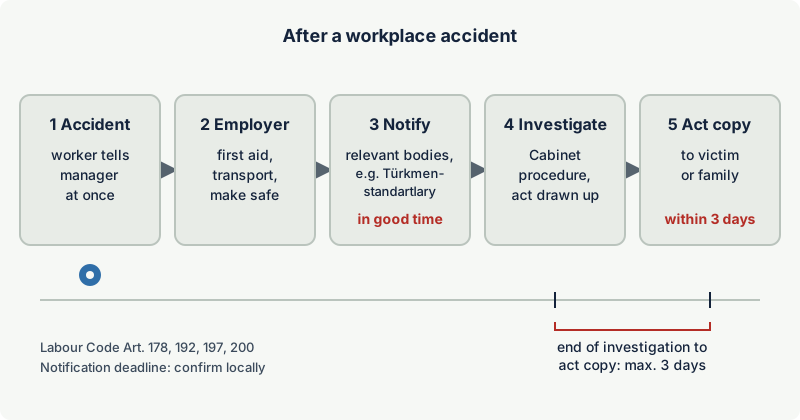
The sequence set by the Labour Code is:
- The worker, or a witness, tells the direct manager immediately (Article 192).
- The employer arranges first aid and transport to a medical institution at its own cost and makes the scene safe (Articles 178, 190 and 197).
- The employer notifies the relevant bodies of the accident or breakdown in good time (Article 178(23)). Türkmenstandartlary investigates accidents and breakdowns (Article 182), and the trade union may take part or investigate itself (Article 406).
- The accident is investigated and recorded under the procedure set by the Cabinet of Ministers (Article 200(2)).
- A copy of the accident act is given to the victim or, after a death, to the family or legal representative no later than three days after the investigation ends (Articles 178(15) and 200(1)).
- Disagreements (refusal to recognise an accident, refusal to investigate, disputed content of the act) go to the OSH executive body or the trade union and then to court; an appeal does not suspend their decisions (Article 201).
The accident act is the first listed evidence of the employer's fault for compensation (Article 212). Where a breakdown (авария) occurs on a hazardous production facility, a technical investigation commission led by the industrial safety authority investigates it, at the operator's expense (Industrial Safety Law, Article 13), and the operator must inform the authorities and the population.
The Cabinet of Ministers' investigation procedure could not be found in an official online source, so the notification deadline, the commission and the investigation period are not given here. The Code only says "in good time"; as good practice, notify on the day of the accident and confirm the required route with Türkmenstandartlary.
Committees, trade unions and worker participation
Labour protection committees (комиссии по охране труда) are created at enterprises on the initiative of the employer, the workers or the trade union (Article 186). They are joint (parity) bodies of employer and worker representatives that organise joint action, inspect workplaces, inform workers of the results and prepare the OSH section of the collective agreement. Türkmenstandartlary approves their model regulation. The Code sets no headcount threshold for the committee.
The Code does not create a separate "safety representative" office. Workers participate personally or through their representatives in OSH matters and in the investigation of their own accident (Article 173), and the trade union technical labour inspectors are the main channel of worker representation in OSH (Article 406).
Chemicals, PPE, explosive atmospheres and hazardous production facilities
Chemicals. Harmful substances may not be used unless methods of metrological control and a toxicological assessment exist; before using a new hazardous substance the employer must agree protective measures with the supervising bodies (Article 198). No national act adopting the UN Globally Harmonized System of Classification and Labelling of Chemicals (GHS) could be identified in official sources, so do not assume that GHS labels and 16-section safety data sheets are a legal requirement; supply them anyway as good practice, with Russian or Turkmen translations for the workforce.
PPE and equipment conformity. PPE must be certified (Article 188), and machinery, equipment, vehicles, chemicals and PPE, including foreign-made ones, must meet labour protection requirements and have certificates of conformity (Article 198(6)). Imported goods must be certified in Turkmenistan, and Türkmenstandartlary is the national standards and certification body (it co-issues, for example, product certification procedures). Turkmenistan is not a member of the Eurasian Economic Union (Armenia, Belarus, Kazakhstan, Kyrgyzstan and Russia), so the EAC mark has no legal status there in itself.
Explosive atmospheres. No Turkmen equivalent of the ATEX directives could be identified. Ex equipment falls under the general certification duty above and, on hazardous production facilities, under Article 8 of the Industrial Safety Law: technical devices undergo the conformity assessment set by technical regulation or, if none is set, an industrial safety expertise before first use, at the end of their service life and after modification or repair following an accident. See Ex certification in other markets and explosive atmospheres in Turkmenistan.
Hazardous production facilities. The Industrial Safety Law follows the CIS model rather than the EU Seveso directive and covers far more than chemical sites: facilities handling flammable, oxidising, combustible, explosive, toxic or environmentally hazardous substances, equipment working at an excess pressure above 0.07 MPa, fixed lifting equipment (not lifts), molten metal installations from 500 kg, mining, and grain or dust-producing plant. Electricity networks and gas networks up to 0.005 MPa are excluded. Facilities are registered in the State Register and given hazard classes I (extremely high) to IV (low); for oil and gas drilling and production, for example, the class depends on the hydrogen sulphide content of the product (class II above 6 % by volume, class III from 1 to 6 %).
Operators need licences for licensable activities, production control (reported to the authority every year by 1 April), compulsory liability insurance, emergency response plans for class I to III facilities that handle hazardous substances, molten metal, mining or dust-producing raw materials, a safety management system for classes I and II, and an industrial safety declaration for classes I and II holding hazardous substances in the quantities of Annex 2. The declaration is redone at least every ten years and also after process changes or an increase of more than 20 % in the quantity of hazardous substances. Planned inspections take place at least once a year for classes I and II and at least once every three years for class III; class IV has no planned inspections, and class I facilities are under permanent state supervision. See major-hazard sites in Turkmenistan.
Comparison with the EU and Türkiye, and a worked example
| Topic | EU (Directive 89/391/EEC) | Türkiye (Law No. 6331) | Turkmenistan (Labour Code 2009) |
|---|---|---|---|
| Main act | Framework directive plus daughter directives | Law No. 6331 on OSH (2012) and regulations | Labour Code, Section XI; Industrial Safety Law 2017 |
| Enforcing authority | National labour inspectorates | Ministry of Labour and Social Security labour inspectors | Türkmenstandartlary; labour ministry; union inspections |
| Risk assessment | Risk assessment required for all employers | Required for all employers (Art. 10) | Attestation of workplaces at least every five years; risk assessment explicit only for hazardous facilities |
| OSH professional | Competent protective services for all employers | OSH expert and workplace physician for all employers, in-house or from an external OSH service (Art. 6) | OSH service or engineer above 50 workers in production enterprises; no occupational physician duty |
| Committee | Consultation of workers or their representatives | OSH committee at 50 or more workers where permanent work lasts more than six months (Art. 22) | Joint committee on initiative of employer, workers or union |
| Accident report | National deadlines | To the Social Security Institution within three working days (Art. 14) | Notify bodies in good time; act copy to victim within three days of investigation end |
| Major hazards | Seveso III directive | Major industrial accident regulation | Hazardous production facility classes I to IV |
Worked example: a contractor starting work at a gas processing plant
A foreign contractor will employ 120 workers, including welders and scaffolders, on a turnaround at a gas processing plant registered as a hazardous production facility. A compliant set-up would include:
- Organisation. With more than 50 workers, a labour protection engineer with technical education reporting to the site manager (Order 106-Ö model job description).
- Documents. Labour protection instructions for each trade, approved after taking account of the union's opinion where a union exists, an assessment of the workplaces, and the operator's permit and emergency arrangements. The operator's safety management system must itself plan risk-reduction measures for work done by contractors on the facility (Industrial Safety Law, Article 12), so agree the interface in writing before mobilisation.
- People. Introductory briefing, training with on-the-job training and an examination for hazardous work, industrial safety attestation where the operator's rules require it, and pre-employment medical examinations.
- Equipment. Certified PPE issued free; Turkmen certificates of conformity for imported and Ex equipment; industrial safety expertise of technical devices where required.
- Accidents. A same-day notification route from supervisor to site manager, plant operator, Türkmenstandartlary and the trade union, and the act copy to the victim within three days of the investigation's end.
What to confirm locally
Confirm with Türkmenstandartlary or the labour ministry: the accident investigation procedure and notification deadline, medical examination lists and intervals, refresher training intervals, current fines, the industrial safety authority for your facility, and which standards (national TDS, interstate GOST or IEC) are accepted for Ex equipment.
Common mistakes
- Citing the 1993 Law on Labour Protection. It was repealed on 1 July 2009; cite the Labour Code instead.
- Assuming an EAC certificate is enough. Turkmenistan is outside the Eurasian Economic Union; obtain Turkmen certification through Türkmenstandartlary.
- Waiting for the investigation before notifying. Notification is a separate, prompt duty; the three-day limit applies only to the act copy.
- Paying cash instead of issuing work clothing. Article 188 prohibits it; PPE must be certified and provided, cleaned and repaired by the employer.
- Treating the 50-worker threshold as optional for contractors. It applies to every production enterprise with more than 50 workers, foreign-owned or not.
Frequently asked questions
Does Turkmenistan have a separate occupational safety law?
No. The 1993 Law on Labour Protection was repealed in 2009; labour protection is now in Section XI of the Labour Code, with the 2017 Industrial Safety Law for hazardous facilities.
Who inspects workplaces for safety in Turkmenistan?
Türkmenstandartlary is the executive labour protection body and can inspect at any time, issue orders, suspend work and fine. The labour ministry controls labour law generally, and trade unions run technical labour inspections.
Is a written risk assessment required?
The Labour Code requires attestation of workplaces at least every five years rather than a general written risk assessment. Hazardous facilities of classes I and II must analyse accident risks in their safety management system and declaration, and a written assessment remains the practical way to inform workers about risks.
Must foreign employers follow the Turkmen rules?
Yes. The Labour Code applies to all employers and workers who conclude an employment contract in Turkmenistan, including foreign nationals and foreign-owned enterprises, unless a law or an international treaty of Turkmenistan provides otherwise (Article 5). A civil-law contract that in fact governs work is treated as an employment relationship, and the industrial safety rules apply to all operators regardless of ownership (Industrial Safety Law, Article 6).
Related on excodex
- What is the main OSH law in Turkmenistan and who enforces it?
- How and when must a workplace accident be reported in Turkmenistan?
- How are explosive atmospheres and Ex equipment regulated in Turkmenistan?
- Which rules apply to major-hazard sites in Turkmenistan?
- OSH law compared: appointments and reporting deadlines
- Ex certification in other markets: UKEX, EAC, INMETRO, CCC, PESO
Standards and further reading
- Labour Code of Turkmenistan, approved by Law No. 29-IV of 18 April 2009, in force 1 July 2009, consolidated Russian translation with amendments to 22 November 2025 (FAOLEX): https://faolex.fao.org/docs/pdf/tuk243144.pdf
- Law of Turkmenistan No. 495-V on Industrial Safety of Hazardous Production Facilities, 4 February 2017 (FAOLEX): https://faolex.fao.org/docs/pdf/tuk184581.pdf and summary https://leap.unep.org/en/countries/tm/national-legislation/law-no-495-v-industrial-safety-hazardous-production-facilities
- Law of Turkmenistan on Labour Protection, 1 October 1993 (repealed 2009, historical): https://faolex.fao.org/docs/pdf/tuk207608.pdf
- Order No. 106-Ö of the Minister of Labour and Social Protection of the Population, 30 November 2012, model regulations on the labour protection service and specialist: https://mlsp.gov.tm/storage/file/8781b287d49dadcbdc0b4a98d2fe77ae.pdf
- ILO, Turkmenistan ratifies the Tripartite Consultation Convention (2019): https://www.ilo.org/resource/news/turkmenistan-ratifies-tripartite-consultation-international-labour
- Government of Turkmenistan, ratification of ILO Convention No. 122 (2021): https://turkmenistan.gov.tm/en/post/53524/document-turkmenistans-ratification-convention-concerning-employment-policy-presented-ilo-director-general
- Türkmenstandartlary procedure for industrial safety norms: https://turkmenhemrasy.gov.tm/en/news/1332
- US International Trade Administration, Turkmenistan standards and conformity assessment (2026): https://www.trade.gov/country-commercial-guides/turkmenistan-standards-trade
- Code of Turkmenistan on Administrative Offences, 29 August 2013 (WIPO Lex, Russian text): https://www.wipo.int/wipolex/es/legislation/details/13824
- Joint Order No. 50/25 of the Minister of Health and Medical Industry and the head of Türkmenstandartlary on the certification of foodstuffs, 6 February 2023 (LEAP summary): https://leap.unep.org/en/countries/tm/national-legislation/joint-order-no-5025-minister-health-and-medical-industry-and-head
- Eurasian Economic Commission, member states: https://eec.eaeunion.org/en/comission/about/
- Council Directive 89/391/EEC of 12 June 1989 on the introduction of measures to encourage improvements in the safety and health of workers at work; Turkish Law No. 6331 on Occupational Health and Safety (İş Sağlığı ve Güvenliği Kanunu) of 20 June 2012.
This article is general occupational safety and health information prepared by the excodex editorial team. It does not replace the applicable legislation, standards, manufacturers' instructions or the assessment of a competent OSH professional or occupational physician.
Questions on this topic
- What is the main occupational safety and health law in Turkmenistan and who enforces it?
- Must an employer in Turkmenistan appoint a safety professional or an occupational physician?
- Is a written risk assessment mandatory in Turkmenistan, and how often must it be reviewed?
- How and within what time must a workplace accident be reported in Turkmenistan?
- What OSH training must employers provide to workers in Turkmenistan?
- Are pre-employment and periodic medical examinations required for workers in Turkmenistan?
- What are the penalties for breaking occupational safety rules in Turkmenistan?
- Is a safety committee or a worker safety representative required in Turkmenistan?
- How are explosive atmospheres and Ex equipment regulated in Turkmenistan?
- Which rules apply to major-hazard chemical sites in Turkmenistan?