Occupational safety International framework and country guides
Must an employer in Israel appoint a safety professional or an occupational physician?
Part of: Occupational safety and health in Israel: law, authorities and employer duties
Short answer
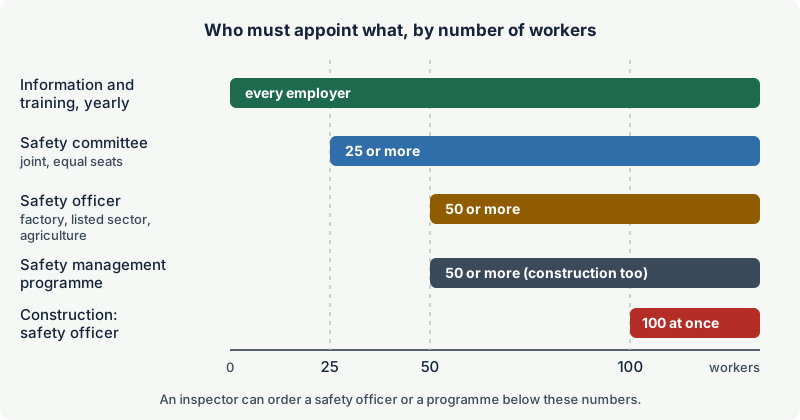
A certified safety officer is mandatory in Israel for factories, listed sectors and agriculture with 50 or more workers and for construction contractors with 100 workers at once, or when an inspector orders it. There is no general duty to appoint an occupational physician.
A safety officer, yes, above set sizes: a certified safety officer (ממונה על הבטיחות) is mandatory for factories, listed service sectors and agricultural employers with 50 or more workers, for construction contractors with 100 or more workers on their sites at the same time, and anywhere a regional labour inspector orders one in writing. An occupational physician is not a general appointment; medical examinations by authorised physicians are required only for specific exposures and groups.
Short answer
- Legal basis: section 25 of the Labour Inspection (Organisation) Law 5714-1954 and the Labour Inspection (Organisation) Regulations (Safety Officers) 5756-1996, as amended in 2025.
- 50 or more workers: workplaces covered by the Work Safety Ordinance (factories and similar), and listed sectors: hospitals and medical institutions, higher education, research institutions, hotels, commerce, airports and airlines, local authorities, cooperative settlement corporations; also agriculture with 50 workers at the same time.
- Construction: a contractor employing 100 or more workers on its sites at the same time, directly or through subcontractors.
- Any size: when a regional labour inspector orders it in writing because of the risks. The chief labour inspector may exempt a workplace with no risks that justify one.
- Occupational physician: no general duty; exposure-related examinations (noise, benzene, lead and others) must be done by an authorised medical service or physician.
Who can be a safety officer in Israel
The safety officer must hold a valid certificate of competence (אישור כשירות) issued by the chief labour inspector. The usual routes are:
| Route | Experience after studies | Course |
|---|---|---|
| Recognised degree in science, technology or engineering | At least 2 years | Approved safety officer course |
| Registered technician or practical engineer | At least 3 years | Approved safety officer course |
| Safety practical engineer (approved diploma) | 18 months under a senior safety officer, or 3 years | Exam before a committee of the chief labour inspector |
| Equivalent education accepted by the chief labour inspector | 3 years in safety | Approved course |
Since a 2025 amendment the certificate is valid for three years and is renewed if the officer completes at least 12 days of further training in each three-year period. In chemicals, pharmaceuticals and petrochemicals, electricity and electronics, construction, explosives, quarries and mines, and agriculture, the officer also needs two years' experience in that sector. The employer submits the appointment to the regional labour inspector on the prescribed form; the inspector may object within 45 days, for example because the candidate's other duties would interfere or the candidate's position in the organisation would not allow the job to be done, and may later disqualify an officer with at least 60 days' notice. The employer or the officer may appeal an objection or a disqualification within seven days to an appeals committee appointed by the chief labour inspector.
What the safety officer does, and what the employer must provide
The safety officer advises the employer on laws, regulations and standards and is expected to identify hazards, check that safety devices and periodic inspections are in place, prepare training programmes and written risk information, investigate accidents and occupational diseases, follow up exposure measurements and medical examinations, set arrangements for contractors, work with the safety committee, keep emergency drills going and accompany inspectors. The officer may order work to stop when there is an immediate danger to life or health and must report this at once to the employer.
The employer must tell workers who the officer is, give the officer a defined place and status in the organisation, the resources and access needed, and time for further training. Where risk, area or headcount justify it, the inspector may require more than one safety officer.
Occupational physician and other health roles
Israeli law does not require a standing occupational physician or occupational health service for every workplace, unlike Türkiye, where Article 6 of Law No. 6331 requires every employer to provide a workplace physician (iş yeri hekimi), employed directly or obtained as an external service. Instead, agent-specific regulations require examinations before and during exposure, carried out by an "authorised physician" (usually a specialist in occupational medicine) or an authorised medical service. The safety management programme of a workplace with 50 or more workers must name the medical services that provide occupational health care, and the first aid regulations may require a trained first-aid provider (מגיש מאומן).
Common mistakes
- Counting only direct employees on a construction project. The 100-worker threshold includes subcontractors' workers on the contractor's sites at the same time.
- Appointing an uncertified "HSE manager". Only a holder of a valid certificate of competence can act as the legal safety officer.
- Ignoring sector experience. In the listed sectors a newly certified officer without two years' sector experience cannot be appointed.
Related on excodex
- Occupational safety and health in Israel: law, authorities and employer duties
- Is a safety committee or a worker safety representative required in Israel?
- Are pre-employment and periodic medical examinations required for workers in Israel?
- OSH law comparison: appointments and reporting deadlines
Standards and further reading
- Labour Inspection (Organisation) Regulations (Safety Officers) 5756-1996 (תקנות ארגון הפיקוח על העבודה (ממונים על הבטיחות), התשנ"ו-1996), as amended in 1999 and 2025.
- Labour Inspection (Organisation) Law 5714-1954, section 25, official gazette text, Knesset.
- Israel Institute for Occupational Safety and Hygiene, about IIOSH.
This article is general occupational safety and health information prepared by the excodex editorial team. It does not replace the applicable legislation, standards, manufacturers' instructions or the assessment of a competent OSH professional or occupational physician.
More questions on this topic
- What is the main occupational safety and health law in Israel and who enforces it?
- Is a written risk assessment mandatory in Israel, and how often must it be reviewed?
- How and within what time must a workplace accident be reported in Israel?
- What OSH training must employers provide to workers in Israel?
- Are pre-employment and periodic medical examinations required for workers in Israel?
- What are the penalties for breaking occupational safety rules in Israel?
- Is a safety committee or a worker safety representative required in Israel?
- How are explosive atmospheres and Ex equipment regulated in Israel?
Part of: Occupational safety and health in Israel: law, authorities and employer duties