Occupational safety International framework and country guides
Occupational safety and health in Israel: law, authorities and employer duties
Abstract
Israeli OSH law rests on the Work Safety Ordinance 1970 and the Labour Inspection (Organisation) Law 1954, enforced by the Ministry of Labour's OSH Administration. Key duties: yearly training for all, safety committee from 25 workers, safety officer and programme from 50, immediate accident notice.
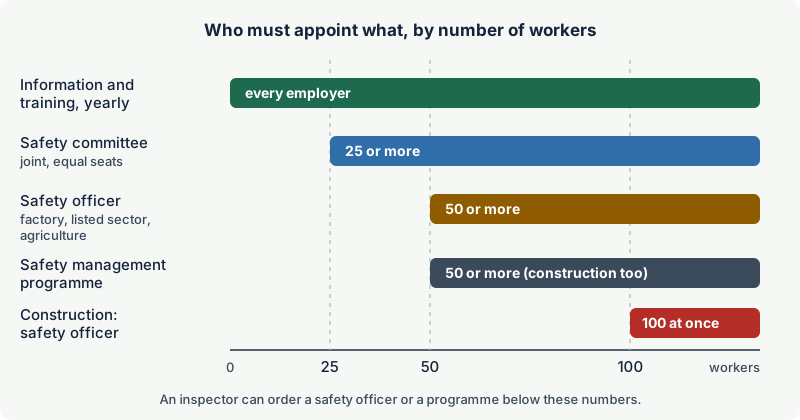
Occupational safety and health (OSH) in Israel is governed mainly by the Work Safety Ordinance [New Version] 5730-1970 and the Labour Inspection (Organisation) Law 5714-1954, plus several dozen regulations made under them. The law is enforced by the Occupational Safety and Health Administration of the Ministry of Labour, through a chief labour inspector and regional labour inspectors who can stop work, prohibit equipment and order improvements. Employers must give every worker written risk information and training at least once a year; a workplace covered by the Ordinance needs a joint safety committee from 25 workers; and factories, listed service sectors and agriculture with 50 or more workers must appoint a certified safety officer and keep a written safety management programme updated every year.
This guide covers the laws, authorities, OSH roles, training, health surveillance, accident reporting, penalties, chemicals, explosive atmospheres, major hazards and personal protective equipment (PPE), with a comparison to the EU and Türkiye.
Key points
- The two pillars are the Work Safety Ordinance [New Version] 5730-1970 and the Labour Inspection (Organisation) Law 5714-1954, with several dozen regulations made under them.
- Enforcement lies with the Occupational Safety and Health Administration (מינהל הבטיחות והבריאות התעסוקתית) of the Ministry of Labour (משרד העבודה) and its regional labour inspectors.
- A certified safety officer (ממונה על הבטיחות) is required from 50 workers in factories, listed sectors and agriculture, and for building contractors from 100 workers on site at once.
- A joint safety committee with equal worker and employer seats is required in a workplace covered by the Ordinance with 25 or more workers and must meet at least eight times a year.
- From 50 workers (on construction, 50 at once) a written safety management programme with a risk analysis is required and must be updated every year.
- An accident that kills a worker or leaves the worker unable to earn full wages for more than three days must be notified in writing to the regional labour inspector immediately.
- Exposure limits for chemical agents follow the ACGIH TLV and BEI book by reference, with national values that take precedence where the regulations set them.
The legal framework: ordinance, law and regulations
Israeli OSH law is older and more prescriptive than the EU framework directive. The Work Safety Ordinance, a 1970 consolidation of the British Mandate factories ordinance, sets detailed technical rules and empowers the minister to make regulations. The Labour Inspection (Organisation) Law creates the inspection service, the safety committees and trustees, the safety officer and the Israel Institute for Occupational Safety and Hygiene. Duties are spread over the Ordinance and the regulations rather than set out in one general-duty clause.
| Instrument (English) | Official Hebrew name | What it covers |
|---|---|---|
| Work Safety Ordinance [New Version] 5730-1970 | פקודת הבטיחות בעבודה [נוסח חדש], התש"ל-1970 | Technical safety, health and welfare rules; offences |
| Labour Inspection (Organisation) Law 5714-1954 | חוק ארגון הפיקוח על העבודה, התשי"ד-1954 | Inspection, orders, committees, trustees, safety officer, IIOSH |
| Accidents and Occupational Diseases (Notification) Ordinance 1945 | פקודת התאונות ומחלות משלח-היד (הודעה), 1945 | Notice of accidents, dangerous occurrences and occupational diseases |
| Labour Inspection (Organisation) Regulations (Safety Officers) 5756-1996 | תקנות ארגון הפיקוח על העבודה (ממונים על הבטיחות), התשנ"ו-1996 | Who must appoint a safety officer, qualifications, duties |
| Labour Inspection (Organisation) Regulations (Safety Management Programme) 5773-2013 | תקנות ארגון הפיקוח על העבודה (תכנית לניהול הבטיחות), התשע"ג-2013 | Written programme with risk analysis, annual plans |
| Labour Inspection (Organisation) Regulations (Provision of Information and Training of Workers) 5759-1999 | תקנות ארגון הפיקוח על העבודה (מסירת מידע והדרכת עובדים), התשנ"ט-1999 | Information, yearly training, training register |
| Labour Inspection (Organisation) Regulations (Safety Committees and Safety Trustees) 5721-1960 | תקנות ארגון הפיקוח על העבודה (ועדות בטיחות ונאמני בטיחות), התשכ"א-1960 | Appointment, term and meetings of committees |
| Work Safety Regulations (Environmental and Biological Monitoring of Workers Exposed to Harmful Agents) 5771-2011 | תקנות הבטיחות בעבודה (ניטור סביבתי וניטור ביולוגי של עובדים בגורמים מזיקים), התשע"א-2011 | Exposure limits, workplace measurements, biological monitoring |
| Work Safety Regulations (Personal Protective Equipment) 5757-1997 | תקנות הבטיחות בעבודה (ציוד מגן אישי), התשנ"ז-1997 | Supply, standards and use of PPE |
| Work Safety Regulations (Construction Work) 5748-1988 | תקנות הבטיחות בעבודה (עבודות בנייה), התשמ"ח-1988 | Construction sites, works manager |
Agent-specific regulations (for example noise, benzene, ionising radiation and lasers) add their own measurement and medical rules. Laws are published in Hebrew in the official gazette, Reshumot (רשומות).
Who enforces OSH law in Israel
The Labour Inspection Service set up by the 1954 Law is today run as the Occupational Safety and Health Administration of the Ministry of Labour. It consists of a chief labour inspector (מפקח עבודה ראשי), a deputy and regional labour inspectors (מפקח עבודה אזורי) organised in four districts (2025 activity summary).
A regional inspector who finds danger may issue a safety order (צו בטיחות) stopping work or banning a machine, substance or process until the danger is removed, and an improvement order (צו שיפור) requiring compliance within a period of at least 14 days. An improvement order can be appealed to the regional labour court within seven days.
Other bodies matter in practice:
- Israel Institute for Occupational Safety and Hygiene (המוסד לבטיחות ולגיהות, IIOSH): statutory tripartite body for information, training, research and support of safety committees; since the end of 2024 an auxiliary unit of the Ministry of Labour.
- Ministry of Environmental Protection: hazardous substances permits under the Hazardous Substances Law 5753-1993 (חוק החומרים המסוכנים, התשנ"ג-1993).
- Standards Institution of Israel (מכון התקנים הישראלי, SII): Israeli Standards (ת"י, SI), some declared official (mandatory).
- National Insurance Institute (המוסד לביטוח לאומי): work-injury benefits for injured workers.
Employer and worker duties
Duties fall on the "occupier of the workplace" (מחזיק במקום העבודה): the employer, the owner or occupier, the person actually managing the workplace, and the actual manager of a company that owns it. When a company commits an offence under the Ordinance, every director, partner or responsible officer is also liable unless that person proves the offence happened without their knowledge and that they took reasonable steps to prevent it (Ordinance s. 222).
Core employer duties include:
- Notify the regional inspector in writing at least 10 days before using premises as a factory (Ordinance s. 195), and notify construction work within seven days of starting unless it will take less than six weeks (s. 192).
- Give each worker, by the first day of work at the latest, a written summary of the risks of the job in Hebrew and in another language the worker understands, and update it when the job or workstation changes.
- Train workers through a suitably qualified person at least once a year and keep a training register (פנקס הדרכה); training time is working time and the worker may not be charged.
- Label hazardous substances, equipment and processes, and announce new hazards to the safety officer, trustee and committee.
- Measure harmful agents, arrange required medical examinations and provide PPE that meets the applicable standard.
Workers must report a newly discovered hazard, attend training, use the safety devices and PPE provided and not interfere with them. Israeli law has an unusual disciplinary rule: a safety committee may recommend measures against a worker who breaks safety rules, and the employer may apply them, including a deduction of up to one week's wages or suspension for up to two weeks; deducted money goes to the committee for safety, hygiene or welfare improvements.
Safety officer, safety committee and trustees
Safety officer (ממונה על הבטיחות)
Under the Safety Officers Regulations 1996 a safety officer must be appointed by: an occupier of a workplace covered by the Ordinance with at least 50 workers; an occupier in a listed sector (hospitals, higher education, research institutions, hotels, commerce, airports and airlines, local authorities, cooperative settlements) with at least 50 workers; a building contractor with at least 100 workers on its sites at once, including subcontractors; an agricultural employer with at least 50 workers at once; and any workplace a regional inspector orders in writing. The chief labour inspector may exempt an employer whose workplace has no risks that justify a safety officer.
The safety officer needs a certificate of competence from the chief labour inspector, usually based on a science or engineering degree with two years' experience, or a technician or practical engineer qualification with three years' experience, plus an approved safety officer course. Under a June 2025 amendment the certificate is valid for three years and is renewed if the officer has completed at least 12 days of further training in each three-year period. In chemicals and petrochemicals, electricity and electronics, construction, explosives and quarries, and agriculture, two years' sector experience is also required. The regional inspector approves or objects within 45 days and may later disqualify the officer.
The officer advises the employer, identifies hazards, investigates accidents, follows up inspections, examinations and measurements, and may stop work in immediate danger to life or health.
Safety committee and trustees
A workplace covered by the Ordinance (a "factory" in the wide statutory sense) with 25 or more workers must have a safety committee (ועדת בטיחות) with equal numbers of worker and employer representatives; smaller workplaces may set one up by agreement. Members serve three years and the committee must meet at least eight times a year; if it does not, the safety officer convenes it. It investigates accidents, recommends improvements and may accompany the inspector. Worker members act as safety trustees (נאמני בטיחות); without a committee, workers may elect trustees. Members and trustees are protected against dismissal for their role.
Occupational physician
Israeli law does not require every employer to appoint an occupational physician. Medical examinations are required by agent-specific regulations and must be done by an authorised medical service or an authorised physician (רופא מורשה). Young workers may not be employed without a medical examination and approval under the Youth Employment Law 5713-1953, with an extra fitness examination by an authorised physician for work that requires it.
Worked example: which roles does this employer need?
Example: A plastics moulding factory near Haifa has 120 workers, noisy granulators and a solvent-based printing line. It needs a safety committee (25 or more workers) meeting eight times a year, a certified safety officer (factory with 50 or more workers) and a written safety management programme prepared by a certified officer with risk management training, approved by the occupier after consulting the committee and updated every year. Noise must be measured by an authorised laboratory at least every two years, with audiometry before starting and yearly for exposed workers; listed solvents need measurements under the 2011 monitoring regulations. If the company also acted as building contractor with 60 workers on its sites at once (including subcontractors), that work would need a programme (50 at once) but not a safety officer (below 100), unless an inspector orders one.
Risk management, training and health surveillance
The Safety Management Programme Regulations 2013 apply to factories, listed sectors and agriculture with at least 50 workers, to construction contractors with at least 50 workers on site at the same time, and to smaller workplaces when a regional inspector orders it. The programme sets the safety policy and the acceptable level of risk and contains a risk management chapter (hazard identification, risk assessment, control options, decision, implementation) naming for each risk who accepts it, who implements controls, a deadline and a follow-up method. Annual plans cover monitoring, audits, corrective actions, training, drills, periodic inspections and medical examinations. The occupier approves and updates the programme every year after consulting the committee and keeps a copy where workers can read it; a regional inspector may grant an exemption.
Training is required in every workplace: at least once a year, by a suitably qualified person, face to face in a language the worker understands. Online or e-learning training is allowed only with the written approval of an appointed safety officer, and never for notifiable construction work. A temporary rule (16 October 2026 to 15 October 2028) requires foreign workers on notifiable construction work to receive at least eight hours of extra training from an approved institution within their first month in Israel.
Health surveillance is exposure-driven. Under the 2011 monitoring regulations listed agents must be measured within 60 days of their introduction or a significant change, then at least yearly where workers exceed the action level on 30 or more days a year, otherwise every two years; the employer keeps results for 20 years. Agent regulations set the medical rhythm: for noise, a first examination within the month before starting and a repeat examination with audiometry every year; for benzene, a first examination within the month before starting, a repeat three months after starting and then every six months.
Accident, dangerous occurrence and disease reporting
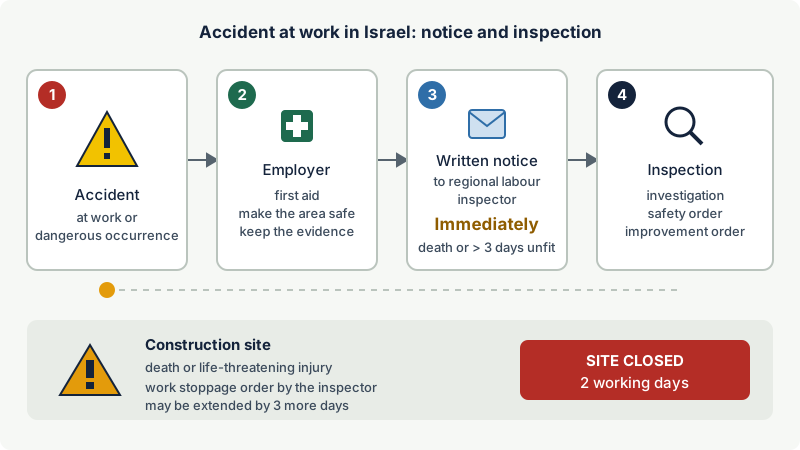
Under the Accidents and Occupational Diseases (Notification) Ordinance 1945, the employer must send written notice immediately to the regional labour inspector of any work accident that causes death or makes the worker unable to earn full wages for more than three days. If the injured worker later dies, a further notice is due at once. Regulations of 1951 extend the duty to listed dangerous occurrences (such as explosions, fires and collapses) even without injury. A physician who believes a patient has an occupational disease must notify the chief labour inspector; an employer who suspects one must notify the regional inspector and the district government physician.
On construction sites, the 2016 amendment to the Labour Inspection Law introduced a work stoppage order: when an inspector learns of a death or of an injury that puts a person in real danger of life, the site is closed for two working days from the accident, which the inspector may extend by three more days; on a site that does not display the required site sign, the occupier must stop work on its own initiative for two working days after a death. Workers absent because of the closure are paid their normal wage.
Inspections, orders and penalties
Breaking the Ordinance or its regulations is a criminal offence. The default penalty is up to six months' imprisonment or a fine, one year where the offence could cause death or injury, plus daily penalties; each worker employed in breach counts as a separate violation. Failing to comply with a safety order carries up to one year's imprisonment or a fine plus a daily fine; failing to comply with an improvement order carries up to six months' imprisonment or a fine plus a daily fine; and breaching a construction stop order carries up to two years' imprisonment or a fine as a strict liability offence. Many offences, including failure to notify an accident or an occupational disease, can also be dealt with by a fixed administrative fine under the Administrative Offences (Administrative Fine - Work Safety) Regulations 5756-1995, doubled for a repeat offence.
Fine amounts are written in each instrument, several by reference to section 61 of the Penal Law 5737-1977, and are updated over time; check the current text before quoting a figure.
Chemicals, explosive atmospheres and major hazards
Chemicals. The Work Safety Regulations (Safety Data Sheet, Classification, Packaging, Labelling and Marking of Packages) 5758-1998 require manufacturers, importers and distributors to pack and label hazardous substances according to Israeli Standard SI 2302 Part 1 and to supply a safety data sheet (SDS) in Hebrew or English; the workplace must keep an SDS for every hazardous substance, make a copy accessible to workers and explain its content to them. Check in the SII catalogue how far the current SI 2302 edition follows the UN Globally Harmonized System (GHS) before relying on EU or GHS labels alone; from 5 September 2027 the amended Hazardous Substances Law bases permit classification on the EU CLP Regulation (EC) No 1272/2008. Exposure limits follow the ACGIH TLV and BEI book as updated each year, replaced by Israeli values where the 2011 regulations set them and supplemented for agents the book does not cover.
Explosive atmospheres. The Ordinance contains general rules on explosive dust (enclosure, removal of accumulations, control of ignition sources, explosion relief) and on opening plant containing flammable vapour under pressure, and it forbids welding or hot cutting on containers that held flammable substances until they are made safe. The Standards Institution publishes the SI 60079 series, which adopts the IEC 60079 standards; for example, SI 60079 on general equipment requirements was published on 30 April 2023 with the body text in English, replacing the 2018 edition. Israel is a member country of the IECEx international certification scheme. No separate national Ex marking was found in the official texts reviewed, and which SI 60079 parts are official (mandatory) is not settled here, so confirm the accepted certificates and standards with the authorities and the purchaser before ordering.
Major hazards. Major-hazard control is moving towards the EU model. Today anyone dealing in poisons needs a poisons permit (היתר רעלים) from the Ministry of Environmental Protection under the Hazardous Substances Law. Amendment No. 10 (2024) replaces this with tiered level A and level B permits whose classification rules refer to CLP and to Annex I of the Seveso III Directive 2012/18/EU. The new regime starts on 5 September 2027 (a date set by a deferral order of July 2026), and existing permit holders apply on dates staggered by activity in the law's Third Schedule. Level A holders storing listed substances above minimum quantities must publish accident scenarios and public warning arrangements; a level A application must include a major-accident prevention policy or a safety report; and the most severe activities must be inspected at least once a year. The workplace OSH rules described here apply in parallel.
PPE. PPE must conform to the applicable Israeli Standard or, where there is none, to an ANSI, ISO, DIN or EN standard or another standard approved by the chief labour inspector. Supervisors must stop the work of a worker who is not using the required PPE.
Israel compared with the EU framework and Türkiye
| Topic | Israel | EU (Directive 89/391/EEC) | Türkiye (Law No. 6331) |
|---|---|---|---|
| Main instrument | Ordinance 1970 and Law 1954, prescriptive regulations | Framework directive and daughter directives, transposed nationally | Law No. 6331 (2012) and regulations |
| OSH professional | Certified safety officer from 50 workers in covered sectors; construction from 100 at once | Competent workers or external services; no fixed headcount | OSH specialist for every workplace, employed or contracted; a less hazardous employer with fewer than 50 workers may run the service after Ministry training |
| Occupational physician | Only for exposure-based examinations by authorised services | Health surveillance per national law | Workplace physician for every workplace, employed or contracted |
| Safety committee | From 25 workers, joint, 8 meetings a year | Consultation and participation of workers | OSH committee from 50 workers where work lasts over six months |
| Written risk assessment | Safety management programme from 50 workers, updated yearly | Required for every employer | Required for every employer, renewed at least every 2, 4 or 6 years by hazard class |
| Accident notice | Immediately, in writing, to regional labour inspector | Per national law | To the Social Security Institution (SGK) within 3 working days |
Common mistakes
- Applying EU thresholds by habit. In Israel the safety committee starts at 25 workers, not 50, and a written safety management programme is tied to 50 workers; check the Israeli numbers.
- Treating training as a one-off induction. Training must be repeated at least yearly and recorded in a training register, and every worker needs a written risk summary by the first day.
- Assuming any safety consultant can sign the programme. The safety management programme must be prepared by a certified safety officer who has completed approved risk management training, or an approved equivalent.
- Waiting for the investigation before notifying. Notice of a fatal accident or one causing more than three days' incapacity is due immediately, in writing.
Frequently asked questions
Is an occupational physician mandatory in Israel?
Not as a general appointment. Medical examinations are required for workers exposed to agents such as noise or benzene, and must be done by an authorised medical service or physician.
Do small employers in Israel have OSH duties?
Yes. Every employer must give written risk information, train workers yearly, provide PPE and comply with the Ordinance; only the safety officer, committee and programme depend on size or an inspector's order.
What happens after a fatal accident on an Israeli construction site?
The inspector orders the site closed for two working days from the accident, extendable by three days, and investigates. The employer must also send written notice immediately.
Does every Israeli employer need a written risk assessment?
Not as a stand-alone document. The risk management chapter is part of the safety management programme, required from 50 workers or on an inspector's order. Every employer must still give each worker a written risk summary by the first day of work.
Can OSH training in Israel be given online?
Only with conditions. Face-to-face training is the rule; online or e-learning training needs the written approval of an appointed safety officer and is never allowed for notifiable construction work.
Related on excodex
- What is the main OSH law in Israel and who enforces it?
- Must an employer in Israel appoint a safety professional or an occupational physician?
- How and within what time must a workplace accident be reported in Israel?
- OSH law comparison: appointments and reporting deadlines
- The IECEx scheme explained
- Turkish OSH Law 6331: scope, structure and key articles
Standards and further reading
- Work Safety Ordinance [New Version] 5730-1970 (פקודת הבטיחות בעבודה [נוסח חדש], התש"ל-1970), consolidated Hebrew text as amended.
- Labour Inspection (Organisation) Law 5714-1954 (חוק ארגון הפיקוח על העבודה, התשי"ד-1954), including Amendment No. 10 (2016) on construction work stoppage orders.
- Accidents and Occupational Diseases (Notification) Ordinance 1945 (פקודת התאונות ומחלות משלח-היד (הודעה), 1945).
- Labour Inspection (Organisation) Regulations (Safety Officers) 5756-1996, as amended in 2025; (Safety Management Programme) 5773-2013; (Provision of Information and Training of Workers) 5759-1999, as amended in 2026; (Safety Committees and Safety Trustees) 5721-1960.
- Work Safety Regulations (Environmental and Biological Monitoring of Workers Exposed to Harmful Agents) 5771-2011; (Occupational Hygiene and Health of Workers Exposed to Noise) 5744-1984; (Occupational Hygiene and Health of Workers Exposed to Benzene) 5744-1983; (Personal Protective Equipment) 5757-1997; (Safety Data Sheet, Classification, Packaging, Labelling and Marking of Packages) 5758-1998.
- Administrative Offences (Administrative Fine - Work Safety) Regulations 5756-1995.
- Hazardous Substances Law 5753-1993 (חוק החומרים המסוכנים, התשנ"ג-1993), Amendment No. 10 (2024) and the Hazardous Substances (Deferral of Dates) Order 5786-2026.
- SI 60079 series, Explosive atmospheres (adoption of IEC 60079), Standards Institution of Israel.
- Knesset official gazette texts: Labour Inspection (Organisation) Law 1954, Work Safety Ordinance, new version 1970, Accidents and Occupational Diseases (Notification) Ordinance 1945, Labour Inspection Law Amendment No. 10, 2016, environmental licensing law of 2024 with Hazardous Substances Law Amendment No. 10.
- Israel Institute for Occupational Safety and Hygiene: about IIOSH, laws and regulations updates, 2025 activity summary.
- Standards Institution of Israel: SI 60079 standard page.
- IECEx: member countries.
- Türkiye: Law No. 6331 on Occupational Health and Safety (İş Sağlığı ve Güvenliği Kanunu, Official Gazette 30.06.2012) and the Regulation on OSH Risk Assessment (İş Sağlığı ve Güvenliği Risk Değerlendirmesi Yönetmeliği, 29.12.2012), consolidated texts.
This article is general occupational safety and health information prepared by the excodex editorial team. It does not replace the applicable legislation, standards, manufacturers' instructions or the assessment of a competent OSH professional or occupational physician.
Questions on this topic
- What is the main occupational safety and health law in Israel and who enforces it?
- Must an employer in Israel appoint a safety professional or an occupational physician?
- Is a written risk assessment mandatory in Israel, and how often must it be reviewed?
- How and within what time must a workplace accident be reported in Israel?
- What OSH training must employers provide to workers in Israel?
- Are pre-employment and periodic medical examinations required for workers in Israel?
- What are the penalties for breaking occupational safety rules in Israel?
- Is a safety committee or a worker safety representative required in Israel?
- How are explosive atmospheres and Ex equipment regulated in Israel?
- Which rules apply to major-hazard chemical sites in Israel?