Occupational safety International framework and country guides
How and within what time must a workplace accident be reported in Israel?
Part of: Occupational safety and health in Israel: law, authorities and employer duties
Short answer
In Israel the employer must send written notice immediately to the regional labour inspector of any work accident that kills a worker or leaves the worker unable to earn full wages for more than three days, and of listed dangerous occurrences even without injury.
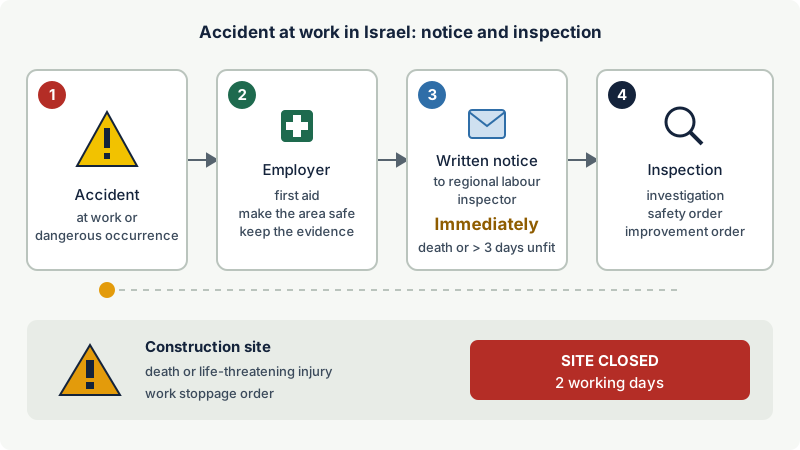
Immediately and in writing. Under the Accidents and Occupational Diseases (Notification) Ordinance 1945, the employer must send written notice at once to the regional labour inspector of any accident at work that causes death or makes the worker unable to earn full wages for more than three days. Listed dangerous occurrences must be notified in the same way even when nobody is hurt.
Short answer
- What: death of a worker, or incapacity to earn full wages in the same job for more than three days, from an accident arising out of and in the course of work.
- To whom: the regional labour inspector (מפקח עבודה אזורי) of the OSH Administration, Ministry of Labour, for the district where the accident happened.
- When: immediately (מיד), on the form and with the particulars set in the Ordinance's first schedule.
- Later death: if a notified injury ends in death, a further written notice is due as soon as the employer learns of it.
- Lent or agency workers: the user undertaking must tell the employer immediately; the employer makes the notice.
- Dangerous occurrences: listed events (for example a crane collapse, a hoist rope breaking, an explosion or fire damaging the building or plant, a scaffold collapse with a fall risk over 2 metres) must be notified even without injury.
- Occupational disease: a treating physician notifies the chief labour inspector; an employer who suspects a case notifies the regional inspector and the district government physician.
Dangerous occurrences that must be notified
The Accidents and Occupational Diseases (Notification of Dangerous Occurrences in Workplaces) Regulations 5711-1951 extend the notice duty to these events, whether or not anyone was injured:
| Group | Events |
|---|---|
| Rotating machinery | Bursting of a power-driven grinding wheel, flywheel, pulley, rotating vessel or centrifuge |
| Lifts and hoists | Collapse or fall of a lift or its car or platform, breaking of a rope or chain, failure of the operating or safety mechanism |
| Cranes | Collapse or fall of a crane, winch or pulley block, breaking of a rope or chain, failure of the operating or safety mechanism |
| Pressure | Explosion or bursting of a gas receiver under pressure, explosion of a steam boiler or damage from flashback |
| Fire and explosion | An explosion or fire that damaged a building, machinery, installations, electrical equipment or power lines |
| Construction | Collapse of a scaffold (unless no fall from it could exceed 2 metres) or of concrete formwork more than 2 metres high |
What happens after the notice
The regional inspector may investigate the causes and circumstances, question witnesses, take samples and photographs and issue a safety order or improvement order. In a fatal case the coroner's inquiry must be adjourned unless an inspector can attend, and the employer, relatives and worker representatives may question witnesses. Employers' notices also feed the OSH Administration's injury statistics, which its 2023 activity report presents by sector.
On construction sites the Labour Inspection Law, as amended in 2016, adds a special rule. When an inspector learns of a death or an injury that puts a person in real danger of life, the inspector issues a work stoppage order closing the site for two working days from the accident, which may be extended by three more days while safety is checked. On a site that does not display the required site sign, the occupier must stop work after a death even without an order. The police must also inform the chief labour inspector of such accidents, and workers kept away by the closure are paid their normal wage.
A practical sequence for the site manager
- Give first aid, call emergency services and make the area safe.
- Do not disturb the scene beyond what rescue and safety require; photograph and record it.
- If the worker died or is likely to be off work for more than three days, send the written notice to the regional labour inspector at once; do not wait for the internal investigation.
- Inform the safety officer and the safety committee, which must investigate causes and recommend measures.
- Record the accident and keep the documents; the safety officer keeps the accident file and lessons learned.
Separately, the injured worker claims work-injury benefits from the National Insurance Institute (המוסד לביטוח לאומי); that claim does not replace the notice to the labour inspector.
Common mistakes
- Waiting three days to see if the worker returns. If incapacity of more than three days is likely, notify at once; failing to notify is an offence under section 8 of the Ordinance and is also listed for a fixed administrative fine.
- Not notifying near misses that are listed dangerous occurrences. A crane collapse with no injury is still notifiable.
- Assuming the agency notifies. The user undertaking must tell the employer immediately.
Related on excodex
- Occupational safety and health in Israel: law, authorities and employer duties
- What are the penalties for breaking occupational safety rules in Israel?
- OSH law comparison: appointments and reporting deadlines
- Work accident and occupational disease reporting to SGK in Türkiye
Standards and further reading
- Accidents and Occupational Diseases (Notification) Ordinance 1945 (פקודת התאונות ומחלות משלח-היד (הודעה), 1945), sections 3 to 5, original gazette text, Knesset, as amended.
- Accidents and Occupational Diseases (Notification of Dangerous Occurrences in Workplaces) Regulations 5711-1951.
- Labour Inspection (Organisation) Law 5714-1954, section 6A, introduced by Amendment No. 10, 2016.
This article is general occupational safety and health information prepared by the excodex editorial team. It does not replace the applicable legislation, standards, manufacturers' instructions or the assessment of a competent OSH professional or occupational physician.
More questions on this topic
- What is the main occupational safety and health law in Israel and who enforces it?
- Must an employer in Israel appoint a safety professional or an occupational physician?
- Is a written risk assessment mandatory in Israel, and how often must it be reviewed?
- What OSH training must employers provide to workers in Israel?
- Are pre-employment and periodic medical examinations required for workers in Israel?
- What are the penalties for breaking occupational safety rules in Israel?
- Is a safety committee or a worker safety representative required in Israel?
- How are explosive atmospheres and Ex equipment regulated in Israel?
Part of: Occupational safety and health in Israel: law, authorities and employer duties