Occupational safety International framework and country guides
How and within what time must a workplace accident be reported in France?
Part of: Occupational safety and health in France: law, authorities and employer duties
Short answer
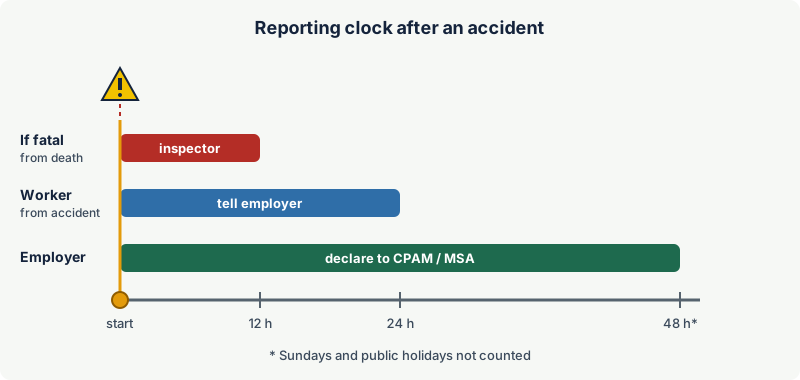
The worker tells the employer within 24 hours. The employer declares the accident to the CPAM (MSA in agriculture) within 48 hours, Sundays and public holidays excluded. After a fatal accident the labour inspector must be told within 12 hours of the death.
In France a workplace accident is reported through Social Security. The worker must inform the employer the same day or at the latest within 24 hours, and the employer must declare the accident to the primary health insurance fund (CPAM, or the agricultural fund MSA) within 48 hours, not counting Sundays and public holidays. If the worker dies, the employer must also inform the labour inspector immediately and at the latest within 12 hours of the death.
Short answer
| Step | Who | To whom | Deadline |
|---|---|---|---|
| Inform the employer | Worker (or someone for the worker) | Employer, by any means | Same day, at the latest within 24 hours |
| Accident declaration (déclaration d'accident du travail, DAT) | Employer | CPAM, or MSA for agricultural workers | 48 hours, Sundays and public holidays excluded |
| Fatal accident | Employer | Labour inspector for the place of the accident | Immediately, at the latest 12 hours after the death |
| Occupational disease | Worker | CPAM | 15 days from the start of sick leave |
- The 24-hour deadline for the worker does not run in case of force majeure, absolute impossibility or a legitimate reason such as hospitalisation.
- If the employer fails to declare, the worker can declare directly to the CPAM within two years.
- A missing or late declaration exposes the employer to a fine of up to 750 euros (natural person) or 3,750 euros (company); failing to inform the labour inspector of a fatal accident is punishable by a fine of 1,500 euros, 3,000 euros for a repeat offence (official service-public.gouv.fr page, last verified by its editors on 29 January 2025).
How the employer declares
The declaration goes to the CPAM of the worker's affiliation (the MSA for agricultural workers) and can be made online through the employer's account on the official declarations portal. The employer also gives the worker an accident form (feuille d'accident), which the worker shows to doctors and pharmacies so that care for the accident is free of charge, and, if the worker stops work, sends the salary certificate needed to calculate daily benefits. For temporary agency workers, an additional prior-information form goes to the CARSAT; the user company and the agency should agree in advance who sends what.
The duty to declare does not depend on the employer agreeing that the accident is work-related: the employer declares and can state its doubts, and the CPAM then decides whether to recognise the accident as work-related. Commuting accidents (accidents de trajet) follow the same declaration route.
Fatal accidents: the 12-hour notice to the labour inspector
Article R. 4121-5 of the Code du travail requires the employer to inform the labour inspector competent for the place where the accident happened, immediately and at the latest within 12 hours of the death. If the employer could only learn of the death later, the 12 hours run from that moment. The notice must be sent by a means that proves the date of sending, such as e-mail or registered letter, and contain:
- the employer's name, postal and e-mail addresses and telephone numbers;
- where different, the same details for the company where the accident happened;
- the victim's surname, first names and date of birth;
- the date, time, place and circumstances of the accident;
- the identity and contact details of any witnesses.
This notice comes in addition to the 48-hour declaration to the CPAM.
What else follows the accident
In companies with 50 or more employees, the social and economic committee (CSE) must meet after any accident that caused or could have caused serious consequences (L. 2315-27), and CSE members investigate accidents and occupational diseases. The employer must also update the single risk assessment document (DUERP) when new information about a risk becomes available (R. 4121-2), which a serious accident almost always provides.
Example: On a Saturday at 10:00, a contractor's technician falls from a platform in a French plant and is taken to hospital, where the technician dies on Sunday at 06:00. The employer, the contracting company, must notify the labour inspector for the plant's location by 18:00 on Sunday at the latest and declare the accident to the CPAM within 48 hours, not counting the Sunday. The host plant's CSE meets, the two companies cooperate in the investigation, and both update their risk assessments.
Common mistakes
- Waiting for the medical certificate before declaring. The 48-hour deadline is short; declare on the facts known and let the medical certificate follow.
- Notifying only the inspector. The inspector is told directly only of deaths; all accidents go to the CPAM or MSA.
- Not declaring because the employer doubts the accident is work-related. Declare and state the doubts; the fund decides.
Related on excodex
- Occupational safety and health in France: law, authorities and employer duties
- Is a safety committee or a worker safety representative required in France?
- What are the penalties for breaking occupational safety rules in France?
- OSH law comparison: appointments and reporting deadlines
Standards and further reading
- Code du travail, articles R. 4121-5 (fatal accident notice), L. 2315-27 and R. 4121-2: Code du travail numérique
- Code de la sécurité sociale, book IV (accidents at work and occupational diseases)
- Service-public.gouv.fr, Accident du travail : démarches à effectuer: https://www.service-public.gouv.fr/particuliers/vosdroits/F171
- Service-public.gouv.fr, Maladie professionnelle : démarches à effectuer: https://www.service-public.gouv.fr/particuliers/vosdroits/F176
This article is general occupational safety and health information prepared by the excodex editorial team. It does not replace the applicable legislation, standards, manufacturers' instructions or the assessment of a competent OSH professional or occupational physician.
More questions on this topic
- What is the main occupational safety and health law in France and who enforces it?
- Must an employer in France appoint a safety professional or an occupational physician?
- Is a written risk assessment mandatory in France, and how often must it be reviewed?
- What OSH training must employers provide to workers in France?
- Are pre-employment and periodic medical examinations required for workers in France?
- What are the penalties for breaking occupational safety rules in France?
- Is a safety committee or a worker safety representative required in France?
- How are explosive atmospheres and Ex equipment regulated in France?
Part of: Occupational safety and health in France: law, authorities and employer duties