Occupational safety International framework and country guides
Occupational safety and health in France: law, authorities and employer duties
Abstract
French OSH law is the fourth part of the Labour Code (Code du travail). The Ministry of Labour sets policy, labour inspectors in the regional DREETS enforce it, and Social Security handles accident declarations (48 hours to the CPAM), prevention advice and insurance premiums.
In France, occupational safety and health (OSH) law is set out in the fourth part of the Labour Code (Code du travail, quatrième partie "Santé et sécurité au travail"), which transposes the EU framework directive 89/391/EEC and its daughter directives. The Ministry of Labour, through its Directorate General of Labour (Direction générale du travail, DGT), sets the rules; labour inspectors working in the regional directorates (DREETS) enforce them; and the Social Security occupational risks branch receives accident declarations, advises on prevention and adjusts each employer's insurance premium.
This guide explains the legal framework, the authorities, the employer's core duties (risk assessment, prevention services, training, medical follow-up), accident reporting deadlines, worker representation, penalties, and the special regimes for chemicals, explosive atmospheres and major-hazard sites, with a comparison against the EU framework and Türkiye. Legal references were checked on the Ministry of Labour's official Labour Code portal in November 2026.
Key points
- The core OSH duty is in article L. 4121-1 of the Code du travail: the employer takes the measures needed to ensure the safety and protect the physical and mental health of workers, applying nine general principles of prevention (L. 4121-2).
- Every employer must record its risk assessment in a single document, the document unique d'évaluation des risques professionnels (DUERP), update it at least once a year when it has 11 or more employees, and keep each version for 40 years.
- Every employer must belong to or set up an occupational health and prevention service (service de prévention et de santé au travail, SPST) and designate one or more competent employees for prevention activities (L. 4644-1).
- The employer must declare a workplace accident to the primary health insurance fund (caisse primaire d'assurance maladie, CPAM, or the agricultural social insurance fund, Mutualité sociale agricole, MSA, for farm workers) within 48 hours, Sundays and public holidays excluded; after a fatal accident it must inform the labour inspector within 12 hours of the death.
- A social and economic committee (comité social et économique, CSE) is required once the company has had 11 or more employees for 12 consecutive months; a health, safety and working conditions commission (CSSCT) is required from 300 employees and in all upper-tier Seveso and basic nuclear establishments.
- Breaching the main OSH rules by personal fault is a criminal offence punished by a fine of 10,000 euros applied once per worker concerned (L. 4741-1), on top of Penal Code liability if someone is injured or killed.
The legal framework and the authorities that enforce it
Main texts
French OSH law is codified. The Code du travail is split into legislative articles (numbered L.), decrees adopted after the Council of State's opinion (R.) and simple decrees (D.). Technical details are completed by ministerial orders (arrêtés). Part 4 applies to private-law employers and their workers, to public industrial and commercial bodies and to some public bodies employing staff under private law (L. 4111-1). The civil service has separate rules.
| Text (French name) | English meaning | What it covers |
|---|---|---|
| Code du travail, quatrième partie | Labour Code, part 4: health and safety at work | General duties, workplaces, work equipment, chemicals, physical agents, OSH services, enforcement |
| Code du travail, deuxième partie (L. 2311-1 and following) | Labour Code, part 2: collective relations | The CSE and its health and safety role |
| Code de la sécurité sociale | Social Security Code | Accident and occupational disease declaration, compensation, insurance premiums |
| Code de l'environnement, livre V | Environment Code, book V | Classified installations (ICPE), Seveso sites, placing ATEX equipment on the market |
| Code rural et de la pêche maritime | Rural and Maritime Fishing Code | Agricultural sector specifics (MSA instead of CPAM) |
| Loi n° 2021-1018 du 2 août 2021 | Law of 2 August 2021 to strengthen prevention in occupational health | Renamed the services SPST, 40-year DUERP retention, annual prevention programme |
Directly applicable EU regulations also apply without transposition: CLP (EC) No 1272/2008 for classification and labelling of chemicals, REACH (EC) No 1907/2006 and the PPE Regulation (EU) 2016/425.
Authorities
| Body | Role in OSH |
|---|---|
| Ministry of Labour, Direction générale du travail (DGT) | Designs prevention policy and the rules, steers the labour inspection system |
| DREETS (regional) and DDETS (departmental) | Regional and departmental labour administration, created on 1 April 2021 (DRIEETS in Île-de-France, DEETS overseas); the "labour policy" unit runs the labour inspection |
| Agents de contrôle de l'inspection du travail | Labour inspectors who check compliance, have a right of entry to any workplace covered (L. 8113-1), record offences, order stop-work measures |
| CNAM and the regional CARSAT (Cramif in Île-de-France, CGSS overseas) | Occupational risks branch of Social Security: prevention engineers and safety controllers, injunctions, premium increases or reductions |
| CPAM (MSA in agriculture) | Receives accident and disease declarations and decides on recognition |
| INRS | National research and safety institute: guidance, studies, training material |
| Inspection des installations classées (in the DREAL, under the prefect) | Inspects ICPE and Seveso sites under the Environment Code |
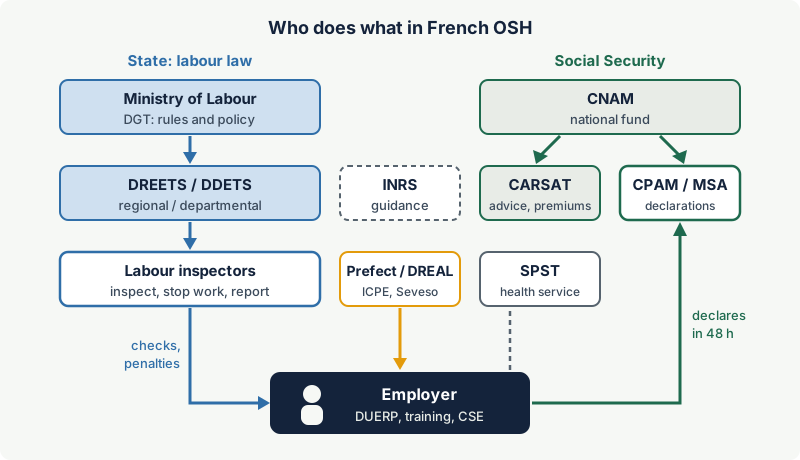
The CARSAT network can, on a report by its engineers or controllers, send an employer an injunction to take safety measures within a set time; failure to comply can lead to an increase in the employer's accident insurance contribution rate. Good prevention can instead earn a reduction or financial aid.
Employer duties, prevention services and the risk assessment
General duty and principles
Article L. 4121-1 requires prevention actions, information and training, and a suitable organisation and resources, adapted when circumstances change. Article L. 4121-2 lists the nine principles of prevention in priority order, the same as in Directive 89/391/EEC: avoid risks, evaluate risks that cannot be avoided, combat risks at source, adapt work to the person, take account of technical progress, replace the dangerous by the non-dangerous or less dangerous, plan prevention (explicitly including moral and sexual harassment and sexist behaviour), give collective protection priority over personal protection, and give appropriate instructions. Where several employers share a workplace they must cooperate (L. 4121-5). When an external contractor works in a host company, the two employers carry out a joint inspection and analyse interference risks; a written prevention plan (plan de prévention) is compulsory when the work totals at least 400 hours over 12 months or appears on the official list of dangerous works (R. 4512-7).
Workers must take care of their own health and safety and that of others affected by their acts, according to their training and the employer's instructions (L. 4122-1). They must alert the employer to any situation they reasonably believe presents a serious and imminent danger, and may withdraw from it (droit d'alerte et de retrait, L. 4131-1) without sanction or loss of pay (L. 4131-3).
Competent employee and the occupational health service
France does not impose a headcount-based quota of safety engineers. Instead, every employer designates one or more competent employees (salariés désignés compétents) for protection and prevention activities; if the in-house skills are not enough, the employer may use registered external prevention specialists (intervenants en prévention des risques professionnels, IPRP) after consulting the CSE (L. 4644-1). The designated employees must have the time and means they need and are protected against discrimination (R. 4644-1).
Separately, every employer must organise an occupational health and prevention service (SPST, L. 4622-1), paid for by employers (L. 4622-6). An in-house (autonomous) service may be set up once the number of employees followed reaches 500 (D. 4622-5); smaller employers join an inter-company service (SPSTI). The service works through a multidisciplinary team led by occupational physicians (médecins du travail) with collaborating physicians, residents, nurses and prevention specialists (L. 4622-8).
The single risk assessment document (DUERP)
The employer assesses risks (L. 4121-3) and records the results, unit by unit, in the DUERP (R. 4121-1). The document must be updated (R. 4121-2):
- at least every year in companies with 11 or more employees;
- whenever an important change alters health and safety or working conditions;
- whenever new information on a risk becomes available.
The assessment leads to an annual prevention programme (programme annuel de prévention, often abbreviated PAPRIPACT, with measures, indicators, costs and a timetable) in companies with 50 or more employees, or to a list of prevention actions recorded in the DUERP below 50 (L. 4121-3-1). The CSE is consulted on the DUERP and its updates (L. 4121-3), the document is sent to the SPST at each update (L. 4121-3-1), and all versions are kept for 40 years and made available to workers, former workers, the CSE, the SPST and inspectors (R. 4121-4). The law also provides for deposit on a digital portal run by employer organisations; until that obligation is in force, the employer keeps the versions on paper or electronically, so employers should check the current status of the portal. Failing to record or update the assessment is a fifth-class contravention (R. 4741-1).
Training, first aid and medical surveillance
Training
The employer must give practical and appropriate safety training to new hires, workers who change job or technique, temporary agency workers, and, at the occupational physician's request, workers returning after at least 21 days off (L. 4141-2). It covers moving around the site, how to do the work safely and what to do after an accident or incident (R. 4141-3), is adapted to the worker's language and experience, and counts as working time (R. 4141-5). Fixed-term, temporary and trainee workers placed in posts with particular risks receive reinforced training (L. 4154-2). Topic-specific rules add, for example, first-aid training for one person in every workshop with dangerous work and on every site with dangerous work employing at least 20 workers for more than 15 days (R. 4224-15), a driving authorisation issued by the employer for listed mobile and lifting equipment with particular risks (R. 4323-56) and electrical authorisation (habilitation) for work on or near electrical installations (R. 4544-9 and R. 4544-10). Since 1 October 2025 (Decree 2025-355 of 18 April 2025), a driving authorisation, and an electrical authorisation for work near bare live parts, are valid only if the worker holds a certificate of no medical contraindication issued by the occupational physician, valid for five years; these posts no longer trigger reinforced medical follow-up for that reason alone.
Medical surveillance
Every worker has an information and prevention visit (visite d'information et de prévention, VIP) within three months of starting work (R. 4624-10), renewed at intervals set by the physician but not longer than five years (R. 4624-16), or three years for night workers, disabled workers and others needing adapted follow-up (R. 4624-17). Night workers and workers under 18 have the visit before starting (R. 4624-18). Workers in posts with particular risks (asbestos, lead, carcinogens, mutagens and reprotoxic agents, biological agents of groups 3 and 4, ionising radiation, hyperbaric work, scaffold erection) have reinforced follow-up (suivi individuel renforcé, SIR) with a fitness examination before assignment, renewed at most every four years with an intermediate visit within two years (R. 4624-23 to R. 4624-28). Return-to-work, mid-career (in principle in the year of the 45th birthday) and end-of-exposure visits complete the system.
Reporting accidents and occupational diseases
French reporting runs through Social Security, not the labour inspectorate, except for fatal accidents.
| Event | Who reports | To whom | Deadline |
|---|---|---|---|
| Workplace accident | Worker (or someone on the worker's behalf) | Employer | The same day, at the latest within 24 hours |
| Workplace or commuting accident | Employer | CPAM (MSA for agricultural workers), usually online | 48 hours, Sundays and public holidays excluded |
| Fatal accident at work | Employer | Labour inspector for the place of the accident | Immediately, at the latest within 12 hours of the death |
| Occupational disease | Worker | CPAM (MSA in agriculture) | 15 days from the start of sick leave; a late claim can still be accepted within 2 years |
If the employer does not declare, the worker can declare the accident to the CPAM within two years. A missing or late declaration exposes the employer to a fine of up to 750 euros (natural person) or 3,750 euros (company), and failing to notify a fatal accident to the inspector to a fine of 1,500 euros (3,000 euros on a repeat offence), according to the official service-public.gouv.fr page (last verified by its editors on 29 January 2025). For a fatal accident, the notice to the inspector must be sent by a means giving a certain date and include the employer's details, the victim's identity, the date, time, place and circumstances, and witnesses (R. 4121-5). In companies with 50 or more employees, the CSE must also be convened after any accident that caused or could have caused serious consequences (L. 2315-27).
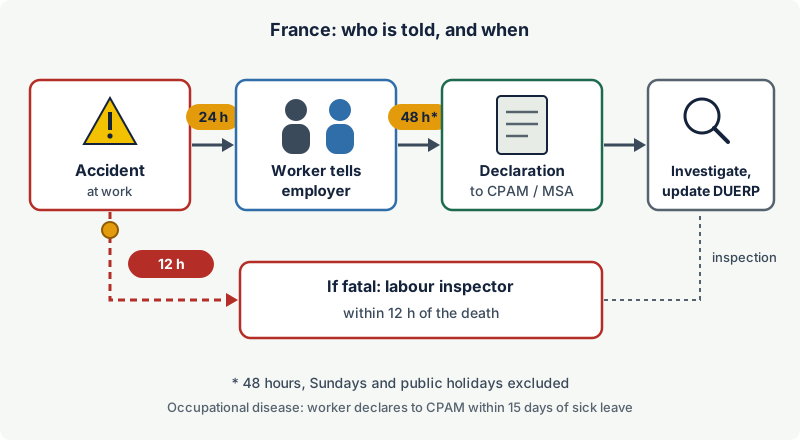
Example: A maintenance technician in a 120-employee plant breaks a wrist on Friday at 15:00 and tells the supervisor at once. The employer must send the accident declaration (déclaration d'accident du travail) to the CPAM within 48 hours, not counting Sunday, so by Monday 15:00 at the latest if Monday is not a public holiday, and give the worker an accident form for medical care. As serious consequences were possible, the CSE meets and investigates. The DUERP is updated with the new information on the risk and the action plan revised. Had the worker died, the labour inspector would also have to be informed within 12 hours of the death.
Worker representatives and the CSE
Since the 2017 reform (Ordonnance n° 2017-1386 of 22 September 2017), the CSE has replaced the former staff delegates, works council and health and safety committee (CHSCT). It must be set up when the company has had at least 11 employees for 12 consecutive months (L. 2311-2). In companies below 50 employees, its members promote health and safety, investigate accidents and occupational diseases and can refer matters to the labour inspector (L. 2312-5). From 50 employees, the CSE analyses occupational risks and is consulted on major changes affecting health, safety or working conditions (L. 2312-8 and L. 2312-9), and at least four of its meetings each year cover health and safety (L. 2315-27).
A CSSCT must be created within the CSE in companies and separate establishments with at least 300 employees and in establishments covered by the high-risk provisions of L. 4521-1 (upper-tier Seveso sites, basic nuclear installations and certain underground storage sites under the Mining Code), and the labour inspector can impose one below 300 where needed (L. 2315-36 and L. 2315-37). CSE members receive health and safety training of at least five days in their first mandate, and at least three days on renewal (five days for CSSCT members in companies of 300 or more), paid by the employer (L. 2315-18). A CSE member who notices a serious and imminent danger alerts the employer, who must investigate immediately with that member (L. 4131-2 and L. 4132-2).
Inspections, enforcement tools and penalties
Labour inspectors (agents de contrôle de l'inspection du travail) are independent under international labour inspection conventions and record offences (L. 8112-1). Their tools, in rising order of severity:
- Formal notice (mise en demeure): by the regional director on the inspector's report for breaches of the general principles (L. 4721-1), or by the inspector before writing a report where the decree requires it (L. 4721-4).
- Immediate report: without prior notice when facts present a serious or imminent danger (L. 4721-5).
- Temporary stop of work: for serious and imminent danger from, for example, falls from height, burial, asbestos or unguarded machinery (L. 4731-1), or persistent overexposure to carcinogens, mutagens or reprotoxic agents (L. 4721-8 and L. 4731-2).
- Urgent court order (référé): the inspector asks a judge to order equipment out of service, seizure or temporary closure of a workshop or site (L. 4732-1).
| Offence | Penalty in the Code du travail (as consulted November 2026) |
|---|---|
| Breach of the main OSH rules by the employer or delegate through personal fault | Fine of 10,000 euros, applied once per worker concerned; repeat offence 1 year in prison and 30,000 euros (L. 4741-1) |
| Failure to comply with a regional director's formal notice | Fine of 3,750 euros (L. 4741-3) |
| Failure to comply with an inspector's stop-work decision | Administrative fine up to 10,000 euros per worker concerned (L. 4752-1) |
| Obstructing a labour inspector | 1 year in prison and 37,500 euros (L. 8114-1) |
| Failure to record or update the DUERP | Fifth-class contravention (R. 4741-1) |
When an accident causes death or injury, managers and the company can also be prosecuted under the Penal Code for involuntary homicide or injury (articles 221-6 and 222-19 and following, to which L. 4741-2 refers), and the court may order the judgment to be posted and published and, on a repeat offence, a ban of up to five years on certain functions (L. 4741-5). Civil compensation and Social Security rules (including the employer's inexcusable fault, faute inexcusable) are a separate track.
Chemicals, explosive atmospheres, major hazards and PPE
Chemicals
CLP and REACH apply directly. The Code du travail adds the hazardous chemical agents rules (R. 4412-1 and following): risk assessment, substitution, binding occupational exposure limits listed in R. 4412-149 and indicative limits set by order (R. 4412-150). Where a limit exists, an accredited body must check exposure at least once a year and after any change likely to worsen it (R. 4412-27).
Explosive atmospheres and Ex equipment
Directive 1999/92/EC is transposed by R. 4227-42 to R. 4227-54 of the Code du travail, the order of 8 July 2003 on the protection of workers exposed to explosive atmospheres (zones 0, 1, 2, 20, 21, 22), the order of 8 July 2003 on safety signs and the order of 28 July 2003 on electrical equipment in hazardous areas. The employer classifies zones and keeps an explosion protection document (document relatif à la protection contre les explosions, DRPCE) integrated in the DUERP (R. 4227-52), prepared before work starts and revised after significant changes (R. 4227-54). Directive 2014/34/EU on ATEX equipment is transposed in the Environment Code (articles R. 557-1-1 to R. 557-5-5 and R. 557-7-1 to R. 557-7-9). See the two ATEX directives explained.
Major-hazard (Seveso) sites
Seveso III (Directive 2012/18/EU) is implemented through the classified installations regime (installations classées pour la protection de l'environnement, ICPE) of the Environment Code, Decrees 2014-284 and 2014-285 of 3 March 2014 and the order of 26 May 2014 on major accident prevention. France had 1,299 Seveso establishments in 2025 (702 upper tier, 597 lower tier) according to the ecology ministry. After the AZF explosion in Toulouse on 21 September 2001 (31 deaths), the law of 30 July 2003 introduced technological risk prevention plans (PPRT) around upper-tier sites. The safety study (étude de dangers) of an upper-tier site must be updated at least every five years, and internal and external emergency plans (POI and PPI) tested and reviewed every three years. Labour law adds duties for these sites: joint prevention measures and specific training for contractors (L. 4522-1 and L. 4522-2) and a mandatory CSSCT.
Personal protective equipment
PPE must carry the CE marking under Regulation (EU) 2016/425. The employer provides suitable PPE where needed and ensures it is actually used (R. 4321-4), and PPE must be appropriate to the risk and must not create new risks (R. 4323-91).
Other national specifics
France tracks exposure to ten arduous-work risk factors (L. 4161-1); for six of them, exposures above set thresholds are declared to Social Security and feed the worker's prevention account (compte professionnel de prévention, L. 4163-1).
France compared with the EU framework and Türkiye
| Topic | EU framework (89/391/EEC) | France | Türkiye (Law No. 6331) |
|---|---|---|---|
| Main law | Directive, transposed nationally | Code du travail part 4 | Law No. 6331 on OSH (2012) and its regulations |
| Prevention staff | Designated workers or competent external services | Designated competent employee for all, plus membership of an SPST | Every employer appoints or contracts an OSH specialist and a workplace physician (Art. 6); minimum working time set by the Ministry by hazard class and headcount |
| Written risk assessment | Required | DUERP; yearly update from 11 employees; kept 40 years | Required; renewed at least every 2, 4 or 6 years in very hazardous, hazardous and less hazardous workplaces (Risk Assessment Regulation Art. 12) and after significant changes |
| Accident reporting | National rules | CPAM within 48 hours; fatal: inspector within 12 hours | Social Security Institution (SGK) within three working days (Law 6331 Art. 14) |
| Committee | Consultation of workers required | CSE from 11 employees; CSSCT from 300 or Seveso upper tier | OSH committee where 50 or more workers and permanent work over six months (Art. 22) |
| Enforcement | National inspectorates | Labour inspection (DREETS) and CARSAT | Labour inspectors of the Ministry of Labour and Social Security (Art. 24) |
The French model relies on a strong occupational health service and on Social Security incentives, while Türkiye ties the minimum working time of the OSH specialist and workplace physician to hazard class and headcount (see OSH services in Türkiye). See also the international comparison of appointments and reporting deadlines.
Common mistakes
- Assuming small firms are exempt from the DUERP. Every employer with at least one employee must assess and record risks; only the annual update depends on having 11 or more employees.
- Reporting the accident to the labour inspector instead of the CPAM. The declaration goes to the CPAM (or MSA) within 48 hours; the inspector is informed directly only of fatal accidents, within 12 hours.
- Treating the occupational physician as the safety manager. The SPST advises and monitors health, but the employer must still designate a competent employee for prevention activities and remains responsible.
- Ignoring the contractor rules. Work by external companies needs a joint inspection and, from 400 hours over 12 months or for listed dangerous works, a written prevention plan before work starts.
- Writing the explosion protection document as a separate file nobody updates. The DRPCE is part of the DUERP and must be revised after significant changes to premises, equipment or organisation.
Frequently asked questions
Is the French OSH law a single act like the UK Health and Safety at Work Act?
No. French OSH law is codified in part 4 of the Code du travail, with legislative articles (L.), regulatory articles (R. and D.) and ministerial orders for technical details. Accident compensation is in the Social Security Code and major-hazard sites in the Environment Code.
Do foreign contractors working in France have to follow French OSH rules?
Yes. French OSH rules apply on French territory to the work carried out there, and the host company and the external company must coordinate prevention through the joint inspection and, where required, a written prevention plan.
Who inspects ATEX zones in France?
The employer is responsible for zoning and the DRPCE, and labour inspectors check compliance with the Code du travail. For classified installations, the classified-installation inspectorate also checks explosion risks under environmental law, and electrical installations need periodic verification by an accredited body or a qualified person (R. 4226-16 and R. 4226-17).
Are the French penalty amounts updated every year?
No. The fines in the Code du travail, such as 10,000 euros per worker under L. 4741-1, are fixed amounts in the law and change only when the law is amended. Check the current text before quoting them.
Related on excodex
- What is the main OSH law in France and who enforces it?
- How and within what time must a workplace accident be reported in France?
- Is a written risk assessment mandatory in France?
- The EU framework directive 89/391/EEC explained
- Seveso III major-accident prevention: tiers and duties
- The explosion protection document and area classification
Standards and further reading
- Code du travail, part 4 (Santé et sécurité au travail), in particular L. 4121-1 to L. 4121-5, R. 4121-1 to R. 4121-5, L. 4141-2, L. 4622-1, L. 4644-1, R. 4624-10 to R. 4624-31, R. 4227-42 to R. 4227-54, L. 4721-1 to L. 4741-11: Code du travail numérique, Ministry of Labour
- Loi n° 2021-1018 du 2 août 2021 pour renforcer la prévention en santé au travail (Law of 2 August 2021 to strengthen prevention in occupational health)
- Ordonnance n° 2017-1386 du 22 septembre 2017 (creation of the CSE)
- Arrêté du 8 juillet 2003 relatif à la protection des travailleurs susceptibles d'être exposés à une atmosphère explosive, and arrêté du 28 juillet 2003 on electrical equipment in hazardous areas: AIDA (INERIS)
- Directive 2012/18/EU (Seveso III); Decrees 2014-284 and 2014-285 of 3 March 2014; Loi n° 2003-699 du 30 juillet 2003 (technological risks)
- Service-public.gouv.fr, Accident du travail : démarches à effectuer: https://www.service-public.gouv.fr/particuliers/vosdroits/F171
- INRS, public authorities in charge of prevention policy: https://www.inrs.fr/demarche/acteurs-institutionnels/pouvoirs-publics-politique-prevention.html
- INRS, Social Security as an actor of prevention: https://www.inrs.fr/demarche/acteurs-institutionnels/assurance-sociale-acteur-prevention-reparation.html
- INRS, explosion regulation and reference texts: https://www.inrs.fr/risques/explosion/reglementation-textes-reference.html
- Ministry of Ecological Transition, Seveso directive and the Risks law: https://www.ecologie.gouv.fr/politiques-publiques/risques-technologiques-directive-seveso-loi-risques
- EU-OSHA national focal point France: https://osha.europa.eu/en/about-eu-osha/national-focal-points/france
- Service-public.gouv.fr, Maladie professionnelle : démarches à effectuer: https://www.service-public.gouv.fr/particuliers/vosdroits/F176
- Code du travail numérique, R. 4323-56 (driving authorisation, version in force from 1 October 2025): https://code.travail.gouv.fr/code-du-travail/r4323-56
- Türkiye: Law No. 6331 on Occupational Health and Safety (İş Sağlığı ve Güvenliği Kanunu), Arts. 6, 14, 22 and 24, and the Regulation on OSH Risk Assessment (İş Sağlığı ve Güvenliği Risk Değerlendirmesi Yönetmeliği) Art. 12: https://www.mevzuat.gov.tr/mevzuat?MevzuatNo=6331&MevzuatTur=1&MevzuatTertip=5
This article is general occupational safety and health information prepared by the excodex editorial team. It does not replace the applicable legislation, standards, manufacturers' instructions or the assessment of a competent OSH professional or occupational physician.
Questions on this topic
- What is the main occupational safety and health law in France and who enforces it?
- Must an employer in France appoint a safety professional or an occupational physician?
- Is a written risk assessment mandatory in France, and how often must it be reviewed?
- How and within what time must a workplace accident be reported in France?
- What OSH training must employers provide to workers in France?
- Are pre-employment and periodic medical examinations required for workers in France?
- What are the penalties for breaking occupational safety rules in France?
- Is a safety committee or a worker safety representative required in France?
- How are explosive atmospheres and Ex equipment regulated in France?
- Which rules apply to major-hazard chemical sites in France?