Occupational safety International framework and country guides
How are explosive atmospheres and Ex equipment regulated in France?
Part of: Occupational safety and health in France: law, authorities and employer duties
Short answer
France applies ATEX 1999/92/EC through Labour Code articles R. 4227-42 to R. 4227-54 and orders of July 2003: employers zone hazardous areas and keep an explosion protection document in the DUERP. ATEX equipment (2014/34/EU) falls under the Environment Code.
France regulates explosive atmospheres in two layers. For workplaces, Directive 1999/92/EC is transposed into the Labour Code (articles R. 4227-42 to R. 4227-54) and three ministerial orders of July 2003: the employer must assess explosion risks, classify hazardous areas into zones, choose equipment of the right category and keep an explosion protection document (document relatif à la protection contre les explosions, DRPCE) as part of the single risk assessment document. For products, Directive 2014/34/EU on equipment for explosive atmospheres is transposed into the Environment Code.
Short answer
- Workplace duties: prevent explosive atmospheres; if impossible, avoid ignition; then limit the effects of an explosion, in that order (R. 4227-44).
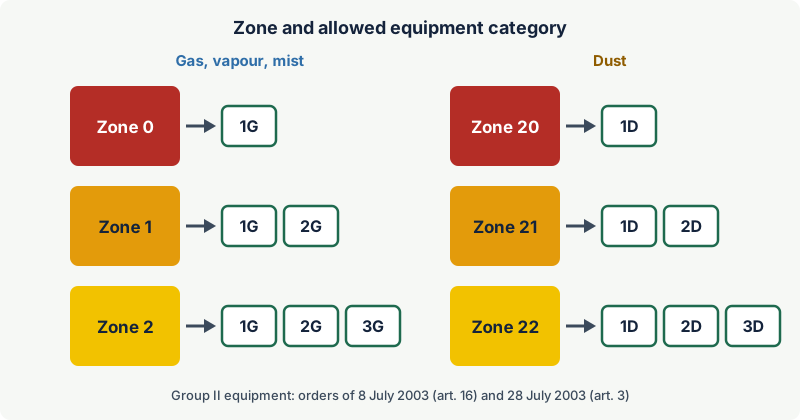
- Zones: 0, 1, 2 for gas, vapour and mist; 20, 21, 22 for dust clouds, as defined in the order of 8 July 2003 (article 3). Dust layers and deposits are treated as sources of explosive atmospheres.
- Equipment categories by zone: zone 0: 1G; zone 1: 1G or 2G; zone 2: 1G, 2G or 3G; zone 20: 1D; zone 21: 1D or 2D; zone 22: 1D, 2D or 3D (order of 8 July 2003, article 16, which allows the DRPCE to provide otherwise on the basis of the risk assessment; for electrical equipment the order of 28 July 2003, article 3, sets the same table without that exception).
- DRPCE: part of the DUERP, written before work starts and revised after significant changes (R. 4227-52 and R. 4227-54).
- Products: Environment Code articles R. 557-1-1 to R. 557-5-5 and R. 557-7-1 to R. 557-7-9 (Directive 2014/34/EU), with CE and Ex marking; an EU-type examination by a notified body is needed for category 1, protective systems and category 2 electrical equipment and engines.
- Exclusions from the workplace rules: areas used for medical treatment of patients, use of gas appliances, and the manufacture, handling, use, storage and transport of explosives and chemically unstable substances (R. 4227-42).
What the employer must do in an ATEX workplace
The employer assesses explosion risks, considering at least the likelihood that explosive atmospheres form and persist, the likelihood that ignition sources (including electrostatic discharges) become active, the installations, substances and processes, and the scale of foreseeable consequences, including areas connected by openings to hazardous areas (R. 4227-46 and R. 4227-48). The employer then zones the hazardous areas and applies the minimum requirements to them (R. 4227-50), signs the access to these areas with the "EX" warning sign under the safety signs order (R. 4227-51), and makes sure that workers receive sufficient and appropriate training in explosion protection and suitable work clothing where needed (R. 4227-49).
Organisational measures in the order of 8 July 2003 include written instructions for work in hazardous areas and a formal permit system for dangerous work, delivered before the work by a person authorised by the employer (article 6), alarms and evacuation before explosive conditions are reached (article 12), and a check of the safety of the whole installation by competent people before the first use of a workplace with hazardous areas (article 14).
Contents of the DRPCE
Article R. 4227-52 lists the minimum contents: the identification and assessment of explosion risks, the measures taken, the zone classification, the places where the minimum requirements apply, how workplaces and equipment (including alarms) are designed, used and maintained, the list of work requiring written instructions or a permit, and the measures for safe use of work equipment. Where several companies work on the same site, the host company's DRPCE sets out the coordination of prevention measures (R. 4227-53).
Ex equipment: placing on the market and installation
Manufacturers, importers and distributors of ATEX equipment and protective systems follow the Environment Code provisions transposing Directive 2014/34/EU, for electrical and non-electrical equipment alike (group I: mines; group II: other industries). The EU declaration of conformity, the CE marking and the specific Ex marking must be present. Category 1 equipment, protective systems, and category 2 electrical equipment and internal combustion engines need an EU-type examination by a notified body; other category 2 equipment and category 3 equipment follow the manufacturer's internal production control, the technical file of other category 2 equipment being sent to a notified body (Directive 2014/34/EU, article 13). Notified bodies are listed in the European Commission's NANDO database.
On the user side, electrical installations in hazardous areas must be designed and their wiring chosen according to the provisions on explosion-risk locations (external influence BE3) of the French low-voltage installation standard NF C 15-100, article 424 as cited in the order of 28 July 2003 (article 4). Electrical measurements in hazardous areas need a permit, and if the measuring equipment is not suitable for the zone, the area must first be made non-hazardous (order of 28 July 2003, article 5). Electrical installations are verified at commissioning (R. 4226-14) and periodically, by an accredited body or a qualified person within the company (R. 4226-16 and R. 4226-17).
Example: A Turkish supplier exports a gas detector marked II 2G Ex db IIC T4 Gb to a French refinery. The refinery's DRPCE classifies the compressor house as zone 1, where category 2G is allowed, and the gas group and temperature class suit the process gases. Before commissioning, the refinery records in the DRPCE that the detector can be used safely in that zone (order of 8 July 2003, article 10) and has the electrical installation verified.
Common mistakes
- Keeping the DRPCE separate from the DUERP. It is legally part of the single risk assessment document.
- Buying IECEx-only equipment for an EU site. Equipment placed on the French market for use in explosive atmospheres needs ATEX conformity and CE marking; an IECEx certificate alone is not enough.
- Forgetting non-electrical equipment. Pumps, fans and gearboxes in zones also fall under the ATEX product rules and the zone-category table.
Related on excodex
- Occupational safety and health in France: law, authorities and employer duties
- ATEX explained: the two EU directives 2014/34/EU and 1999/92/EC
- The explosion protection document (EPD) and area classification drawings
- Is IECEx certification accepted in the EU instead of ATEX?
- excodex Ex tools
Standards and further reading
- Code du travail, articles R. 4227-42 to R. 4227-54, R. 4226-14, R. 4226-16, R. 4226-17: Code du travail numérique
- Arrêté du 8 juillet 2003 relatif à la protection des travailleurs susceptibles d'être exposés à une atmosphère explosive: AIDA (INERIS)
- Arrêté du 28 juillet 2003 relatif aux conditions d'installation des matériels électriques dans les emplacements où des atmosphères explosives peuvent se présenter: AIDA (INERIS)
- Arrêté du 8 juillet 2003 complementing the safety signs rules (EX sign)
- Code de l'environnement, articles R. 557-1-1 to R. 557-5-5 and R. 557-7-1 to R. 557-7-9 (Directive 2014/34/EU, conformity assessment in article 13)
- INRS, explosion regulation and reference texts: https://www.inrs.fr/risques/explosion/reglementation-textes-reference.html
This article is general occupational safety and health information prepared by the excodex editorial team. It does not replace the applicable legislation, standards, manufacturers' instructions or the assessment of a competent OSH professional or occupational physician.
More questions on this topic
- What is the main occupational safety and health law in France and who enforces it?
- Must an employer in France appoint a safety professional or an occupational physician?
- Is a written risk assessment mandatory in France, and how often must it be reviewed?
- How and within what time must a workplace accident be reported in France?
- What OSH training must employers provide to workers in France?
- Are pre-employment and periodic medical examinations required for workers in France?
- What are the penalties for breaking occupational safety rules in France?
- Is a safety committee or a worker safety representative required in France?
Part of: Occupational safety and health in France: law, authorities and employer duties