Occupational safety International framework and country guides
Must an employer in Belgium appoint a safety professional or an occupational physician?
Part of: Occupational safety and health in Belgium: law, authorities and employer duties
Short answer
Yes. Every Belgian employer needs an internal prevention service with at least one prevention adviser (below 20 workers the employer may take the role), and health surveillance by an occupational physician through an accredited external service or an internal medical department.
Yes, from the first worker. Every employer in Belgium must have an internal service for prevention and protection at work with at least one prevention adviser; in a firm with fewer than 20 workers the employer may take that role personally. Health surveillance by an occupational physician (prevention adviser-occupational physician) must be bought from an accredited external service unless the employer has its own medical department.
Short answer
- Prevention adviser (conseiller en prévention / preventieadviseur): compulsory for every employer under Article 33 of the Well-being Act, inside an internal service.
- Fewer than 20 workers: the employer may act as prevention adviser (group D), but an external service then performs the core risk-analysis and accident-investigation tasks.
- Training level of the internal adviser depends on the employer group A, B, C or D, set by headcount and sector.
- Occupational physician: every employer without an internal medical department must join an accredited external service, which provides the physician; health surveillance itself is compulsory for workers in safety or vigilance posts or activities with a defined risk.
- Psychosocial prevention adviser: every employer needs access to one; below 50 workers it must come from an external service.
Internal and external services
The internal service (SIPPT / IDPBW) assists the employer, line managers and workers with all well-being rules. It must visit workplaces regularly, carry out a thorough inspection of workplaces at least once a year, investigate accidents, keep documentation, draft monthly or quarterly reports and an annual report, and act as secretariat of the Committee.
An accredited external service (SEPPT / EDPBW) supplements the internal service. It always performs health surveillance unless the internal service has a medical department meeting the Code's conditions. In group D, and in group C where the internal service has no adviser with level I or II training, it also performs the risk-analysis advice, the investigation of accidents at the workplace causing four or more days of incapacity, and the tasks the employer gives it after serious accidents. Those same employers must take the external service's strategic advice into account in the global prevention plan.
Employer groups and required training
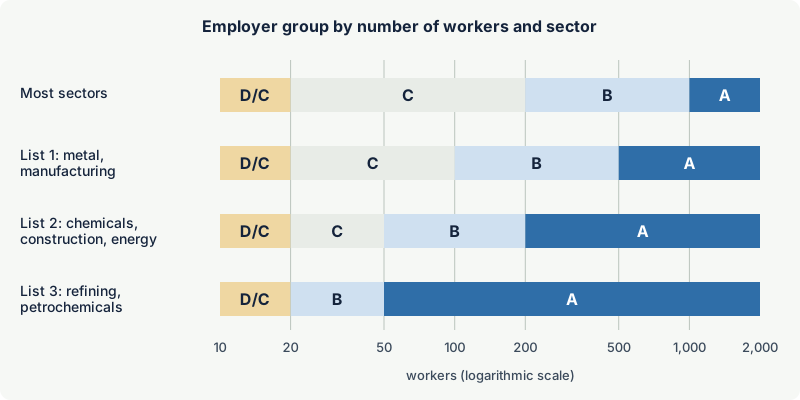
| Group | Typical size (most sectors) | Minimum for the internal service |
|---|---|---|
| A | More than 1,000 workers; 500, 200 or 50 in listed sectors | Advisers with at least level II; head with level I and two years' experience |
| B | 200 to 1,000 workers; lower in listed sectors | Head of service with at least level II |
| C | Fewer than 200, not A or B | No level I or II required; external service covers more tasks |
| D | Fewer than 20, employer acts as adviser | External service covers core tasks |
The listed sectors include water supply, metal processing, precision mechanics and other manufacturing (A above 500); energy, primary metals, chemicals, fabricated metal products, machinery and vehicles, wood, construction, meat processing, health care and transport and storage (A above 200); and nuclear fuel, coke ovens, refining, basic chemicals and petrochemicals (A above 50). Headcount is the yearly average over the four preceding quarters. Levels I and II are approved supplementary courses for prevention advisers.
The employer appoints, replaces or removes a prevention adviser only after the prior agreement of the Committee for prevention and protection at work. Without agreement, the inspectorate gives an opinion first.
The occupational physician
Belgium calls the occupational physician the prevention adviser-occupational physician (conseiller en prévention-médecin du travail). Only this physician performs pre-employment and periodic health assessments and return-to-work examinations, and decides on fitness. Workers whose surveillance is compulsory are those in a safety post, a vigilance post or an activity with a defined risk identified in the risk analysis.
Example: A logistics company with 60 workers (transport and storage, a 200-threshold sector) is in group B. It needs an internal prevention adviser whose head of service has at least level II training, an external service for health surveillance of forklift drivers (safety posts), and an external or internal psychosocial adviser. With 60 workers it also needs a Committee.
Common mistakes
- Assuming that buying an external service replaces the internal service. The internal service, with at least one adviser, is always required.
- Letting the occupational physician also act as psychosocial adviser. The Act forbids combining the two roles.
Related on excodex
- Occupational safety and health in Belgium: law, authorities and employer duties
- Are pre-employment and periodic medical examinations required for workers in Belgium?
- Is a safety committee or a worker safety representative required in Belgium?
Standards and further reading
- Act of 4 August 1996 on the well-being of workers, Articles 32sexies and 33: FPS Employment PDF
- Code of well-being at work, book II titles 1 and 3 (articles II.1-2, II.1-6, II.1-10, II.1-19, II.1-21) and article I.2-8, consolidated 13 June 2026: FPS Employment PDF
This article is general occupational safety and health information prepared by the excodex editorial team. It does not replace the applicable legislation, standards, manufacturers' instructions or the assessment of a competent OSH professional or occupational physician.
More questions on this topic
- What is the main occupational safety and health law in Belgium and who enforces it?
- Is a written risk assessment mandatory in Belgium, and how often must it be reviewed?
- How and within what time must a workplace accident be reported in Belgium?
- What OSH training must employers provide to workers in Belgium?
- Are pre-employment and periodic medical examinations required for workers in Belgium?
- What are the penalties for breaking occupational safety rules in Belgium?
- Is a safety committee or a worker safety representative required in Belgium?
- How are explosive atmospheres and Ex equipment regulated in Belgium?
Part of: Occupational safety and health in Belgium: law, authorities and employer duties