Occupational safety International framework and country guides
Occupational safety and health in Belgium: law, authorities and employer duties
Abstract
Belgian OSH law rests on the Well-being Act of 4 August 1996 and the Code of well-being at work. Every employer needs a prevention service and written prevention plans, declares accidents to its insurer within 8 days and reports serious ones to the inspectorate (fatal at once, report in 10 days).
Occupational safety and health in Belgium is governed by the Act of 4 August 1996 on the well-being of workers in the performance of their work (the "Well-being Act") and by the Code of well-being at work, which gathers almost all of its implementing royal decrees. The law is federal and is enforced by the Supervision of Well-being at Work, the OSH inspectorate of the Federal Public Service (FPS) Employment, Labour and Social Dialogue. Every employer, whatever its size, must run a dynamic risk management system, have a prevention service with at least one prevention adviser, arrange health surveillance through an occupational physician where the risk analysis requires it, and report accidents within strict deadlines.
This guide covers the law, authorities, duties, prevention services, training, health surveillance, reporting, committees, penalties, chemicals, explosive atmospheres and major hazards, with a comparison against the EU framework and Türkiye. Facts were checked against the consolidated Code (version of 13 June 2026) and official FPS Employment and Fedris pages.
Key points
- The basic law is the Act of 4 August 1996 on the well-being of workers (Loi relative au bien-être des travailleurs / Wet betreffende het welzijn van de werknemers); the detailed rules sit in the Code of well-being at work, in force since 12 June 2017.
- Enforcement lies with the Directorate-General Supervision of Well-being at Work (Contrôle du bien-être au travail, CBE / Toezicht op het Welzijn op het Werk, TWW) of the FPS Employment; breaches are punished under the Social Penal Code.
- Every employer must have an internal prevention service with at least one prevention adviser (below 20 workers the employer may take the role); an accredited external service covers the rest, including health surveillance.
- Employers must keep a written five-year global prevention plan and a written annual action plan, based on a risk analysis made at organisation, work-group and individual level.
- Accidents are declared to the accident insurer within 8 days from the next day; serious accidents with death or permanent injury are notified to the inspectorate immediately, and every serious accident needs a circumstantial report within 10 days.
- A Committee for prevention and protection at work is required from an average of 50 workers (20 in underground mines and quarries), with members elected every four years.
- For offences committed from 1 February 2026, the most serious level of the Social Penal Code carries 6 months to 3 years of imprisonment and/or a criminal fine of 6,000 to 70,000 euros (amounts including the surcharge multiplier).
The legal framework: the Well-being Act and the Code
The Well-being Act is a framework law. It sets the general principles of prevention (avoid risks, evaluate the rest, combat them at source, put collective before personal protection), the duties of employers and workers, prevention services, committees, and chapters on construction sites, psychosocial risks and serious accidents. Most of its royal decrees are codified in the Code of well-being at work (Code du bien-être au travail / Codex over het welzijn op het werk).
The Code is written mainly as goal-setting rules guided by the risk analysis. Its prescriptive predecessor, the General Regulation for Labour Protection (RGPT / ARAB), has mostly been emptied; the FPS Employment is moving its remaining provisions into the Code or repealing them.
| Text | French / Dutch name | What it covers |
|---|---|---|
| Act of 4 August 1996 | Loi bien-être / welzijnswet | Framework: principles, duties, services, committees, sanctions basis |
| Code of well-being at work (2017) | Code du bien-être au travail / Codex over het welzijn op het werk | Ten books: general principles, organisation, workplaces, work equipment, physical agents, chemicals, biological agents, ergonomics, protective equipment, specific worker groups |
| Royal Decree of 25 January 2001 | AR chantiers temporaires ou mobiles | Temporary or mobile construction sites, safety and health coordinators |
| Social Penal Code (Book 2) | Code pénal social / Sociaal Strafwetboek | Offences and four sanction levels |
| General Regulation on Electrical Installations (Royal Decree of 8 September 2019) | RGIE / AREI | Electrical installations, inspections by accredited bodies, BA4/BA5 competence |
| Cooperation agreement of 16 February 2016 | Accord de coopération Seveso | Major-accident hazards (Seveso III) |
The Code states, title by title, which EU directive it transposes. Book I (except title 3) and most of Book II transpose the Framework Directive 89/391/EEC, and Book III, title 4 transposes the ATEX workplace Directive 1999/92/EC.
Who enforces OSH law in Belgium
The FPS Employment, Labour and Social Dialogue (SPF Emploi, Travail et Concertation sociale / FOD Werkgelegenheid, Arbeid en Sociaal Overleg) is responsible. Within it:
- The Directorate-General Supervision of Well-being at Work (CBE / TWW) inspects workplaces. Its Division of regional supervision covers ordinary enterprises through a central directorate and eight regional directorates; its Division for the control of chemical risks supervises Seveso establishments and supports colleagues on chemical exposure.
- The Directorate-General Humanisation of Work (HUT) prepares and interprets the rules and publishes the consolidated Code.
- Fedris, the Federal Agency for Occupational Risks, oversees the compulsory accident-at-work insurance system and occupational diseases. It also follows companies with a high accident-risk index.
Social inspectors may enter workplaces at any time without notice, question people and demand documents. For safety and health they may also prescribe measures, prohibit the use of a workplace, machine or substance, stop work, order evacuation and apply seals when danger is imminent. Anyone affected may appeal to the president of the labour tribunal, but the appeal does not suspend the measure. Inspectors decide between a warning, a deadline to comply or an official report (pro justitia) sent to the labour prosecutor.
Employer and worker duties
The employer is responsible for a planned, structured approach to prevention through a dynamic risk management system (système dynamique de gestion des risques). It covers seven domains: work safety, health protection, psychosocial aspects, ergonomics, occupational hygiene, embellishment of workplaces and the environmental measures that affect them. The system has four steps: set the policy, programme it, implement it and evaluate it, and it must be adapted whenever circumstances change.
The core documents are:
- Risk analysis at three levels: the organisation as a whole, each group of workstations or functions, and the individual. It consists of identifying hazards, determining the risks and evaluating them.
- Global prevention plan (plan global de prévention): written, for five years, drawn up with line management and the prevention services, and renewed at least every five years.
- Annual action plan (plan d'action annuel): written, for the following year, submitted to the Committee no later than the first day of the second month before the year starts.
Preventive measures are chosen in a fixed order: avoid risks, then avoid harm, then limit harm. Line managers have legal tasks too, including examining accidents and organising the welcome of each new worker with an experienced colleague.
Workers must use machines, substances and personal protective equipment (PPE) correctly, must not disable safety devices, must report serious and immediate danger and defects at once, and must cooperate with the employer and the internal service (Article 6 of the Act). Any worker who leaves a workstation because of serious, immediate and unavoidable danger is protected from prejudice.
Prevention services, prevention advisers and occupational physicians
Belgium does not use the title "safety officer". The key function is the prevention adviser (conseiller en prévention / preventieadviseur), who works in a service:
- Internal service for prevention and protection at work (SIPPT / IDPBW): compulsory for every employer, with at least one prevention adviser. In firms with fewer than 20 workers, the employer may perform the role personally.
- External service for prevention and protection at work (SEPPT / EDPBW): an accredited service that supplements the internal service. It is compulsory for health surveillance unless the internal service has its own medical department.
- Prevention adviser for psychosocial aspects: internal only with the agreement of all worker representatives on the Committee; employers with fewer than 50 workers must use one from an external service. A person of trust (personne de confiance) may also be designated.
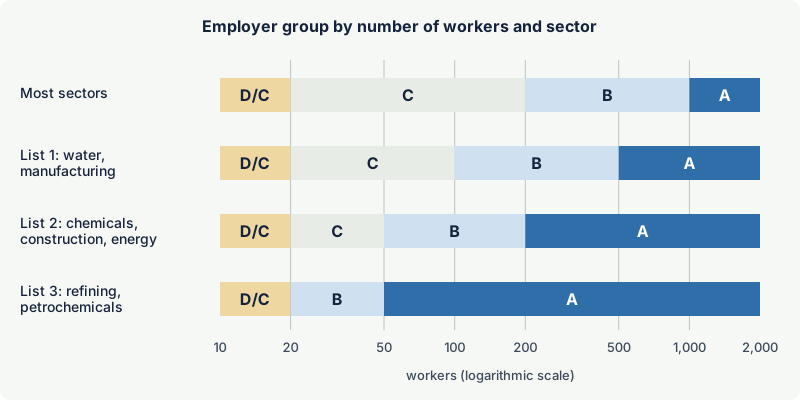
The training required for the internal prevention adviser depends on the employer's group, set by the number of workers and the sector (fig. 2).
| Group | Who (most sectors) | Internal service minimum |
|---|---|---|
| A | More than 1,000 workers (500, 200 or 50 in listed higher-risk sectors) | Advisers with level II training; head of service with level I and two years' experience |
| B | 200 to 1,000 workers (lower ranges in listed sectors) | Head of service with level II training at least |
| C | Fewer than 200 workers, not in A or B | No level I or II course required; without such an adviser, the external service takes over risk-analysis advice and accident investigations |
| D | Fewer than 20 workers, employer acts as prevention adviser | External service performs the core risk-analysis and accident-investigation tasks |
The higher-risk lists include, among others, water supply, metal processing, precision engineering, optics and other manufacturing (500 threshold); energy, primary metals, metal products, machinery, vehicles, chemicals, construction, health care and transport (200); and oil refining, basic chemicals and petrochemicals (50). The worker count is an annual average from the personnel register, with part-time workers below three-quarters time counted as half.
The occupational physician is called the prevention adviser-occupational physician (conseiller en prévention-médecin du travail). Only this physician performs the preventive medical examinations and decides on fitness for work.
Training, first aid and health surveillance
The Code requires sufficient and adequate training specific to each worker's job, given at recruitment, at a transfer or change of function, when new work equipment or a change of equipment is introduced, and when new technology is introduced. It is repeated periodically if necessary, given during working time and at no cost to the worker. The employer also keeps a training programme for line management and workers based on the global prevention plan. The Code does not set a fixed number of hours for general OSH training, unlike Türkiye, where the 2026 training regulation sets at least 8, 12 or 16 lesson hours of basic training by hazard class; specific Belgian titles add their own training duties (explosive atmospheres, electrical work, first aid, chemicals and others).
First-aiders (secouristes) must complete approved training with an annual refresher, which may be two-yearly if the employer justifies it in a risk analysis after advice from the occupational physician and the Committee. Employers in groups A, B and C need a first-aid room unless the risk analysis shows it is unnecessary.
Health surveillance is compulsory for workers in a safety post, a vigilance post or an activity with a defined risk (chemical, physical or biological exposure, ergonomic strain, or high psychosocial risk), unless the risk analysis made with the occupational physician and submitted to the Committee shows it is unnecessary. It includes a pre-employment health assessment before starting such work and periodic surveillance at the frequency of annex I.4-5: often 24 months with intermediate checks, 12 months for carcinogens and for noise at or above 87 dB(A). A return-to-work examination is required after at least four consecutive weeks' absence for these workers, at the latest within ten working days of their return.
Accident and occupational disease reporting
Belgium has two parallel reporting channels: one to the insurer (compensation) and one to the inspectorate (prevention). Figure 1 shows the sequence.
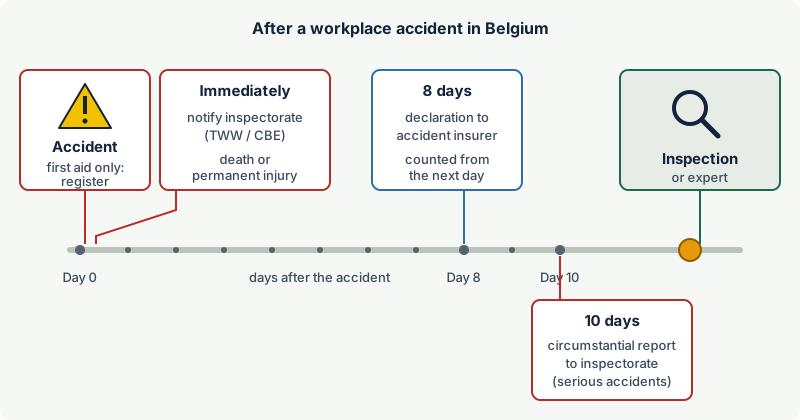
- Minor accident (first aid only, no medical care, no incapacity or loss of pay): recorded in the first-aid register; declared to the insurer within 8 days only if the worker's condition worsens later.
- Declaration to the insurer: every other accident at work or on the way to and from work is declared to the employer's accident-at-work insurer within 8 days, counted from the day after the accident, with the medical certificate of first finding when available. A late accident must still be declared within the 3-year limitation period.
- Serious accident (accident du travail grave): a fatal accident, or one linked to listed deviations or material agents that causes a permanent injury or a listed temporary injury (for example a fracture, amputation, serious burn, acute poisoning or asphyxia). Fatal accidents and those with permanent injury are notified to the inspectorate immediately. For every serious accident, the competent prevention service investigates at once and the employer sends a signed circumstantial report to the inspectorate within 10 days; a provisional report may be accepted.
- Accident sheet: the prevention service completes an accident sheet for every accident causing four or more days of incapacity; the insurer declaration form can replace it. Sheets are kept for at least ten years.
Fedris notes that the option of declaring accidents through the social security portal ends on 1 January 2027; from that date declarations go directly to the insurer. Occupational disease compensation claims in the private sector are handled by Fedris.
Example: A metal-products manufacturer with 140 workers is in group B (sector list with a 200 threshold, B from 50 to 200). On Monday a worker falls from a mezzanine and fractures a wrist. A fall from height with a fracture is a serious accident, so the internal service investigates the same day and the Committee delegation visits the scene. The Code requires immediate notification only for fatal accidents and those causing a permanent injury; because permanence is not yet known, notifying the inspectorate straight away is the prudent choice (Fedris guidance presents immediate notice as the rule for serious accidents). The insurer declaration is due within 8 days counted from Tuesday, and the circumstantial report with causes, measures and an action plan must reach the inspectorate within 10 days of the accident.
Committees, worker representatives and consultation
A Committee for prevention and protection at work (Comité pour la prévention et la protection au travail, CPPT / Comité voor preventie en bescherming op het werk, CPBW) is set up in every technical business unit that normally employs on average at least 50 workers, or 20 in underground mines and quarries. Worker delegates are elected in social elections held every four years; employer delegates are appointed. The Committee meets at least once a month, gives prior advice on the global prevention plan and the annual action plan, and must agree before the employer appoints or removes a prevention adviser.
Without a Committee, the trade-union delegation takes over its tasks. Where there is neither, workers participate directly: the employer consults them through a register and a notice board, with 15 days to respond. Belgium has no separate individual "safety representative" role in the UK sense.
Inspections and penalties
Since 1 July 2011, breaches of the Well-being Act and the Code are sanctioned under the Social Penal Code. Article 127 covers employer breaches of the Act and the Code in general; other articles cover psychosocial risks, the internal service, contractors, construction sites and the Committee. Fines are multiplied by a surcharge coefficient: 8 for offences from 1 January 2017 to 31 January 2026 and 10 from 1 February 2026. The base amounts of levels 3 and 4 were also raised for offences from 1 July 2025.
| Level | Prison | Criminal fine (from 1 Feb 2026) | Administrative fine (from 1 Feb 2026) |
|---|---|---|---|
| 1 | None | None | 100 to 1,000 euros |
| 2 | None | 500 to 5,000 euros | 250 to 2,500 euros |
| 3 | None | 2,000 to 20,000 euros | 1,000 to 10,000 euros |
| 4 | 6 months to 3 years | 6,000 to 70,000 euros | 3,000 to 35,000 euros |
Where the offence article says so, the fine is multiplied by the number of workers concerned, up to 100 times the maximum. Where the offence article allows it, courts may add a ban on operating, a professional ban or closure of the business for one month to three years. These extra penalties are reserved for level 3 and 4 offences, for example OSH breaches that caused ill health or incapacity for work. Separately, the general Criminal Code (articles 418 to 420) punishes involuntary manslaughter and injury through lack of foresight.
Chemicals, explosive atmospheres, major hazards and PPE
Chemicals. The EU CLP Regulation and REACH apply directly. Book VI of the Code covers chemical agents, carcinogens, mutagens, reprotoxic and endocrine-disrupting agents, asbestos and asbestos removal. Annex VI.1-1 lists the Belgian occupational exposure limit values; titles 1 and 2 of Book VI were last amended by a royal decree of 25 May 2026.
Explosive atmospheres. Book III, title 4 transposes Directive 1999/92/EC: risk assessment, zoning (0, 1, 2 for gases; 20, 21, 22 for dusts), an explosion protection document kept up to date, training, written instructions and work permits where needed, signs at entrances and verification before first use. Equipment categories must match the zones. The Code still refers to the Royal Decree of 22 June 1999 for equipment categories; products placed on the market today must conform to Directive 2014/34/EU. Electrical installations in hazardous areas also fall under the RGIE and its inspections by accredited bodies.
Major hazards. Seveso III (Directive 2012/18/EU) is transposed by the cooperation agreement of 16 February 2016 between the federal state and the three regions, in force since 10 June 2016. Operators notify the regional coordinating service, adopt a major-accident prevention policy reviewed at least every five years, prepare an internal emergency plan tested at intervals not exceeding three years and, for upper-tier sites, a safety report reviewed at least every five years. There is one inspection team per region, combining regional and federal inspection services, and the FPS Employment inspectorate coordinates each team and the teams as a whole.
PPE and work equipment. Book IX, title 2 sets employer duties for PPE; products must carry CE marking under Regulation (EU) 2016/425. Book IV covers work equipment, lifting equipment and temporary work at height.
Notable national specifics
- Psychosocial risks have their own chapter in the Act and title in the Code, with formal internal procedures on violence and harassment.
- National action plan 2022 to 2027: priorities are psychosocial risks, musculoskeletal disorders, hazardous chemicals and a "vision zero" for accidents.
- Construction: safety and health coordinators for design and execution under the Royal Decree of 25 January 2001, and electronic attendance registration on certain sites.
- Electrical safety: the RGIE requires inspections by accredited bodies and reserves certain work for persons with BA4 or BA5 competence.
- Return to work: the employer informs the occupational physician of any incapacity of four weeks or more, and Book I, title 4 sets a reintegration pathway for workers on long-term incapacity (last amended by royal decree of 17 December 2025).
- Temporary agency workers: the user company completes a workstation sheet for agency workers in posts requiring health surveillance.
- Two working languages: the FPS Employment publishes the Act and the Code in French and Dutch, and terms differ (conseiller en prévention / preventieadviseur), so check both versions when quoting.
Belgium, the EU framework and Türkiye compared
| Topic | Belgium | EU framework (89/391/EEC) | Türkiye (Law No. 6331) |
|---|---|---|---|
| Main law | Well-being Act 1996 + Code (2017) | Framework Directive + daughter directives | OSH Law No. 6331 (2012) + regulations |
| Prevention staff | Internal service with prevention adviser for all; external accredited service as needed | Designated competent workers or external services | OSH specialist and workplace physician for every workplace, certificate class by hazard class; employers with fewer than 50 workers in the less hazardous class may run the service themselves after Ministry training |
| Risk assessment | Dynamic system, 5-year plan, annual action plan | Employer must hold a risk assessment | Documented; renewed at least every 2, 4 or 6 years (very hazardous, hazardous, less hazardous) |
| Accident reporting | Insurer 8 days; serious: immediate notice and 10-day report to inspectorate | National rules; list of accidents causing more than 3 working days' unfitness | Social Security Institution (SGK) within 3 working days after the accident |
| Committee | 50 workers (20 in underground mines) | Consultation and participation | 50 or more workers and continuous work lasting over six months |
Common mistakes
- Treating the prevention adviser as optional in small firms. Every employer needs an internal service; below 20 workers the employer may hold the role personally but must still use an external service for the core tasks.
- Sending only the insurer declaration after a serious accident. The circumstantial report to the inspectorate within 10 days is a separate duty, and fatal or permanent-injury accidents must also be notified immediately.
- Keeping a risk assessment but no written global prevention plan or annual action plan. Inspectors ask for both, and the action plan needs the Committee's prior advice.
- Using EU-wide training hour tables. The Code sets triggers and outcomes, not fixed hours; document training against the risk analysis.
- Quoting fines without the surcharge coefficient or the date of the offence. Since 1 February 2026 the multiplier is 10.
Frequently asked questions
Is OSH law in Belgium federal or regional?
The Well-being Act and the Code are federal and apply across all three regions. The regions come in for major-accident hazards: under the Seveso cooperation agreement, regional services receive notifications and inspect together with the federal inspectorate.
Does a foreign contractor working in Belgium have to follow Belgian OSH law?
Yes. The Act applies to employers and workers on Belgian workplaces, and the host employer must coordinate with contractors and inform them of risks, including non-conforming electrical installations. On temporary or mobile construction sites the safety and health coordinator rules also apply.
Who decides whether a worker is fit for a job?
The prevention adviser-occupational physician decides, based on the medical examination and the up-to-date risk analysis of the post. A worker who disagrees can use a consultation procedure and can appeal to the social medical inspector of the inspectorate within 21 calendar days. Neither route applies to the pre-employment health assessment.
What is the accident-at-work insurance in Belgium?
Private-sector employers must insure every worker from the first day with an approved insurer. An uninsured employer is automatically affiliated with Fedris, pays a flat-rate contribution and repays the compensation, and may also be prosecuted.
Related on excodex
- What is the main OSH law in Belgium and who enforces it?
- Must an employer in Belgium appoint a safety professional or an occupational physician?
- How and within what time must a workplace accident be reported in Belgium?
- The EU framework directive 89/391/EEC explained
- ATEX explained: the two EU directives
- Occupational safety and health in France
Standards and further reading
- Act of 4 August 1996 on the well-being of workers in the performance of their work (Moniteur belge 18 September 1996), consolidated text: FPS Employment PDF
- Code of well-being at work (28 April 2017), consolidated version of 13 June 2026: FPS Employment PDF
- Cooperation agreement of 16 February 2016 on the control of major-accident hazards involving dangerous substances: FPS Employment PDF
- FPS Employment, well-being at work theme: emploi.belgique.be and werk.belgie.be
- FPS Employment, supervision and sanctions: Surveillance et sanctions and Poursuites pénales
- FPS Employment, labour inspection and its powers: L'inspection du travail, Les contrôles and L'issue d'un contrôle
- Fedris, accident declaration in the private sector: fedris.be and employer obligations: fedris.be
- FPS Employment, Seveso explanation: emploi.belgique.be
- Directive 89/391/EEC, Directive 1999/92/EC, Directive 2014/34/EU, Directive 2012/18/EU, Regulation (EU) 2016/425, Regulation (EC) No 1272/2008 (CLP)
This article is general occupational safety and health information prepared by the excodex editorial team. It does not replace the applicable legislation, standards, manufacturers' instructions or the assessment of a competent OSH professional or occupational physician.
Questions on this topic
- What is the main occupational safety and health law in Belgium and who enforces it?
- Must an employer in Belgium appoint a safety professional or an occupational physician?
- Is a written risk assessment mandatory in Belgium, and how often must it be reviewed?
- How and within what time must a workplace accident be reported in Belgium?
- What OSH training must employers provide to workers in Belgium?
- Are pre-employment and periodic medical examinations required for workers in Belgium?
- What are the penalties for breaking occupational safety rules in Belgium?
- Is a safety committee or a worker safety representative required in Belgium?
- How are explosive atmospheres and Ex equipment regulated in Belgium?
- Which rules apply to major-hazard chemical sites in Belgium?