Who is responsible for ATEX compliance: the manufacturer, the installer or the employer?
Abstract
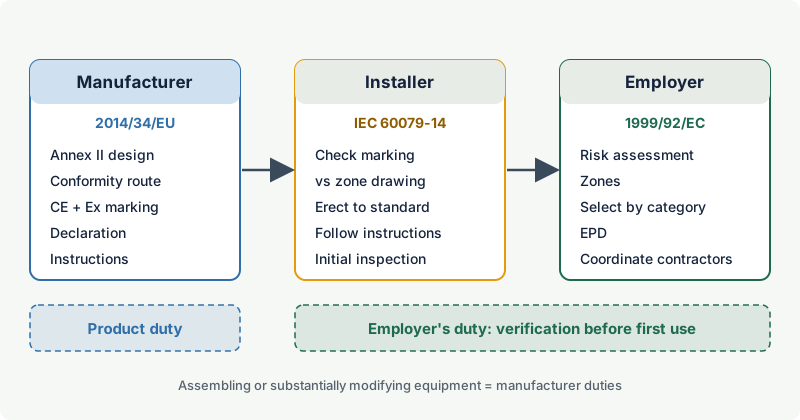
Each for its own part. The manufacturer answers for the product under 2014/34/EU, the employer for the workplace under 1999/92/EC (risk assessment, zones, equipment selection, EPD), and the installer for correct installation to the employer's classification and IEC 60079-14.
All three, each for a different part, and the law names two of them. Directive 2014/34/EU makes the manufacturer (with importers and distributors) responsible for the product being safe and correctly certified for its category. Directive 1999/92/EC makes the employer responsible for the workplace: assessing explosion risks, classifying zones, selecting suitable equipment and keeping the Explosion Protection Document. The installer is not named in either directive; he works under the employer's duty and must install to the classification, the equipment instructions and IEC 60079-14.
Short answer
- Manufacturer: designs to the essential health and safety requirements, completes the conformity assessment, issues the EU declaration of conformity, affixes CE and Ex marking, supplies instructions (2014/34/EU, Article 6).
- Importer and distributor: the importer checks that a non-EU manufacturer has done this; both check that marking and documents are present before they supply the product (2014/34/EU, Articles 8 and 9).
- Employer (site owner or operator): prevents explosive atmospheres where possible, assesses risks, classifies zones, selects equipment by category, coordinates contractors and keeps the Explosion Protection Document (1999/92/EC, Articles 3 to 8).
- Installer: builds the installation as designed, following the equipment certificate, specific conditions of use and IEC 60079-14; his duties come from the employer's contract and national worker safety law.
- Anyone who builds equipment for own use, assembles ATEX items into a new unit or substantially modifies equipment becomes a manufacturer for that product.
What the law assigns to each party
| Party | Legal basis | Responsible for | Typical evidence |
|---|---|---|---|
| Manufacturer | 2014/34/EU, Article 6 | Product meets Annex II, correct conformity route for its category, marking, instructions | EU declaration of conformity, certificate where required, technical file (kept 10 years) |
| Importer, distributor | 2014/34/EU | Checking the manufacturer's compliance and documents | Copy of declaration, labelling |
| Employer | 1999/92/EC, Articles 3 to 9, Annexes I and II | Risk assessment, zones, equipment selection, training, permits, Explosion Protection Document, verification before first use | Explosion Protection Document, area classification drawings, inspection records |
| Installer, designer, maintainer | Contract with the employer; national worker safety law; IEC 60079-14 and IEC 60079-17 as technical rules | Correct selection checks, erection, initial inspection, later inspection and maintenance | Installation documentation, inspection reports |
The European Commission's ATEX Guidelines say plainly that the product directive does not regulate installation: combining compliant equipment at the user's premises produces an installation, not new equipment, and installing it is generally subject to the Member States' own legal requirements. The same guidelines add that the installer must make sure the equipment still complies when it is taken into service, by following all the manufacturers' installation instructions. So a perfect product, installed badly, is the employer's problem, and the employer will look to the installer's contract and competence.
The employer carries the workplace duty
Directive 1999/92/EC puts the explosion protection duties on the employer:
- follow the order of priority: prevent explosive atmospheres, otherwise avoid ignition, then mitigate the effects (Article 3);
- assess the explosion risks overall, including places connected through openings (Article 4);
- classify hazardous places into zones and apply the minimum requirements of Annex II (Article 7);
- draw up the Explosion Protection Document before work starts and revise it after significant changes (Article 8);
- select equipment by category for each zone unless the document justifies otherwise (Annex II, Part B);
- have the overall explosion safety of a workplace verified by persons competent in explosion protection before it is used for the first time (Annex II, Part A, 2.8).
The employer may hire consultants to classify areas or write the document, but the duty stays with him. Where workers of several companies share a site, each employer is responsible for matters under his control, and the employer responsible for the workplace coordinates the measures and records how in the Explosion Protection Document (Article 6). This is where a contractor's own employees are covered: the contractor is their employer.
Where the installer stands
The installer turns the employer's classification and the manufacturer's product into a working installation. In practice he:
- checks that each item's marking (category or EPL, gas group, temperature class, ambient range) matches the zone drawing;
- follows the certificate's specific conditions of use and the manufacturer's instructions;
- erects cables, glands, earthing and bonding to IEC 60079-14 (edition 6, 2024);
- carries out and records the initial inspection before energising.
If he modifies certified equipment, for example by drilling extra entries in a flameproof enclosure, he may change its certified state; a substantial modification makes him responsible as a manufacturer. Ongoing inspection and maintenance follow IEC 60079-17.
Example: A gas compressor skid is built from a certified motor, a certified compressor and certified instruments. The packager who connects them and sells the skid as one unit with a single EU declaration takes responsibility for that assembly, after an ignition risk assessment of the combination. The site electrician who later connects the skid to site power works under the employer's permit system and to IEC 60079-14. The plant operator, as employer, checks the skid's category against the Zone 2 classification and records it in the Explosion Protection Document.
Common mistakes
- "The equipment is ATEX certified, so the site is compliant." Certification covers the product only; selection, installation and maintenance are workplace duties.
- "The consultant wrote our Explosion Protection Document, so it is his responsibility." The duty to have and update it remains with the employer.
- "The installer only follows the drawings." He must also follow the equipment instructions and the installation standard, and stop if marking and zone do not match.
- Forgetting that modifications move responsibility. Whoever substantially modifies or assembles equipment takes on the manufacturer's obligations.
Related on excodex
- ATEX explained: the two EU directives 2014/34/EU and 1999/92/EC in plain language
- The Explosion Protection Document (EPD) and area classification drawings under ATEX 1999/92/EC
- Ex installation basics under IEC 60079-14
- Who can carry out an ATEX explosion risk assessment?
- Standards spaces: IEC 60079-14, IEC 60079-17
Standards and further reading
- Directive 2014/34/EU, Article 6 (obligations of manufacturers): EUR-Lex
- Directive 1999/92/EC, Articles 3 to 9 and Annex II: legislation.gov.uk
- European Commission, ATEX 2014/34/EU Guidelines, 6th edition (January 2026), sections on installation, assemblies and products for own use: single-market-economy.ec.europa.eu
- EU-OSHA summary of Directive 1999/92/EC: osha.europa.eu
- IEC 60079-14, explosive atmospheres: design, selection, erection and initial inspection of electrical installations
- IEC 60079-17, explosive atmospheres: inspection and maintenance of electrical installations
This article is general technical information prepared by the excodex editorial team. It does not replace the applicable standards, the equipment certificates and instructions, national regulations or the assessment of a competent person.