What is the Ex warning sign and where must it be placed?
Abstract
The Ex warning sign is a yellow triangle with black edging and black letters "EX" (Annex III of Directive 1999/92/EC). Where necessary, the employer places it at the points of entry to places where explosive atmospheres may occur, not on every zone boundary.
The Ex warning sign is a triangular sign with black edging and the black letters "EX" on a yellow background, defined in Annex III of the ATEX workplace directive 1999/92/EC. The employer places it, where necessary, at the points of entry to places where explosive atmospheres may occur in quantities that endanger workers, so that people see it before they step in. It marks entrances to hazardous places, not each zone boundary inside them.
Short answer
- Legal basis: Article 7(3) and Annex III of Directive 1999/92/EC, through national law: Schedule 4 of DSEAR in Great Britain, Annex 4 (Ek-4) of the 2013 Turkish regulation on explosive atmospheres at work, and the corresponding rules of each EU Member State.
- Design: triangle, black letters "EX" on yellow, black edging, with the yellow covering at least 50 % of the sign area. Member States may add explanatory text.
- Position: at the points of entry (doors, gates, hatches, access routes) to places classified as hazardous, facing the person who is about to enter.
- "Where necessary": the risk assessment decides. In Great Britain the HSE accepts equally effective alternatives where a sign is impractical and says individual zones need not be marked.
- Who: the employer (the operator of the workplace), not the equipment manufacturer.
What the Ex sign looks like and what it means
The directive fixes only a few distinctive features; everything else (size, material, extra text) is left to the employer and to national sign rules.
| Feature | Requirement |
|---|---|
| Shape | Triangle (the usual warning-sign shape) |
| Symbol | Black letters "EX" |
| Colours | Yellow background, black edging |
| Yellow area | At least 50 % of the sign area |
| Extra text | Allowed; Member States may add explanatory information |
| Size | Not fixed; large enough to be seen and read from the approach |
The sign says one thing: beyond this point an explosive atmosphere may be present, and special precautions apply. It does not tell the zone, the gas or the rules, so it is usually combined with a supplementary text panel, for example "Explosion hazard area: no naked flames, no smoking, Ex-certified equipment only, authorised persons only, antistatic footwear required". The HSE lists exactly these uses: showing where site rules apply, where portable and mobile equipment must be explosion-protected and where fixed equipment must be of an Ex design.
The Ex sign is a workplace sign. It is not the hexagon with "Ex" that appears on certified equipment under the product directive 2014/34/EU, and it is not the ISO 7010 sign W021 (flammable material, a flame pictogram) or W002 (explosive material). ISO 7010:2019 does not contain an "EX" sign; the "EX" triangle comes from the directive.
Where exactly to place the Ex sign
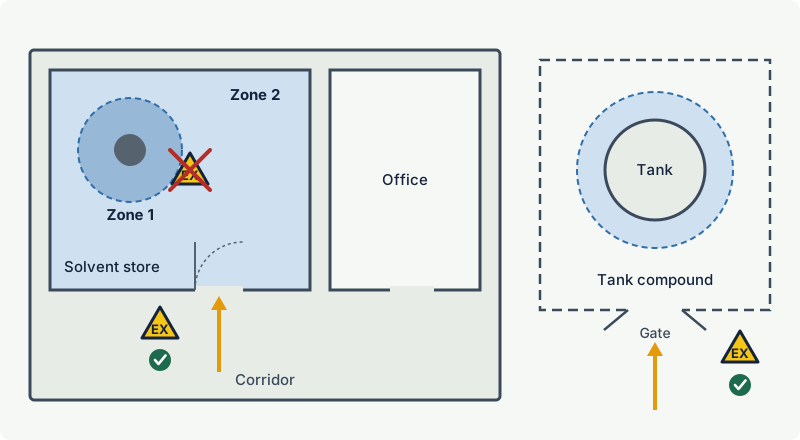
The legal text says "at their points of entry". In practice:
- Rooms and buildings: on the outside of each door into a classified room (solvent store, paint mixing room, battery charging room if classified), typically at eye level on or beside the door, so it is seen before the door is opened.
- Fenced outdoor plant: on every gate and access point of a fenced tank farm or process unit. The HSE guidance adds that signs should face outwards on the boundary and at fire service entry points.
- Open plant without walls: where the hazardous place has no clear boundary, signs at the access routes supplement other means of marking, such as painted lines on the ground.
- Whole sites: if the same special precautions apply throughout a site, marking the site entrances may be more appropriate than marking dozens of individual places inside it (HSE guidance).
- Not on zone lines: a Zone 1 inside a Zone 2 does not get its own sign. Zone types and extents belong on the area classification drawing in the Explosion Protection Document (EPD).
Signs must stay clean and visible, and workers must be told what the sign means and what they must do. Under DSEAR the HSE links this explicitly to the training duty.
How EU, British and Turkish law handle the Ex sign
| Jurisdiction | Where the rule is | Wording on necessity |
|---|---|---|
| EU | Directive 1999/92/EC, Article 7(3) and Annex III | "Where necessary", at points of entry |
| Great Britain | DSEAR 2002, regulation 7(3) and Schedule 4 | "Where necessary"; ACOP allows equally effective alternatives |
| Türkiye | 2013 regulation, Article 9(1)(c) and Ek-4 | Employer places the sign at the entrances; no "where necessary" in the Turkish text |
In Türkiye the regulation is the Regulation on the Protection of Workers from the Hazards of Explosive Atmospheres (Çalışanların Patlayıcı Ortamların Tehlikelerinden Korunması Hakkında Yönetmelik, Official Gazette 30 April 2013, No. 28633). Its Article 9 obliges the employer to place the Ek-4 signs at the entrances of places where explosive atmospheres may occur in quantities that can endanger workers, and Ek-4 repeats the triangle, black edging, black letters on yellow and the 50 % yellow rule.
In Great Britain, the HSE also notes that if signs already provided under other sign legislation are sufficient to warn of an explosive atmosphere, the Schedule 4 sign may not be needed in addition.
Common mistakes
- Putting the sign inside the room or on the equipment. It must be seen before entering.
- Marking every zone boundary with its own sign. Zones are shown on the area classification drawing.
- Using the flame pictogram (W021) instead of the "EX" triangle. The flame sign warns of flammable material; it does not satisfy Annex III.
- A sign without rules. Without supplementary text, training and a permit-to-work system, people do not know what the sign requires of them.
Related on excodex
- ATEX explained: the two EU directives 2014/34/EU and 1999/92/EC in plain language
- The Explosion Protection Document (EPD) and area classification drawings under ATEX 1999/92/EC
- Must the entrances to hazardous areas carry the yellow Ex warning sign?
- Which workplaces in Turkey must prepare an explosion protection document?
- Standards space: Directive 1999/92/EC
Standards and further reading
- Directive 1999/92/EC on minimum requirements for protecting workers potentially at risk from explosive atmospheres, Article 7 and Annex III: legislation.gov.uk, Article 7 and Annex III
- Dangerous Substances and Explosive Atmospheres Regulations 2002, regulation 7 and Schedule 4: legislation.gov.uk
- HSE L138, Dangerous substances and explosive atmospheres, Approved Code of Practice and guidance (2nd edition, 2013), section on marking areas containing explosive atmospheres: hse.gov.uk
- Turkish regulation on protecting workers from explosive atmospheres (2013), Article 9 and Ek-4: resmigazete.gov.tr
- ISO 7010, Graphical symbols, safety colours and safety signs, registered safety signs: iso.org
This article is general technical information prepared by the excodex editorial team. It does not replace the applicable standards, the equipment certificates and instructions, national regulations or the assessment of a competent person.