Is sugar dust explosive?
Abstract
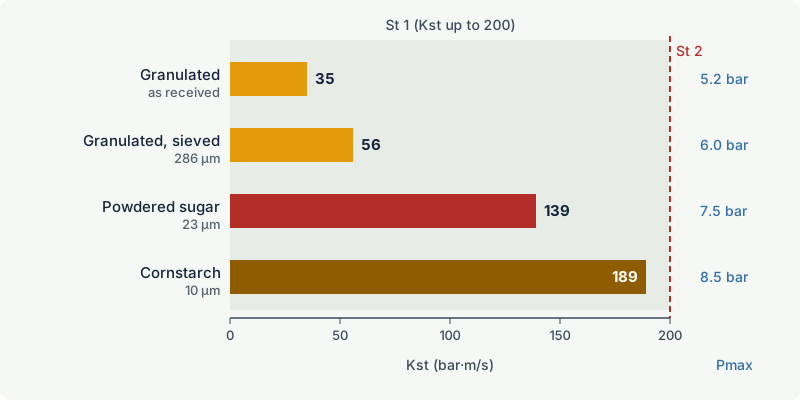
Yes. Fine sugar dust is explosible: in tests for the 2008 Port Wentworth investigation, powdered sugar reached 7.5 bar and Kst 139 bar·m/s. Coarse granulated sugar is less violent, but handling creates fines, and settled sugar dust fuelled that disaster.
Yes. Fine sugar dust is an explosible dust: powdered (icing) sugar and the fine dust produced when granulated sugar is ground, conveyed and packed can form clouds that explode with pressures of several bar. Coarse granulated sugar as sold is much less reactive, but handling always creates fines, and settled sugar dust fuelled the 2008 refinery explosion at Port Wentworth, Georgia, which killed 14 workers.
Short answer
- In tests carried out for the US Chemical Safety Board (CSB) investigation, powdered sugar (mean particle size 23 µm) reached a maximum explosion pressure of 7.5 bar and a Kst of 139 bar·m/s, and ignited with sparks of between 10 and 30 mJ.
- Granulated sugar as received still exploded in the test (5.2 bar, Kst 35 bar·m/s) but was far harder to ignite by spark (minimum ignition energy above 1000 mJ).
- All these samples are in explosion class St 1. St 1 means a slower pressure rise than St 2 or St 3, not a harmless dust: several bar is far more than a building can withstand.
- The danger is greatest inside mills, conveyors, bucket elevators, silos, dust collectors and packing machines, and in buildings where sugar dust has been allowed to settle on floors, beams and pipes.
How explosive is sugar dust?
The CSB had four samples from the refinery tested to ASTM methods in the standard 20 litre apparatus:
| Sample (CSB investigation) | Mean particle size | Pmax | Kst | MEC | MIE |
|---|---|---|---|---|---|
| Granulated sugar, as received | not determined | 5.2 bar | 35 bar·m/s | 115 g/m³ | above 1000 mJ |
| Granulated sugar, sieved below 500 µm | 286 µm | 6.0 bar | 56 bar·m/s | 115 g/m³ | above 1000 mJ |
| Powdered sugar | 23 µm | 7.5 bar | 139 bar·m/s | 95 g/m³ | 10 to 30 mJ |
| Cornstarch | 10 µm | 8.5 bar | 189 bar·m/s | 105 g/m³ | 10 to 30 mJ |
Pmax is the maximum explosion overpressure in a closed vessel, Kst the normalised rate of pressure rise, MEC the minimum explosible concentration and MIE the minimum ignition energy. The table shows the effect of particle size directly: grinding sugar to a fine powder roughly quadruples Kst compared with granulated sugar as received and brings the ignition energy down into a range that an electrostatic spark can reach. A spark from a charged, ungrounded person is of the order of 10 mJ or more.
Powdered sugar usually also contains a little starch as an anti-caking agent (the refinery's product contained about 3 % cornstarch), which is itself an explosible dust. Database values, for example in GESTIS-DUST-EX, each describe one sample and change with fineness and moisture, so design values should come from tests on your own material, see What makes a dust explosive?
What happened at Port Wentworth in 2008
On 7 February 2008 a series of explosions destroyed the packing buildings of a sugar refinery near Savannah, Georgia. Fourteen workers died and many more were injured, several with severe burns. The CSB concluded that:
- The primary explosion most likely occurred inside a steel belt conveyor beneath two sugar silos. The conveyor had been enclosed with steel panels the year before, without dust removal or explosion venting, so sugar dust could build up inside it above its minimum explosible concentration.
- The most likely ignition source was an overheated bearing on the conveyor, although damage prevented confirmation.
- The blast lifted sugar and sugar dust that had accumulated throughout the packing buildings, from spills up to knee deep around equipment and dust on elevated surfaces, and caused secondary explosions that spread through the buildings.
- Conveying equipment was not designed or maintained to keep dust and spills out of work areas, housekeeping was poor, and earlier warnings and small incidents had not led to corrective action.
The CSB also notes that sugar lying on a floor does not explode by itself: it becomes dangerous when a disturbance throws it into the air. That is why a small event inside one conveyor could destroy whole buildings. The investigation is covered in What caused the Port Wentworth sugar refinery explosion in 2008?
Where the risk sits in a sugar or confectionery plant
- Sugar mills and pulverisers making icing sugar: fine powder, mechanical ignition sources and a cloud in normal operation.
- Silos, hoppers and bucket elevators: dust clouds during filling and emptying, with friction, hot bearings and tramp metal as ignition sources.
- Dust collectors serving mills and packing lines: fine, dry dust in a cloud at every cleaning pulse.
- Enclosed conveyors and transfer points: as Port Wentworth showed, enclosing a conveyor without dust extraction and venting can create a new explosion hazard.
- Packing rooms and buildings: layers on floors, beams, pipes and light fittings provide the fuel for secondary explosions.
The usual measures are dust-tight equipment with extraction, explosion venting or suppression with isolation on the vessels, earthing of plant and personnel where fine powder is handled, Ex equipment selected for the dust zones, and housekeeping that removes layers before they build up. These are discussed in Dust collectors, silos and bucket elevators.
Common mistakes
- "Sugar is food, not a chemical." Sugar, starch and flour are classic explosible dusts.
- "Granulated sugar is too coarse." It still exploded in the test, and conveying and grinding produce the fines that settle in buildings.
- "St 1 is low risk." Port Wentworth involved St 1 dusts.
- Enclosing equipment to keep dust in, without extraction or venting. The enclosure can become the place where the primary explosion starts.
Related on excodex
- What makes a dust explosive? Particle size, concentration and the dust explosion pentagon
- Dust collectors, silos and bucket elevators: where dust explosions start
- What caused the Port Wentworth sugar refinery explosion in 2008?
- Why is a secondary dust explosion usually worse than the first?
- Why can an St 1 dust still cause a devastating explosion?
Standards and further reading
- EN 14034 series and ASTM E1226, E1515 and E2019: test methods for explosion pressure and Kst, minimum explosible concentration and minimum ignition energy of dust clouds.
- IEC 60079-10-2, classification of areas with explosive dust atmospheres.
- NFPA 660, combustible dusts (2025; supersedes NFPA 61 for agricultural and food processing facilities, NFPA 652 and NFPA 654).
- US Chemical Safety Board, Port Wentworth sugar refinery dust explosion and fire (2008), investigation page: csb.gov, and final report (2009): csb.gov (PDF)
- IFA, explanation of the GESTIS-DUST-EX explosion characteristics: dguv.de (PDF)
This article is general technical information prepared by the excodex editorial team. It does not replace the applicable standards, the equipment certificates and instructions, national regulations or the assessment of a competent person.