Does a dust layer create a zone, or only a dust cloud?
Abstract
Only a dust cloud defines a zone. A layer is not an explosive atmosphere, but it is a source that can be raised into one and must be considered in the classification. Where layers persist, the area around them is usually classified at least Zone 22.
Only a dust cloud defines a zone: Zones 20, 21 and 22 describe how often an explosive cloud of combustible dust in air is present. A layer is not an explosive atmosphere in itself, but it is a source that can be raised into one, and both the EU workplace directive and IEC 60079-10-2 require layers to be taken into account. Where layers are allowed to persist, the area around them is usually classified as at least Zone 22.
Short answer
- The zone definitions refer only to a cloud of combustible dust in air. A settled layer does not meet them.
- Directive 1999/92/EC, Annex I, states that layers, deposits and heaps of combustible dust must be considered like any other source that can form an explosive atmosphere.
- IEC 60079-10-2 treats layers as one possible source of release for dust clouds and deals with the fire risk of layers separately.
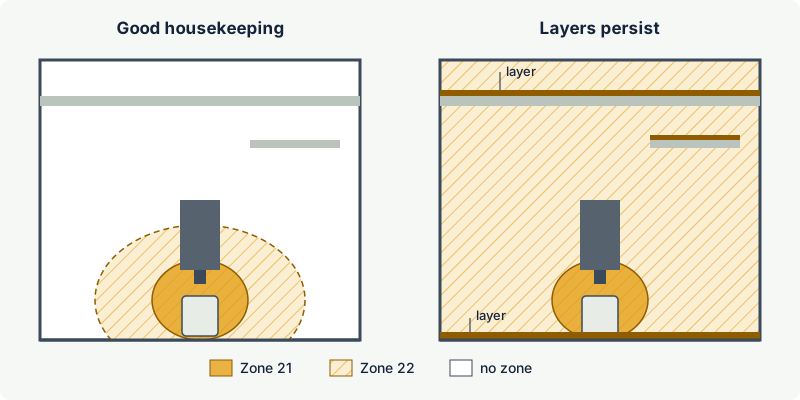
- Whether a layer changes the zones depends on the housekeeping level: negligible layers add nothing, layers that persist for more than a shift are a source in their own right.
- HSE guidance for inspectors (written for the rubber and plastics industries) classifies the whole room as Zone 22 where dust deposits regularly, with particular attention to high ledges and beams.
- A layer is also a fire hazard: on a hot surface it can smoulder and later ignite a cloud, so equipment temperatures must allow for it.
Why the zone is drawn around the cloud, not the layer
A dust explosion needs particles dispersed in air at a concentration above the minimum explosible concentration, so that a flame can run from particle to particle. In a layer the dust lies at its bulk density with very little air between the grains. It can burn or smoulder, but it cannot explode as it lies. That is why the zone definitions of Directive 1999/92/EC and IEC 60079-10-2 speak of a cloud.
The problem is how little dust a cloud needs. A layer under 1 mm thick, spread through the height of a room, can exceed the minimum explosible concentration of many dusts (see Dust layers and housekeeping). HSE guidance notes that layers can form even when no single release is large enough to form a visible cloud, and that they can be lifted by rapid air movement, for example from a fan or a compressed air line. In the worst case a small primary explosion shakes dust off every ledge and feeds a secondary explosion.
So the layer is not the zone, but it decides where a cloud can appear: where layers form, how thick they get, how long they stay and what could disturb them.
How layers enter the classification
IEC 60079-10-2 states that its examples assume effective housekeeping that stops layers from accumulating. Where that is not the case, the classification must include clouds that can form from layers. The standard describes three housekeeping levels in an informative annex on dust layer hazards; the Irish Health and Safety Authority (HSA) summarises them, from the 2015 edition, as follows:
| Housekeeping level | Layers | Effect on the zones |
|---|---|---|
| Good | Negligible thickness or none, whatever the grade of release | Layers add no cloud and no fire risk; zones follow from the process sources |
| Fair | Not negligible but short-lived, typically less than one shift | Dust is removed before a fire can start; clouds raised from layers still need to be considered |
| Poor | Not negligible and persisting, typically more than one shift | Layers are a source of release; fire and secondary explosion risk may be significant |
In practice the result is usually Zone 22, because a cloud raised from a layer needs a disturbance that is not part of normal operation and settles again quickly. HSE guidance for inspectors in the rubber and plastics industries gives working rules that are widely applied:
- To find the extent of Zone 22, determine where dust regularly collects. A room with any regular deposits is Zone 22 throughout.
- Pay particular attention to high-level ledges, beams and light fittings. If dust dislodged from them could form a large cloud, the whole room is Zone 22.
- An adjacent room with no dust release of its own, such as an office or control room, can stay unclassified if it is kept permanently clean and its door is kept closed.
- Dust that readily absorbs water is harder to raise once settled, which can be taken into account.
Layers as a fire and ignition source
The scope of IEC 60079-10-2 treats explosive dust atmospheres and combustible dust layers separately, because layers create a second hazard: they can ignite and then act as an ignition source for a cloud. A layer on a motor, a lamp or a steam line insulates the surface and can start to smoulder well below the ignition temperature of a cloud of the same dust. If the smouldering layer is later disturbed, the glowing particles can ignite the cloud that forms around them.
This is why equipment selection under IEC 60079-14 limits the maximum surface temperature of equipment both to two thirds of the cloud ignition temperature and to the ignition temperature of a 5 mm layer minus 75 K, with lower limits where thicker layers can form. The IEC definition of "poor" housekeeping carries the same message: the fire risk may be significant and is controlled by selecting equipment according to IEC 60079-14. The full rule is in Surface temperature limits for dust.
Practical case: a packing hall
A sack filler releases a puff of dust with each sack, giving a small Zone 21 at the spout. If the floor and the cable trays at 6 m are vacuumed every shift, the rest of the hall may need only local Zone 22 at leak points. If the trays and beams carry a film of dust cleaned once a month, those layers are a source of release: the whole hall becomes Zone 22, and every luminaire and motor in it needs EPL Dc or better with a surface temperature that suits layers. Stopping the leaks and scheduling high-level cleaning is usually the cheaper fix.
Common mistakes
- "No visible cloud, so no zone." Persistent layers are a source of release even if a cloud is never seen in normal operation.
- Inspecting only the floor. The finest dust settles on high ledges, beams, cable trays and above suspended ceilings, and it disperses well when it falls.
- Drawing the layer itself as the zone. The zone is the volume where a cloud raised from the layer can exist, often the whole room, not a thin band over the floor.
Related on excodex
- Dust zones 20, 21 and 22 explained with practical examples
- Dust layers and housekeeping: how thick is too thick?
- Can good housekeeping reduce a Zone 22 to a non-hazardous area?
- Why is a secondary dust explosion usually worse than the first?
- Standards spaces: IEC 60079-10-2, ATEX 1999/92/EC
Standards and further reading
- IEC 60079-10-2:2026 (edition 3.0, June 2026, replaces the 2015 edition), classification of areas for explosive dust atmospheres; scope on layers as a source of release and informative Annex C on dust layer hazards and levels of housekeeping: preview (ANSI webstore)
- IEC 60079-14, selection of equipment, including surface temperature limits for dust layers.
- Directive 1999/92/EC, Annex I, zone definitions and the note on layers, deposits and heaps: legislation.gov.uk
- Health and Safety Authority (Ireland), ATEX delivery guide, combustible dust: hsa.ie
- HSE, area classification for explosible dusts in the rubber and plastics industries (guidance for inspectors): hse.gov.uk
- HSE, HSG103 Safe handling of combustible dusts: hse.gov.uk (PDF)
- IEC Common Data Dictionary, housekeeping level "poor": electropedia.org
This article is general technical information prepared by the excodex editorial team. It does not replace the applicable standards, the equipment certificates and instructions, national regulations or the assessment of a competent person.