When is an explosion vent required on a dust collector?
Abstract
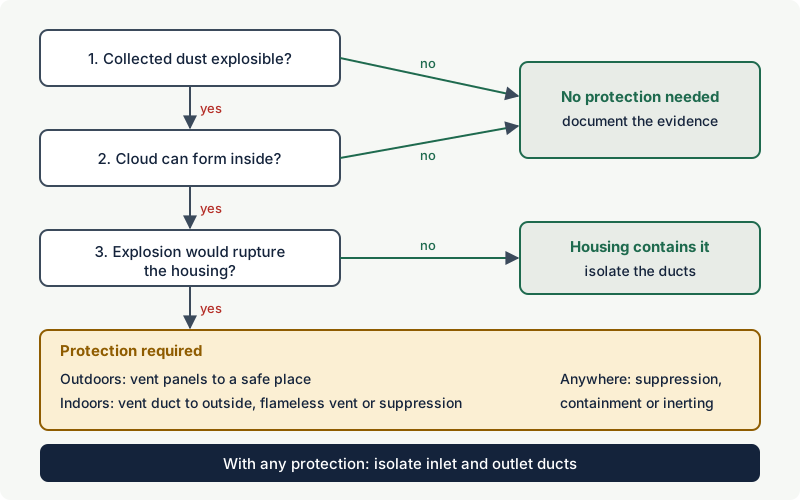
When the collector handles an explosible dust, an explosive cloud can form inside it and an explosion would rupture it, unless another protective measure is used: suppression, containment or inerting. Vents must discharge to a safe place, usually outdoors.
An explosion vent, or another explosion protection measure, is needed whenever a dust collector handles an explosible dust, an explosive dust cloud can form inside it, and an explosion would burst the housing. That describes almost every dry filter or cyclone collecting combustible dust. Venting is not mandatory as such: suppression, an explosion-pressure-resistant design or inerting can do the same job. What is not acceptable is a collector of explosible dust with no protection at all.
Short answer
- First question: is the collected dust explosible? Test the dust actually collected, because filter fines are often finer and more reactive than the product.
- Second: can an explosive cloud form inside? HSE notes that cyclones and filters are likely to contain an explosive atmosphere somewhere, even when the concentration in the duct is below the lower explosible limit. Pulse cleaning and hopper discharge create clouds.
- Third: would an explosion rupture the housing? HSE gives typical maximum overpressures of dust explosions of 8 to 10 bar, far more than an ordinary filter housing withstands.
- If all three are "yes", a protective measure is required. HSE guidance states that explosion vents are normally needed for filters handling dusts that can explode.
- Venting is the usual choice outdoors. Indoors, use a vent duct to the outside, flameless venting, suppression or containment.
- Vent area is calculated with EN 14491 or NFPA 68 from the volume, Kst, Pmax, the vent opening pressure and the pressure the housing can withstand.
- Isolation of the connected ducts is needed in addition, whichever measure is chosen; a vent protects only the collector.
Why collectors need explosion protection
A dust collector concentrates the finest, most easily ignited fraction of the dust in the plant and repeatedly disperses it: every pulse-jet cleaning cycle and every discharge through the hopper raises a cloud. The dirty side is therefore usually classified Zone 20, or at least Zone 21. Ignition sources are hard to rule out completely, because sparks and hot particles from grinding, sanding or dryers travel along the ducts, and a collector can also be ignited by friction, static discharges from unearthed filter cages or a fire in the collected dust.
The law expects prevention first. Directive 1999/92/EC requires employers to prevent explosive atmospheres or, where that is not possible, to avoid their ignition, and then to mitigate the effects of an explosion. Inside a collector the first step is impossible in practice and the second cannot be relied on alone, so mitigation is needed. In the United States, the NFPA dust standards, consolidated in December 2024 into NFPA 660 (2025), require a dust hazard analysis and, where it shows a deflagration hazard in equipment, protection by the methods of NFPA 68 (venting) or NFPA 69 (suppression, isolation, containment and other prevention methods), with isolation devices between connected equipment.
When a vent may not be needed
A collector can be left without a vent when one of the conditions above is clearly not met, or when another measure takes its place:
| Situation | Why venting may not be needed | What must be shown |
|---|---|---|
| Dust tested as not explosible | No explosion possible | Test of the collected dust, repeated when the product or process changes |
| Explosion suppression fitted | The explosion is extinguished inside | Certified system designed for the collector, dust and Kst |
| Housing built to withstand the explosion (containment) | Pressure is contained | Explosion-pressure-resistant design, connected parts included |
| Inerting | Oxygen kept below the limit for the dust | Continuous oxygen monitoring and interlocks |
| Wet collector | Dust is captured in liquid | No dry deposits in ducts or on the clean side; check reactive metal dusts separately |
| Special cases in a specific code | Some codes allow conditional exceptions, for example for enclosureless collectors under NFPA rules | Every condition met and documented under the code edition that applies |
The US grain handling standard illustrates the choice in regulatory form: filter collectors installed after 30 March 1988 must be located outside, or inside in an area protected by explosion suppression, or in an area with at least one hour fire-resistant separation, against an outside wall and vented to the outside.
What a vent design needs
Vent sizing uses EN 14491 (2012) in Europe or NFPA 68 (2023) in the United States; their equations differ, so one method should be used consistently. The inputs are:
- the dirty-side volume and shape of the collector,
- the dust's Kst and Pmax from tests of the collected dust,
- the static opening pressure Pstat and the certified efficiency of the vent panel,
- the reduced explosion pressure Pred, which must stay below the pressure the housing can withstand.
The worked example in Dust explosion protection shows a 10 m³ bag filter needing about 0.4 m² of effective vent area, and how quickly the area grows with a weaker housing or a more reactive dust. Vents should be placed on the dirty side, discharge to a place where nobody regularly goes, and be followed by fan and conveyor trips when they open. In the EU, vent panels and other protective systems placed on the market separately are covered by Directive 2014/34/EU and come with certificates and instructions that define their limits.
Common mistakes
- Using product data instead of filter fines. The dust in the collector is often much more explosive than the bulk product.
- Venting indoors. An open vent inside a building releases a fireball and can raise settled dust into a secondary explosion.
- Forgetting isolation. A vented collector can still push flame back through the inlet duct to the work area.
- Changing the dust without reviewing the vent. A new product or a finer grind can raise Kst beyond the design value.
Related on excodex
- Dust explosion protection: venting, suppression, isolation and containment
- Dust collectors, silos and bucket elevators: where dust explosions start
- Can an explosion vent discharge inside a building?
- Why does a vented dust collector still need isolation on the inlet duct?
- Which dust test results do you need to select Ex equipment and size explosion vents?
Standards and further reading
- EN 14491:2012, dust explosion venting protective systems: standards.ie
- NFPA 68 (2023 edition), explosion protection by deflagration venting: standards.ie; NFPA 69, explosion prevention systems.
- NFPA 660 (2025), combustible dusts and particulate solids (replaced NFPA 61, 484, 652, 654, 655 and 664).
- HSE, HSG103 Safe handling of combustible dusts (filters, venting, siting): hse.gov.uk (PDF)
- Directive 1999/92/EC, Article 3, order of prevention and protection measures: legislation.gov.uk
- OSHA 29 CFR 1910.272, grain handling facilities, paragraph (l) on filter collectors: osha.gov
- NFPA 652, first revision record for the 2019 edition (dust hazard analysis, isolation, relief devices not venting into hazard areas), since replaced by NFPA 660 (2025): nfpa.org (PDF)
This article is general technical information prepared by the excodex editorial team. It does not replace the applicable standards, the equipment certificates and instructions, national regulations or the assessment of a competent person.