How many air changes per hour make a room adequately ventilated?
Abstract
No fixed number. IEC 60079-10-1 sets no air change rate: the air flow needed depends on the release rate, the LFL and the mixing in the room. Figures such as 6 air changes per hour come from US codes, which also require the result to stay below 25 % of the LFL.
There is no air change rate that makes a room adequately ventilated by itself. IEC 60079-10-1 does not set one: the ventilation needed depends on how much flammable gas or vapour can be released, its lower flammable limit (LFL) and how well the air mixes. Rules of thumb such as 6 air changes per hour come from US codes and are tied to a performance test, keeping the concentration below 25 % of the LFL; a small room with a large possible leak can need many times that.
Short answer
- IEC 60079-10-1 and ATEX: no air change figure. The assessor calculates the dilution for each release and, indoors, checks that the background concentration stays below a critical value, most often 25 % of the LFL.
- US practice: NFPA 497 has defined adequate ventilation as 6 air changes per hour or 1 cubic foot per minute per square foot of floor area, with the intent of preventing accumulations above 25 % of the LFL. API RP 500 defines adequate ventilation by the same 25 % LFL criterion. Check the current editions before use.
- The same air change rate gives very different results in a small and a large room, because the air flow scales with room volume while the release does not.
- Reliability matters as much as rate: UK guidance (HSE L138) expects mechanical ventilation to be monitored, with flow failure detection and alarm.
- Research behind UK practice agrees: HSE research for the Energy Institute code EI 15 found the air-change approach inappropriate because it is not related to the size of the release, and proposed limiting the average concentration in the enclosure to 25 % of the LFL, with a factor for mixing efficiency.
Why a fixed air change rate does not work
An air change rate is the ventilation air flow divided by the room volume. Dilution, however, depends on the air flow compared with the gas flow from the leak. A simple mass balance, the basis of the indoor background concentration check in IEC 60079-10-1 and of the HSE research for EI 15, gives the average concentration Xb approximately as
Xb ≈ f × Qg / Qa
where Qg is the volume flow of released gas, Qa the ventilation air flow and f a factor for imperfect mixing (1 for ideal mixing, higher for poor mixing). The room volume does not appear. Six air changes per hour in a 600 m³ hall moves ten times more air than the same rate in a 60 m³ plant room, so the large room can dilute a leak ten times larger.
The background check is only part of the method. The standard also compares the release with the ventilation velocity on its dilution chart to decide between high, medium and low dilution, and it rates the availability of the ventilation separately. A room with plenty of air changes can still fail the assessment if the extract is in the wrong place or the fan can stop unnoticed.
Worked example: what 6 air changes per hour can handle
Natural gas, treated as methane: LFL 4.4 % by volume (excodex library), density about 0.67 kg/m³ at 20 °C. Critical background concentration 25 % of the LFL, that is 1.1 % by volume. Mixing factor f = 2. The values are illustrative.
Room A, 60 m³ plant room at 6 air changes per hour. Air flow 360 m³/h, or 0.1 m³/s. The largest gas flow that keeps Xb at 1.1 % is 0.011 × 0.1 / 2 = 0.00055 m³/s, about 0.37 g/s of methane. A secondary release of 0.5 g/s would need about 8 air changes per hour; one of 0.05 g/s would need less than 1.
Room B, 600 m³ hall at 6 air changes per hour. Air flow 3600 m³/h, ten times more. The tolerable release rises to about 3.7 g/s.
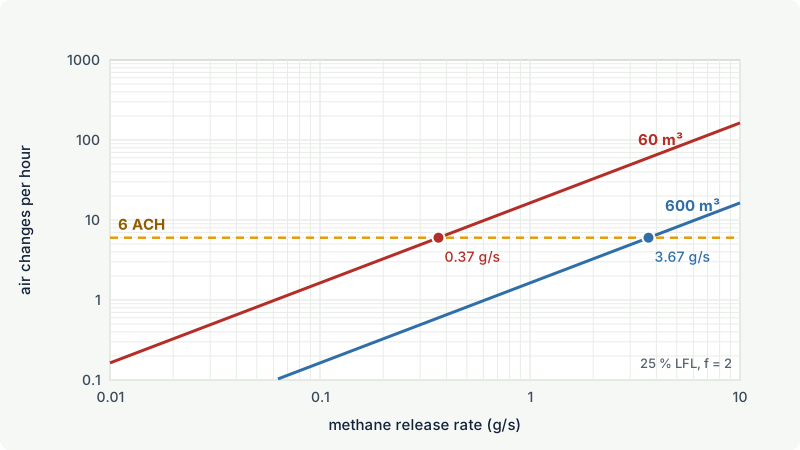
The air change rate that is "adequate" therefore depends entirely on the release you have to dilute. Start from the credible releases (hole size, pressure, gas) and work out the air flow; then express it as air changes per hour if a figure is needed for the building services specification.
What the codes and guidance say
| Source | What it says about ventilation rate |
|---|---|
| IEC 60079-10-1:2020 | no air change figure; dilution assessed from the release characteristic and ventilation velocity, plus a background concentration check indoors; guidance in an informative annex |
| NFPA 497 (US) | has defined adequate ventilation as 6 air changes per hour or 1 cfm per square foot of floor area, intended to keep concentrations below 25 % of the LFL; area classification should not be relaxed if that is not achieved |
| API RP 500 (US, divisions) | adequate ventilation is ventilation sufficient to prevent accumulations above 25 % of the LFL; inadequate ventilation is defined against a specified minimum number of air changes |
| HSE L138 (Great Britain, DSEAR) | ventilation should dilute foreseeable releases to a safe level; mechanical ventilation should be monitored with flow failure detection and alarm; no fixed rate |
Sector codes for specific installations, such as battery rooms or gas installations, have their own calculation methods. Where one applies, use it rather than a general rule of thumb.
Common mistakes
- Quoting "6 ACH" as an ATEX or IEC requirement. It is a US code value tied to a 25 % LFL performance criterion.
- Ignoring the size of the release. No air change rate is adequate for a large or high-pressure leak in a small room.
- Extracting at the wrong height. High level for lighter-than-air gases such as methane and hydrogen, low level for heavier vapours.
- Counting the air flow but not its reliability. A single unmonitored fan can stop unnoticed, which lowers the availability rating whatever its rate.
Related on excodex
- Ventilation in area classification: degree of dilution and availability
- Estimating the extent of a hazardous zone: release rates and dilution
- Can ventilation make a Zone 2 area non-hazardous?
- How is the required ventilation of a battery room calculated?
- Tools: methane in the gas library, standards spaces IEC 60079-10-1, API RP 505
Standards and further reading
- IEC 60079-10-1:2020, Classification of areas, explosive gas atmospheres (clause 7 and Annex C on ventilation): iteh.ai sample
- IEC 60079-13:2017, Equipment protection by pressurized room "p" and artificially ventilated room "v".
- NFPA 497, Recommended practice for the classification of flammable liquids, gases or vapors and of hazardous locations; discussed in IAEI Magazine, 5 methods of protection, 2012: iaeimagazine.org
- API RP 500 and API RP 505, definitions of adequate and inadequate ventilation, as compiled in the IADC Lexicon: iadclexicon.org
- HSE, RR993 Technical input on ventilation effectiveness for area classification guidance EI15 (air changes not related to release size; 25 % LFL average concentration; mixing efficiency factor): hse.gov.uk
- HSE, L138 Dangerous substances and explosive atmospheres, Approved Code of Practice on ventilation: hse.gov.uk
- HSE, Hazardous area classification and control of ignition sources: hse.gov.uk
This article is general technical information prepared by the excodex editorial team. It does not replace the applicable standards, the equipment certificates and instructions, national regulations or the assessment of a competent person.