How is the required ventilation of a battery room calculated?
Abstract
For stationary lead-acid and NiCd batteries, IEC/EN IEC 62485-2 gives Q = 0.05 x n x Igas x Crt x 10^-3 m³/h (n cells, Igas gassing current in mA/Ah from the standard's table, Crt capacity in Ah). Natural ventilation needs inlet and outlet openings of at least 28 x Q cm² each.
For stationary lead-acid and nickel-cadmium batteries, the air flow comes from IEC 62485-2 (EN IEC 62485-2 in Europe): Q = 0.05 x n x Igas x Crt x 10⁻³ in m³/h, where n is the number of cells, Igas the gassing current in mA per Ah taken from the standard's table for the battery type and charging mode, and Crt the rated capacity in Ah. The result keeps the hydrogen far below its lower explosive limit of 4 % by volume. For natural ventilation, the inlet and the outlet each need a free area of at least A = 28 x Q in cm².
Short answer
- Formula: Q = v x q x s x n x Igas x Crt x 10⁻³, which simplifies to Q = 0.05 x n x Igas x Crt x 10⁻³ (m³/h).
- Constant 0.05: dilution factor v = 24 (from 100 % hydrogen down to 4 %), hydrogen yield q = 0.42 x 10⁻³ m³ per Ah at 0 °C, and a general safety factor s = 5.
- Igas: not the charger current, but the part of the current that produces gas, per Ah of capacity; it depends on battery type (vented or valve-regulated) and on float or boost charge. Use the boost value if the charger can boost.
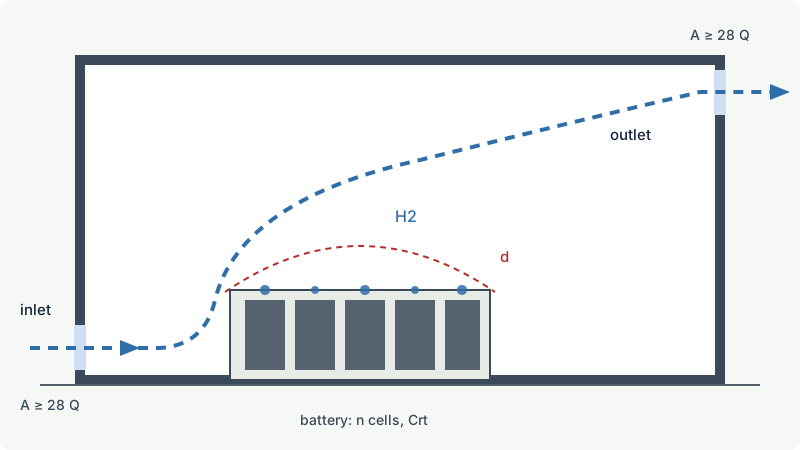
- Natural ventilation: free inlet and outlet areas of A ≥ 28 x Q cm² each, inlet low, outlet high, on opposite walls or well apart.
- Near the cell vents dilution is not assured, so the standard also sets a safety distance free of ignition sources.
- Traction batteries (forklift charging) use IEC 62485-3, where the gassing current is derived from the charger; lithium-ion batteries do not gas in normal charging and are covered by IEC 62485-5.
Where the formula comes from
Once a lead-acid or nickel-cadmium cell is full, further charging current electrolyses water. By Faraday's law, 1 Ah decomposes water into about 0.42 litres of hydrogen and 0.21 litres of oxygen at 0 °C and 1013 hPa. The ventilation must dilute that hydrogen:
| Term | Value | Meaning |
|---|---|---|
| v | 24 | (100 % - 4 %) / 4 %: air needed per volume of hydrogen to stay at 4 % |
| q | 0.42 x 10⁻³ m³/Ah | hydrogen generated per Ah at 0 °C |
| s | 5 | general safety factor |
| n | number of cells | a 2 V lead-acid cell counts as one; a 12 V block has six cells |
| Igas | mA per Ah | gassing current from the table of IEC 62485-2 |
| Crt | Ah | rated capacity (C10 for lead-acid, C5 for NiCd) |
v x q x s = 24 x 0.00042 x 5 = 0.0504, rounded to 0.05. The traction battery standard IEC 62485-3:2014 corrects q to 25 °C with the factor (T + 273)/273, about 1.09, and therefore writes its own formula with 0.055 (the 2010 edition used 1.095); some national calculation forms use the higher constant for stationary batteries too.
The safety factor of 5 covers uneven mixing and tolerances, but not local accumulation at the vents or in ceiling pockets, so opening positions and the safety distance still matter.
Worked example
A substation battery has n = 55 vented lead-acid cells of Crt = 400 Ah (C10). The charger can boost charge, so the design value is the boost-charge Igas for vented lead-acid cells, taken from the table of IEC 62485-2:
- Air flow: Q = 0.05 x 55 x Igas x 400 x 10⁻³ = 1.1 x Igas m³/h, with Igas in mA/Ah. Every 1 mA/Ah of gassing current needs 1.1 m³/h of air for this battery.
- Natural ventilation: A = 28 x Q = 30.8 x Igas cm² of free area for the inlet and the same for the outlet, after deducting louvre blades and mesh.
- Forced ventilation: a fan extracting at least Q, with the air inlet positioned to sweep the room; interlocking the charger or an alarm with fan failure keeps the assumption valid.
- Sense check: in a 30 m³ room, each mA/Ah of Igas corresponds to less than 0.04 air changes per hour; the design effort goes into where the air enters and leaves.
Because Q is proportional to Igas, a boost value several times the float value multiplies the required air flow by the same factor.
Placing the openings and the safety distance
The Swiss accident insurer Suva, applying SN EN 62485-2 and -3, describes the practical layout: two openings with at least the calculated free area, the inlet close to the floor (no more than about 10 cm above it) and the outlet close to the ceiling (no more than about 10 cm below it), on opposite walls or at least 2 m apart if on the same wall. It also notes that the required air flow can be halved where gas recombination plugs are fitted. The 28 x Q rule itself assumes an air velocity of about 0.1 m/s through the openings (Q in m³/h divided by 3,600 and by 28 x Q x 10⁻⁴ m² gives 0.099 m/s).
Close to the battery, the formula's dilution does not yet apply. IEC 62485-2 therefore calculates a safety distance around cell vents (in an annex) within which sparks, arcs, glowing parts and hot surfaces are not allowed; Suva describes the area of poor dilution as extending up to about 1 m from the battery. Chargers, switches, sockets and light fittings belong outside it.
Common mistakes
- Using the charger current as Igas. For stationary batteries Igas comes from the standard's table per Ah of capacity.
- Sizing on float only when the charger can boost or equalise.
- Counting 12 V blocks as one cell. n is the number of cells.
- Outlet below a ceiling pocket or downstand beam, where hydrogen collects.
- Applying the formula to lithium-ion rooms. Their hazard is thermal runaway gas.
Related on excodex
- Battery rooms and charging areas: hydrogen ventilation and hazardous areas
- Ventilation in area classification: degree of dilution and availability
- Is a lead-acid battery room a hazardous area, even with sealed VRLA batteries?
- Is a forklift battery charging area a hazardous zone?
- Tools: hydrogen in the gas library
Standards and further reading
- IEC 62485-2:2010, safety requirements for secondary batteries and battery installations, Part 2: stationary batteries (EN IEC 62485-2:2018, which superseded EN 50272-2:2001): iteh.ai sample
- IEC 62485-3:2014 (edition 2.0), Part 3: traction batteries; the preview shows the derivation of the constants: iteh.ai sample
- IEC 62485-5:2020, Part 5: safe operation of stationary lithium-ion batteries.
- Suva, ventilation measures when charging lead-acid batteries (in French): suva.ch
- Trade article on battery room ventilation (in German, 2003, based on EN 50272-2, the predecessor of EN IEC 62485-2; the only public source found for the formula details): elektropraktiker.de
This article is general technical information prepared by the excodex editorial team. It does not replace the applicable standards, the equipment certificates and instructions, national regulations or the assessment of a competent person.