Is a lead-acid battery room a hazardous area, even with sealed VRLA batteries?
Abstract
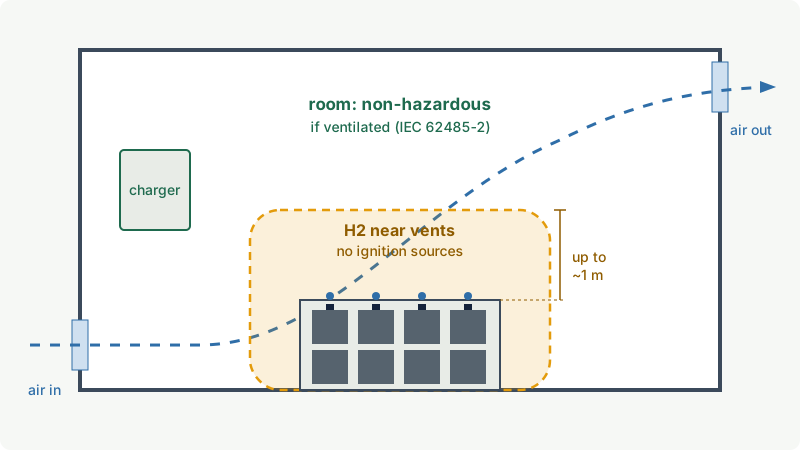
Normally the room as a whole is not, if it is ventilated to IEC 62485-2. The space close to the cells is: ignition sources stay out of a calculated safety distance, and UK HSE guidance treats up to 1 m around batteries on charge as Zone 1. VRLA cells gas less, not zero.
Usually not as a whole room, but always in a small space around the cells. A lead-acid battery room ventilated to IEC 62485-2 (EN IEC 62485-2) is normally treated as non-hazardous, while the space close to the cell vents is where hydrogen can reach a flammable concentration during charging. Valve-regulated (VRLA, "sealed") batteries release much less hydrogen than vented ones, but not none, so the same logic applies to them.
Short answer
- Room: with ventilation sized by the IEC 62485-2 formula, and any forced ventilation proven to run whenever charging is possible, the room is normally not classified.
- Close to the cells: IEC 62485-2 keeps sparks, arcs, glowing parts and hot surfaces out of a calculated safety distance around the vent openings. UK HSE guidance on batteries says a Zone 1 should be considered to exist for up to one metre in all directions around batteries under charge.
- VRLA: most of the gas recombines inside the cell, but some hydrogen still escapes, and much more when the cells are overcharged, too hot or faulty. They still need ventilation and the safety distance.
- Ventilation not reliable: if the air flow cannot be ensured, the room must be classified with IEC 60079-10-1 like any other release, typically giving a zone in the upper part of the room where hydrogen collects.
Why the cells, not the room, are the hazardous place
As a lead-acid cell approaches full charge, the surplus current electrolyses water in the electrolyte into hydrogen and oxygen. Gassing rises steeply with cell voltage and temperature, so boost and equalising charges produce far more gas than float charge. Hydrogen has a lower explosive limit (LEL) of 4 % vol, a very low ignition energy, gas group IIC and temperature class T1, and it rises quickly to the ceiling.
IEC 62485-2 treats this as an explosion prevention problem. It sizes the room ventilation so that the average hydrogen concentration stays far below the LEL, with a dilution factor and a safety factor built into its formula. Right at a vent cap, however, the gas has not yet mixed with the room air. That is why the standard has a separate clause on the close vicinity of the battery and an annex that calculates a safety distance d from the gassing current and the cell capacity.
Swiss accident insurance guidance on lead battery charging says the same in plain words: when the ventilation requirement is met, charging rooms are not at risk of explosion, but within about 1 m of the battery dilution is not always guaranteed, so ignition sources should be avoided there. UK HSE's leaflet on storage batteries goes one step further and names that space: a Zone 1 for up to one metre around batteries under charge, with suitable equipment inside it, while good ventilation may allow everything beyond the immediate vicinity to be non-hazardous.
What changes with sealed VRLA batteries
A VRLA cell is designed so that oxygen from the positive plate recombines at the negative plate, which suppresses most hydrogen formation and means no water needs topping up. Recombination is not perfect. Industry information on VRLA degassing systems states that VRLA batteries still release a hydrogen and oxygen mixture during charging, at lower rates than vented batteries, and that hydrogen also escapes by diffusion. HSE describes valve-regulated batteries as much less likely to release hydrogen than vented ones, but warns that charging too fast or too long builds up gas pressure that the valve then releases.
In practice this means:
- Because VRLA cells gas less, the gassing current used for them in the IEC 62485-2 calculation is lower, so the required air flow and the safety distance are smaller, but the calculation is still done.
- Charger faults matter more than the battery type. A failed voltage regulator or high room temperature can push a VRLA string into heavy gassing and, at worst, thermal runaway.
- Some organisations still draw a small calculated Zone 1 around UPS batteries in their explosion risk assessment and keep electrical ignition sources out of it, while expecting only a negligible zone for small VRLA batteries in portable equipment.
- Where the vents are piped to a central degassing system, the safety distance applies at the end of the pipe.
How to decide for your room
- Calculate the air flow with the IEC 62485-2 formula for the real number of cells, capacity, battery type and the highest charging mode the charger can use. See how battery room ventilation is calculated.
- Check the ventilation is reliable: natural openings that cannot be closed, low inlet and high outlet, no ceiling pockets; forced extraction monitored, for example interlocked with the charger or alarmed.
- Keep ignition sources out of the space close to the cells: chargers, battery breakers, switches, relays, non-Ex luminaires and sockets. Mount them outside the safety distance or behind a partition.
- Record the result in the risk assessment or explosion protection document: room non-hazardous, the space around the cells defined, and what happens if the fan fails.
- Escalate to a full classification under IEC 60079-10-1 if adequate ventilation cannot be ensured.
US model codes take a similar line: the 2015 International Mechanical Code, aligned with the International Fire Code, required rooms with flooded lead-acid, nickel-cadmium or VRLA batteries to be ventilated so that hydrogen stays below 1 % of the room volume, a quarter of the LEL.
Common mistakes
- Calling VRLA batteries "gas-free". They gas less, and a charger fault can make them gas a lot.
- Mounting the charger or battery breaker directly above the cells. That puts switching contacts in the richest part of the hydrogen plume.
- Classifying the whole room as Zone 1 and buying Ex equipment for it instead of fixing the ventilation. The battery standards solve the problem by dilution.
- Switching off forced ventilation as soon as charging stops. Cells keep releasing gas for a while; Swiss guidance asks for at least one hour of extraction afterwards.
Related on excodex
- Battery rooms and charging areas: hydrogen ventilation and hazardous areas
- Hydrogen safety basics: wide flammable range, low ignition energy and invisible flames
- Is a forklift battery charging area a hazardous zone?
- What happens to the zone classification if the ventilation fan fails?
- Gas card: hydrogen; standards space: IEC 60079-10-1
Standards and further reading
- IEC 62485-2, safety requirements for secondary batteries and battery installations, Part 2: stationary batteries (EN IEC 62485-2:2018, which superseded EN 50272-2), including provisions against explosion hazards, the close vicinity of the battery and the safety distance annex: contents preview
- IEC 60079-10-1, classification of areas, explosive gas atmospheres
- HSE INDG139, Using electric storage batteries safely (rev. 2011), including the Zone 1 of up to one metre around batteries under charge: hse.gov.uk (PDF)
- Suva, ventilation measures when charging lead batteries (in French): suva.ch
- ZVEI information leaflet 26, degassing systems for VRLA batteries in stationary applications (2018): PDF
- Brzezińska, D., Ventilation system influence on hydrogen explosion hazards in industrial lead-acid battery rooms, Energies 11 (2018) 2086: mdpi.com
- International Code Council, 2015-2017 code change proposals quoting the hydrogen limit of 1.0 percent of the room volume for battery rooms (2015 International Mechanical Code 502.4.1, which referred to International Fire Code section 608): iccsafe.org (PDF)
This article is general technical information prepared by the excodex editorial team. It does not replace the applicable standards, the equipment certificates and instructions, national regulations or the assessment of a competent person.