What happens when pressurisation fails in a pressurised room?
Abstract
An alarm, then power isolation. Under IEC 60079-13 a pb room must automatically switch off all equipment not rated EPL Gb or better; a pc room may keep power for a limited time first. Defined administrative controls can replace the trip, and the room is purged before restart.
The room raises an alarm and then, depending on its level of protection, cuts power to everything inside that is not suitable for the surrounding zone. Under IEC 60079-13:2017, a room protected as pb (for Zone 1) must disconnect all equipment without EPL Ga or Gb automatically, while a room protected as pc (for Zone 2) may keep power on for a limited time and must disconnect it if pressurisation is not restored. Both may replace the shutdown by defined administrative controls, and the room must be purged again before the non-Ex equipment is switched back on.
Short answer
- What counts as failure: room pressure below 25 Pa against adjacent spaces, or loss of air flow at the fan discharge. Both must be detected and alarmed.
- pb room: automatic disconnection of all equipment that is not EPL Ga or Gb (Da or Db for dust), or continued operation under administrative controls.
- pc room: power may stay on for a limited duration; if pressurisation is not restored, disconnect all equipment that is not EPL Ga, Gb or Gc (or the dust equivalents), or continue under administrative controls.
- Restart: purge again (normally 10 room volumes) before re-energising; for pb the purge sequence is automatic.
- Ventilated rooms (v) with internal releases follow a separate table: isolate power or the internal source, or alarm and shut down after a limited time, depending on the zone the room would have without ventilation.
Detecting the failure
IEC 60079-13 asks for a pressure sensor inside the room, able to raise an alarm when the differential falls below 25 Pa, and a flow sensor at the fan discharge. An open door can collapse the pressure, so the alarm may be delayed while door switches show it open and enough air flows out through it. During a purge, a loss of pressure with a door open pauses the purge timer; if the loss lasts more than 60 s, the purge restarts from the beginning.
The safety devices themselves (pressurisation controls, power disconnection, fan and motor, gas detectors) must be suitable for the zone as if the room had no protection, because they must work exactly when gas may have entered. The pressurisation system must be powered independently of the room. The control system must tolerate a single fault for pb and be reliable in normal operation for pc; IEC 61508 and IEC 61511 may be used.
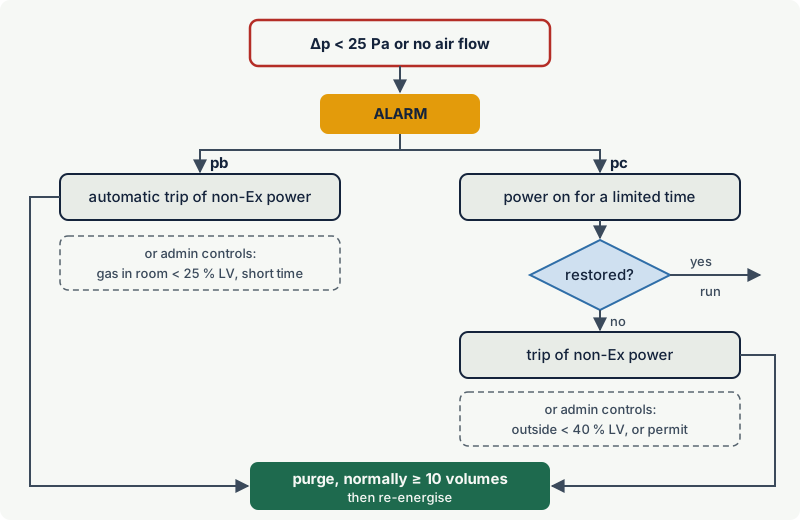
Actions for pb and pc rooms
| Pressurisation pb (room in Zone 1 or 21) | Pressurisation pc (room in Zone 2 or 22) | |
|---|---|---|
| Required action | Cut-off switch de-energises automatically all equipment without EPL Ga or Gb (Da or Db) | Power may continue for a limited duration; then de-energise all equipment without EPL Ga, Gb or Gc (Da, Db or Dc) |
| Shut-down device | Contacts disconnecting power automatically | Manual shutdown is acceptable |
| Examples of administrative controls given by the standard | Short continued operation while a door is open, with gas detectors confirming the room is below 25 % of the limiting value; short continued operation where immediate loss of power would create a more hazardous condition, with the same gas detection; work under permit | Continued power if the area outside the room is known not to have exceeded 40 % of the limiting value, for example confirmed by gas detection; work under permit |
The limiting value is the lowest lower flammable limit (LFL) of the flammable components that can be present. The "limited duration" for pc is not a number in the standard; it is set in the design and the risk assessment, together with who acknowledges the alarm and what they do. The draft third edition of IEC 60079-13 adds a requirement for a risk assessment of pressurisation or ventilation failure.
Rooms with internal releases: ventilation failure
Analyser houses and similar rooms protected by artificial ventilation "v" dilute releases from inside. When their ventilation fails, the action depends on the EPL the room would need without ventilation:
| Room without ventilation would need | Equipment inside | Action on loss of ventilation |
|---|---|---|
| EPL Gb | Not Ex rated | Isolate power or the internal source of release |
| EPL Gb | EPL Gc | Alarm; shut down power or source after a limited duration, unless gas detection or backup ventilation is provided (not for local extraction) |
| EPL Gc | Not Ex rated | Alarm; shut down power or source after a limited duration, with the same exceptions |
Gas detectors in a ventilated room must isolate power or the flammable supply at 25 % of the limiting value. Where loss of ventilation could let gas build up, audible and visual alarms must warn people not to enter, and the alarm must be audible inside so that people leave.
Equipment that must stay on, and restarting
Some circuits cannot simply be switched off, such as fire and gas detection and essential plant controls. IEC 60079-13 recognises this in an informative annex and says additional layers of protection can be required for them; for gas turbine enclosures it describes shutting off the flammable supply outside the enclosure and venting the internal piping to a safe place until power is off or protection is restored. It also requires measures against ignition after shutdown, for example equipment with hot surfaces above the ignition temperature, which can be handled by early shutdown so that equipment cools before gas approaches the LFL, or by auxiliary pressurisation.
Restarting follows the purge rules: clean air until gas is at most 25 % of the limiting value, normally at least 10 room volumes at no less than five air changes per hour; the purge time is marked at the isolating switch. After a short loss with no other abnormal situation, the user may judge administrative controls sufficient to confirm a gas-free room, but the means to purge must always be provided.
Common mistakes
- A bypass key on the trip that becomes permanent. Administrative controls must be defined in advance, not improvised.
- UPS-fed loads that keep running after the trip. Every non-Ex supply into the room, including batteries, must be included in the isolation.
- Restarting without a purge after a long outage, because the screens are needed.
Related on excodex
- Pressurised rooms and analyser houses: making an area non-hazardous by ventilation
- Pressurisation (Ex p): px, py and pz, purging and protective gas
- What overpressure must a pressurised room or analyser house maintain?
- What happens if the purge pressure is lost in an Ex p enclosure?
- Standards spaces: IEC 60079-13, IEC 61511
Standards and further reading
- IEC 60079-13:2017 (edition 2), clauses on action on pressurisation failure, safety devices, ignition prevention under system failure, ventilation failure (Table 3) and informative Annexes B and C: law.resource.org; IEC webstore
- Draft third edition, prEN IEC 60079-13 (adds a risk assessment for pressurisation or ventilation failure): standards.iteh.ai
- IEC 61508 and IEC 61511, functional safety, usable for the integrity of the safety devices
This article is general technical information prepared by the excodex editorial team. It does not replace the applicable standards, the equipment certificates and instructions, national regulations or the assessment of a competent person.