Do unused cable entries in an Ex d enclosure need certified stopping plugs?
Abstract
Yes. Each unused entry in a flameproof (Ex d) enclosure must be closed with a blanking element (stopping plug) certified for flameproof use, with the same thread form and size, fitted directly in the entry and removable only with a tool. Plastic transit caps are not acceptable.
Yes. An unused entry in a flameproof (Ex d) enclosure is an open hole into the space where an explosion is expected, so it must be closed with a certified flameproof blanking element, often called a stopping plug. The plug must match the entry's thread form and size, be screwed directly into the entry with enough threads engaged, and be removable only with a tool. The plastic caps that protect threads in transit are not blanking elements.
Short answer
- IEC 60079-14 requires unused openings to be closed with blanking elements suitable for the type of protection that comply with IEC 60079-0 and can be removed only with a tool (2007 edition, 9.6.4). For Ex e entries, the 2007 edition also required at least IP54 or the rating the location needs, whichever is higher. The 2024 edition adds an informative annex on the IP degree for each type of protection; check the edition you work to.
- For Ex d, IEC 60079-1 requires Ex equipment or Ex component blanking elements that keep the enclosure flameproof. An Ex component plug is acceptable only where the enclosure's certificate specifies it.
- The plug must be certified for flameproof use and for a gas group that covers the enclosure: a IIC plug can close a IIB entry, not the other way round.
- Same thread system and size: metric into metric, NPT into NPT. Mixing thread forms is a serious fault.
- IEC 60079-1 does not allow a blanking element to be fitted in a separately certified thread adapter. Interpretation sheet 1 (2020) clarifies that this does not apply to an adapter fitted and assessed by the manufacturer as part of the enclosure.
What makes a plug a flameproof blanking element
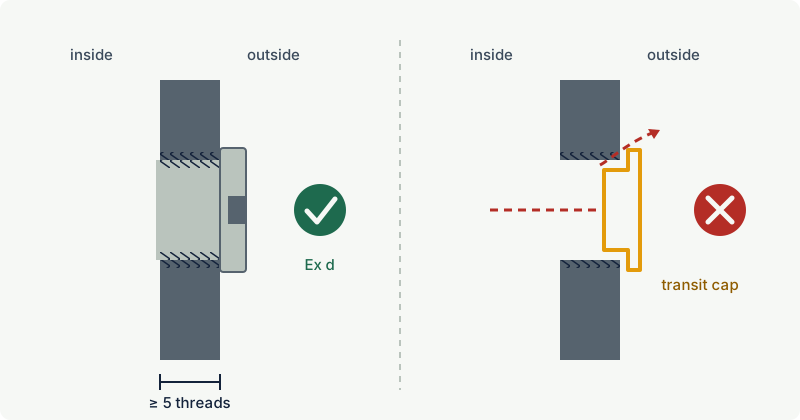
The threaded joint between plug and entry is a flamepath like any other. IEC 60079-1 sets the rules the plug is built and tested to:
- Thread length. External metric threads on entry devices are at least 8 mm long with at least eight full threads, so that at least five full threads are engaged once fitted.
- Retention. The plug must be removable from outside only after releasing a retaining device inside, or only with a tool, or by a method different from the one used to fit it. It must not be possible to pull it out by hand.
- Strength. Ex blanking elements are type tested for torque and with a static overpressure (3,000 kPa for Group II in the 2014 edition).
- Marking. The certificate and marking state the type of protection and gas group, for example a plug marked for
Ex db IIC.
A plug from a hardware store, a cable gland with no cable in it, or a plug certified only for increased safety (Ex e) does not meet these requirements.
Practical rules for installers
- Check the entry thread on the enclosure label, beside the hole or in the instructions (for example M20 or 1/2 NPT). IEC 60079-1 requires the thread type and size of entries to be identified.
- Choose a certified Ex d plug with that exact thread, and a gas group and ambient temperature range that cover the enclosure.
- Fit it directly into the entry, not into a separately certified adapter or reducer.
- Tighten it fully so that the required engagement is achieved. A sealing washer is acceptable only if five full threads remain engaged. Where taper threads are used, the connection is made wrench tight.
- Record it in the equipment dossier, so that inspectors can verify the plug type later.
Note: Combined Ex db eb equipment usually has its entries in the Ex e terminal compartment. Those entries need blanking elements suitable for increased safety and the required IP rating, not necessarily flameproof plugs. Check which compartment the entry belongs to.
Common mistakes
- Plastic transit caps left in place after commissioning. They only protect the thread during shipping and are one of the most frequent Ex inspection findings.
- A blanking plug screwed into a thread adapter to close a larger entry.
- NPT plugs in metric entries, or the reverse. They may engage for a turn or two and look tight.
- Uncertified metal plugs without marking or documentation.
- Removing a plug to "borrow" an entry and leaving the hole open, even temporarily, while the equipment is energised.
Related on excodex
- Flameproof enclosures (Ex d): how flamepaths stop an internal explosion
- Cable glands for hazardous areas: barrier glands, compound glands and selection
- Common Ex inspection findings and how to fix them
- Can thread adaptors or reducers be used on an Ex d cable entry?
- Ex marking check: /tools/ex
Standards and further reading
- IEC 60079-1:2014 (edition 7) with corrigendum 1 (2018) and interpretation sheet 1 (2020), flameproof enclosures "d": blanking elements (clause 13.8 and Annex C), entry threads, no blanking element in a thread adapter; publicly available as incorporated by reference: law.resource.org. A 2026 edition has since been published.
- IEC 60079-14, unused openings and blanking elements; the 2007 text, published as AS/NZS 60079.14:2009 (clauses 9.6.4 and 11.2.2): archive.org; table of significant changes in the 2024 edition (new Annex P on the IP degree for each type of protection): cdn.standards.iteh.ai
- P. Thurnherr (convenor of IEC maintenance team MT 60079-14), presentations on IEC 60079-14 including unused openings and blanking elements, IECEx conferences in Shanghai (2017) and Split (2018), and on the 2024 edition at the 2024 IECEx International Hydrogen Conference, Singapore: IECEx 2017, IECEx 2018, IECEx 2024
- Polish standards body interpretation of EN 60079-14 clause 10.6.1 (sealing washers, five full threads, taper threads): pkn.pl
- IEC 60079-17, inspection schedule item on bolts, cable entry devices and blanking elements; 2007 edition as IS/IEC 60079-17: law.resource.org
This article is general technical information prepared by the excodex editorial team. It does not replace the applicable standards, the equipment certificates and instructions, national regulations or the assessment of a competent person.