Can intrinsically safe and non-IS cables run in the same cable tray?
Abstract
Yes, if they are separate cables and the IS circuits are protected from the others, for example by an earthed metal or insulating partition, or by armoured, metal-sheathed or screened cables. IS and non-IS circuits must never share one multicore cable.
Yes, they can share a tray, but not without precautions. The intrinsically safe (IS) and non-IS circuits must be in separate cables, and the installation must make sure that damage to a non-IS cable cannot bring its energy into contact with an IS conductor: typically an earthed metal or insulating partition in the tray, or armoured, metal-sheathed or screened cables. What is never allowed is IS and non-IS circuits in the same multicore cable.
Short answer
- Same multicore cable: no. IEC 60079-25 states that a multicore cable containing ia, ib or ic circuits must not contain non-IS circuits.
- Same tray or duct: yes, with separation. The usual methods are a partition (earthed metal or insulating) between the two groups, or the use of armoured, metal-sheathed or screened cables for the IS or the non-IS circuits.
- Terminals: IS and non-IS terminals need at least 50 mm between bare conducting parts, or a partition (IEC 60079-11).
- Identification: IS cables are marked so they can be recognised; where a sheath colour is used it is light blue (IEC 60079-14). Marking is not required if all IS cables, or all non-IS cables, are armoured, metal-sheathed or screened.
- North American installations follow NEC Article 504 (intrinsically safe systems), which has its own separation rules for raceways, cable trays and enclosures.
Why separation matters
An intrinsically safe circuit is safe only because its energy is limited at the associated apparatus. If a non-IS cable is damaged, for example crushed in the tray, cut during work or burned, its conductors can touch an IS conductor. Mains or 24 V supply energy then enters the IS circuit downstream of the barrier, and the field device, the junction box and the cable in the hazardous area are no longer intrinsically safe. The barrier cannot help, because the energy bypasses it.
Separation therefore aims at one failure mode: a non-IS conductor touching an IS conductor. Each method blocks it differently.
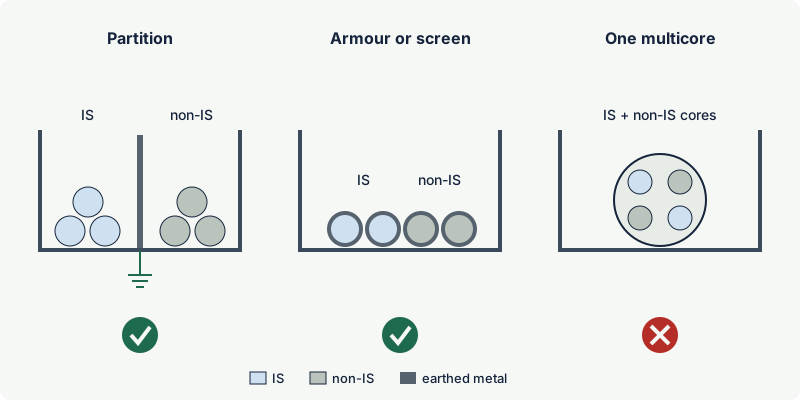
The accepted methods
IEC 60079-14 has for many editions required intrinsically safe installations to be arranged so that other circuits cannot affect them. In the wording used in earlier editions, the installer could achieve this by separating IS cables from non-IS cables, by protecting the IS cables against mechanical damage, or by using armoured, metal-sheathed or screened cables, and IS and non-IS conductors in the same bundle or duct had to be separated by an insulating layer or an earthed metal partition unless metal sheaths or screens were used. The 2024 edition restructured the intrinsic safety clauses (cables, multicore cables and their fault considerations), so check the current text for the project.
| Method | How it protects | Notes |
|---|---|---|
| Separate trays or tray sections | Distance and physical separation | Simplest |
| Earthed metal partition in the tray | A damaged conductor touches earthed metal, not the IS cable | Partition must be continuous and bonded |
| Insulating partition | Prevents contact | Mechanically robust, fixed in place |
| Armoured, metal-sheathed or screened IS cables | Any intruding conductor meets the earthed sheath first | Screens and armour earthed according to the design |
| Armoured or screened non-IS cables | The fault is contained in the non-IS cable's own sheath | Useful when IS cables are unarmoured |
IEC 60079-17 makes this an inspection point: inspectors are told to pay particular attention to the protection provided where cables carrying IS systems and other cables run in the same pipe, duct or cable tray.
Multicore cables with several IS circuits
Several IS circuits may share one multicore cable, but only under the rules of IEC 60079-25 and IEC 60079-14 for multicore cables. These sort cables into types A, B and C by individual screening, protection against damage and circuit voltage; the type decides which faults between the circuits have to be assumed. Spare cores in such a cable need care too: they must never be used for a non-IS circuit, and IEC 60079-17 draws the inspector's attention to the use of spare cores in multicore cables carrying more than one IS circuit.
Example: A pipe rack carries 400 V motor cables, 24 V control cables and light blue IS instrument cables on one wide ladder tray. The designer fits a bonded steel divider along the tray and lays the IS cables on one side. Where the routes split, the IS cables continue on a separate tray. At the marshalling cabinet, IS terminals are on their own rail, separated from the 24 V terminals by more than 50 mm.
Common mistakes
- Using a spare core of a control multicore for an IS signal. IS and non-IS circuits in one multicore is never allowed.
- Partition gaps at bends and tees. The separation must be continuous along the shared route.
- Assuming the blue colour is the protection. Identification helps maintenance; it does not separate anything.
- Running IS cables close to heavy single-core power cables. Strong magnetic fields can induce voltages into IS circuits; keep a sensible distance or use screened, twisted cables.
Related on excodex
- Intrinsic safety (Ex i): ia, ib and ic and the energy limitation principle
- Ex installation basics under IEC 60079-14
- Do intrinsically safe cables have to be blue?
- Can Ex i circuits be terminated inside an Ex e or Ex d enclosure?
- Standards spaces: IEC 60079-14, IEC 60079-25
Standards and further reading
- IEC 60079-14, electrical installations (edition 6, 2024), cables for intrinsically safe circuits.
- IEC 60079-25, intrinsically safe systems (edition 3, 2020, with amendment 1 of 2025), multicore cables.
- IEC 60079-11, intrinsic safety "i" (edition 7, 2023), separation of terminals.
- IEC 60079-17, inspection and maintenance (edition 6, 2023).
- IEC 60079-25:2010 text (edition 2, superseded), multicore cables and the ban on non-IS circuits in them: law.resource.org
- IEC 60079-11:2011 text (edition 6, superseded), 50 mm terminal separation: law.resource.org
- AS/NZS 60079.14:2009, the Australian and New Zealand adoption of IEC 60079-14:2007 (superseded), with the earlier wording on IS cable installation and separation: archive.org
- IS/IEC 60079-17:2007 (Indian adoption of IEC 60079-17 edition 4, superseded), inspection of cables in shared trays: law.resource.org
This article is general technical information prepared by the excodex editorial team. It does not replace the applicable standards, the equipment certificates and instructions, national regulations or the assessment of a competent person.