Which is safer, Ex d or Ex e?
Abstract
Neither. Flameproof Ex db and increased safety Ex eb both give EPL Gb for Zone 1. Ex d contains an explosion inside the enclosure, Ex e prevents ignition sources. Real safety depends on choosing the right one for the job and keeping it as certified.
Neither is safer in principle. Flameproof level db and increased safety level eb both give EPL Gb, the level required for Zone 1, so the standards treat them as equally safe. They reach that level in opposite ways: Ex d lets the gas inside ignite and stops the explosion from getting out, while Ex e makes sure nothing inside can ignite the gas at all. Which one is safer in your plant depends on what the equipment has to do and on how well it is installed and maintained.
Short answer
- Both
Ex dbandEx ebare EPL Gb (ATEX category 2G) and suitable for Zone 1 and Zone 2. Levelsdcandecgive EPL Gc for Zone 2 only. - Ex d contains an internal explosion: strong walls and narrow flamepaths cool the escaping gases. It can house parts that spark in normal operation, such as switches, contactors and breakers.
- Ex e prevents ignition: no arcs, sparks or excessive temperatures, through secure terminals, larger creepage and clearance distances and temperature limits on every part the gas can reach. It cannot house normally sparking parts.
- Each has its own weak points in the field: damaged or obstructed flamepaths and wrong glands for Ex d; loose or overfilled terminals and worn seals for Ex e.
- Choose by application, gas group, cable entry and maintenance, not by a belief that one is "more explosion-proof".
Two routes to the same protection level
The equipment protection level (EPL) is the measure of safety that the standards and the law use. EPL Gb means the equipment is not an ignition source in normal operation or with expected malfunctions. In the EU, Directive 1999/92/EC allows category 1 or 2 equipment in Zone 1, and both concepts provide category 2.
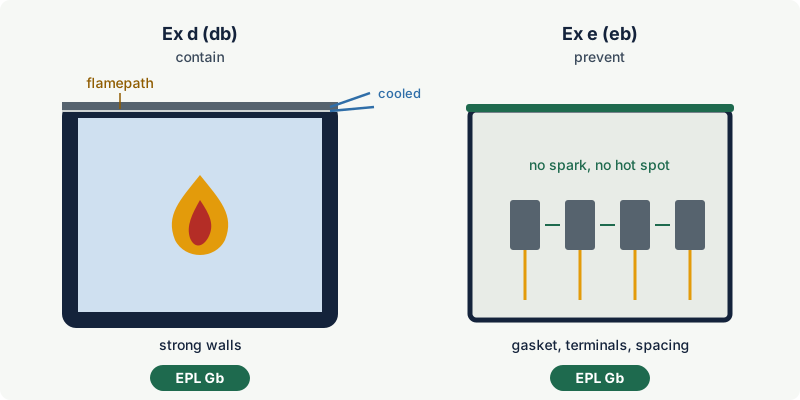
Flameproof (IEC 60079-1). The standard assumes that gas will get inside, because joints are not gas-tight and enclosures breathe. If it ignites, the enclosure must withstand the pressure and every joint must be long and narrow enough to quench the flame. Because the gas group decides how narrow those gaps must be, Ex d design gets stricter from IIA to IIC. The current edition is IEC 60079-1:2026, which replaced the 2014 edition.
Increased safety (IEC 60079-7). The standard defines Ex e as additional measures that give increased security against excessive temperatures and against arcs and sparks. Terminals must not loosen, insulation is tested, spacings are larger than in industrial equipment, and enclosures need at least IP54 where bare live parts are present (IP44 where all live parts are insulated). Semiconductors and electrolytic capacitors are excluded from level eb because their expected malfunctions could cause arcs, sparks or excessive temperatures.
What really decides safety in practice
| Aspect | Ex d (db) | Ex e (eb) |
|---|---|---|
| Sparking parts inside | Allowed | Not allowed unless they are certified components with their own protection, e.g. Ex db eb |
| Gas group dependence | Strong: gaps, joints and obstruction distances depend on IIA, IIB, IIC | Weak: most terminal boxes are certified for IIC |
| Temperature class based on | Outer surface | Every part the gas can reach, inside and outside |
| Cable entry | Flameproof glands with the correct thread; IEC 60079-14 decides when a barrier gland is needed | Certified glands that keep the IP rating |
| Main inspection points | Flamepaths clean and undamaged, all bolts present, no obstruction near flanges, no paint or unapproved sealant on joints | Terminals tight and within their rating, conductor count respected, gaskets intact, IP maintained |
| Typical failure that removes protection | Corroded or scratched flange, missing bolt, pipe or wall too close to a flange | Loose connection overheating, damaged seal letting in water and dirt |
Neither concept tolerates neglect. A flameproof box with a missing cover bolt may no longer contain an explosion, and an Ex e box with a loose terminal can overheat and arc in a place the design assumed would never spark. Inspection to IEC 60079-17 checks exactly these points.
Practical guidance for choosing
- Junction boxes with terminals only: Ex e is usually lighter, cheaper, easier to wire and easier to inspect, and it hardly depends on the gas group.
- Switchgear, control stations, contactors, breakers: need flameproof protection for the switching parts, either a full Ex d enclosure or flameproof components inside an Ex e enclosure.
- Motors: Ex eb motors need protection that trips a stalled motor within its tE time; Ex d motors are common where starting duty, size or converter operation make Ex e difficult. See Ex d or Ex e for motors and junction boxes.
- IIC gases such as hydrogen: Ex d becomes heavier and more sensitive to flange damage; Ex e terminal boxes are often the simpler choice where no sparking parts are needed.
- Harsh, corrosive or wet sites: consider which one your maintenance team can keep as certified. Corroded flamepaths and neglected gaskets are the usual way both concepts fail.
Common mistakes
- Calling Ex d "explosion-proof" and therefore better. It is designed to survive an internal explosion, which Ex e is designed never to have.
- Fitting an ordinary switch into an Ex e box. Switching parts inside an Ex e enclosure must be certified Ex components with their own protection, typically flameproof, and covered by the enclosure's certificate.
- Using an IIB flameproof enclosure in a IIC area. The gas group on an Ex d marking is essential.
- Forgetting that Ex e terminals have conductor limits. Adding conductors beyond the certified combination voids the protection.
Related on excodex
- Ex d or Ex e? Choosing between flameproof and increased safety for motors and junction boxes
- Flameproof enclosures (Ex d): how flamepaths stop an internal explosion
- Increased safety (Ex e): preventing sparks, arcs and hot spots
- Are explosion-proof and flameproof the same thing?
- Standards spaces: IEC 60079-1, IEC 60079-7, IEC 60079-17
Standards and further reading
- IEC 60079-1, equipment protection by flameproof enclosures "d" (2026 edition). IEC webstore page of the 2014 edition, showing its withdrawal on 9 October 2026 and the newer 2026 version: webstore.iec.ch
- IEC 60079-7, equipment protection by increased safety "e" (2015 with Amendment 1 of 2017).
- IEC 60079-14, design, selection and installation, including cable entries for Ex d and Ex e (edition 6, 2024).
- IEC 60079-17, inspection and maintenance of electrical installations.
- IEC 60079-7:2015 text (scope, definition of increased safety, degrees of protection): law.resource.org
- Directive 1999/92/EC, Annex II, Part B, equipment categories for each zone: legislation.gov.uk
This article is general technical information prepared by the excodex editorial team. It does not replace the applicable standards, the equipment certificates and instructions, national regulations or the assessment of a competent person.