What is the difference between explosion-proof and intrinsically safe?
Abstract
Explosion-proof (flameproof, Ex d) equipment lets gas ignite inside a strong enclosure and stops the flame escaping. Intrinsically safe (Ex i) equipment limits circuit energy so nothing can ignite the gas. Ex i suits low-power instruments, Ex d power equipment.
Explosion-proof equipment accepts that gas will get inside and ignite. Its enclosure is strong enough to withstand that internal explosion, and its joints cool the escaping gases so the atmosphere outside does not ignite. Intrinsically safe equipment works the other way round: it limits the voltage, current and stored energy in the circuit so far that no spark or hot surface can ignite the gas, even with faults. One contains the explosion; the other prevents it.
Short answer
- Explosion-proof is the North American term (for example UL 1203); the IEC and ATEX equivalent is the flameproof enclosure, Ex d (IEC 60079-1). It suits motors, switchgear, lighting and anything with real power.
- Intrinsically safe (Ex i, IEC 60079-11; UL 913 in North America) suits low-power instruments such as transmitters, sensors and signalling, not motors or heaters.
- Zones: flameproof
dbgives EPL Gb (Zone 1); intrinsic safetyiagives EPL Ga and can be used in Zone 0,ibin Zone 1,icin Zone 2. - System: an Ex d box is safe by itself when closed; an Ex i device is only safe together with its associated apparatus (barrier or isolator) and a verified loop.
- Maintenance: Ex d enclosures must be isolated before they are opened in a hazardous area (IEC 60079-17 allows exceptions only under a safe work procedure or, in Zone 2, a recorded safety assessment); intrinsically safe circuits can be worked on live under the conditions of IEC 60079-17 and site rules.
- "Exproof" in Turkish and in trade language is often used loosely for any Ex equipment. Read the marking to see which concept is actually used.
Two opposite principles
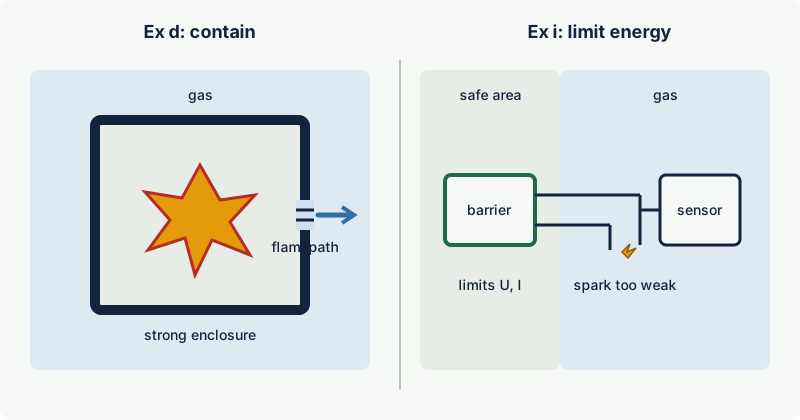
Explosion-proof / flameproof. US regulations define explosion-proof apparatus as enclosed in a case that can withstand an explosion of a specified gas inside it, prevents ignition of the surrounding gas by sparks, flashes or the internal explosion, and runs at an outer temperature that will not ignite the atmosphere. IEC flameproof enclosures work the same way: every joint is a long, narrow flamepath that cools the escaping gas. Anything can be placed inside, including contactors that spark in normal operation. The protection depends on the gas group, because hydrogen and acetylene (IIC) pass through gaps that would stop propane (IIA).
Intrinsically safe. IEC 60079-11 describes intrinsic safety as a type of protection in which circuits are incapable of causing ignition of the surrounding atmosphere. An interface in the safe area, a zener barrier or a galvanic isolator, limits the open-circuit voltage and short-circuit current, and the cable's capacitance and inductance are included in a loop check. A common IS source of 28 V and 93 mA with a resistive (linear) characteristic can deliver at most about 0.65 W into a matched load (28 V x 0.093 A / 4): enough for a 4-20 mA transmitter, far too little for a pump.
Side-by-side comparison
| Point | Explosion-proof / flameproof (Ex d) | Intrinsically safe (Ex i) |
|---|---|---|
| Principle | Contain the explosion, cool escaping gas | Prevent ignition by limiting energy |
| Standards | IEC 60079-1; UL 1203 in North America | IEC 60079-11 and IEC 60079-25; UL 913 in North America |
| Power | Unlimited by the concept (motors, lighting, switchgear) | Typically well under 1 W per loop |
| Best EPL | Gb (db); da only for portable detector sensors | Ga (ia) |
| Zones | Zone 1 and 2; Class I Division 1 | Zone 0, 1 and 2 (by level); Class I Division 1 |
| Depends on | Intact flamepaths, all bolts, certified glands or conduit seals | Correct barrier, documented loop, segregation from other circuits |
| Weight and cost | Heavy cast or machined enclosure | Light field device; cost in the interface and documentation |
| Live work | Not with the cover open in a hazardous atmosphere | Possible under IEC 60079-17 provisions and site rules |
| Typical failure | Corroded or damaged flamepath, missing bolt, wrong gland | Wrong or missing barrier, mixed IS and non-IS wiring |
How to choose between them
- Look at the power. Anything above a few watts (motors, heaters, lighting, contactors) cannot be intrinsically safe; use flameproof, increased safety or pressurisation.
- Look at the zone. Inside a tank vapour space (Zone 0), intrinsic safety
iais the usual answer; flameproofdbis not acceptable there. - Look at the maintenance. Instruments that are calibrated or replaced often are easier to keep safe as Ex i, because work can be done without a gas-free permit where site rules allow it.
- Look at the gas. Both concepts depend on the gas group; IIC makes flameproof enclosures heavier and shortens permissible IS cable lengths.
Many products combine both: a gas detector can have a flameproof housing with intrinsically safe outputs, marked for example Ex db [ia Ga] IIC T4 Gb.
Example: A pressure transmitter on a solvent tank nozzle in Zone 1 can be either Ex db IIC T6 Gb (flameproof housing, ordinary 4-20 mA supply via flameproof glands) or Ex ia IIC T4 Ga (fed through an [Ex ia] isolator in the control room). The Ex ia version also allows the same model to be used inside the tank and to be checked live.
Common mistakes
- Calling every Ex device "explosion-proof". An Ex e junction box or an Ex i sensor is not explosion-proof; it uses a different principle and different installation rules.
- Installing an IS device without associated apparatus. A 24 V supply connected directly is not intrinsically safe, whatever the device marking says.
- Thinking Ex d is safer because it is heavier. Both
dbandibare EPL Gb;iais a higher level than any common flameproof design.
Related on excodex
- Ex protection concepts at a glance: d, e, i, p, m, o, q, n and t
- Flameproof enclosures (Ex d): how flamepaths stop an internal explosion
- Intrinsic safety (Ex i): ia, ib and ic and the energy limitation principle
- Are explosion-proof and flameproof the same thing?
- Does a 24 V circuit need to be intrinsically safe in Zone 1?
Standards and further reading
- IEC 60079-1, equipment protection by flameproof enclosures "d".
- IEC 60079-11:2023 (edition 7.0), equipment protection by intrinsic safety "i", abstract: webstore.iec.ch
- IEC 60079-25, intrinsically safe electrical systems; IEC 60079-14, selection and installation.
- IEC 60079-17, inspection and maintenance (current edition 2023); the 2007 text as adopted in India (IS/IEC 60079-17:2007) shows the isolation and live-work rules: archive.org
- UL 1203 (edition 6, 2023), explosion-proof and dust-ignition-proof electrical equipment for hazardous (classified) locations: webstore.ansi.org
- UL 913 (edition 8, 2013), intrinsically safe apparatus and associated apparatus for Class I, II and III, Division 1 locations: webstore.ansi.org
- US OSHA, 29 CFR 1910.399, definition of explosion-proof apparatus: osha.gov
This article is general technical information prepared by the excodex editorial team. It does not replace the applicable standards, the equipment certificates and instructions, national regulations or the assessment of a competent person.