What is pressure piling in a flameproof enclosure?
Abstract
Pressure piling is an explosion in one part of an Ex d enclosure that pre-compresses the unburnt gas in another part, so the second ignition starts from a higher pressure and peaks far above the normal explosion pressure. Certified layouts and conduit seals control it.
Pressure piling is what happens when an ignition in one compartment of a flameproof (Ex d) enclosure pushes unburnt gas into a second compartment and compresses it before the flame arrives. The second explosion then starts from a raised pressure, with strong turbulence, and its peak can be well above the pressure the enclosure would see in a single open space. It is the reason internal layouts, partitions and connections between flameproof enclosures are fixed by the certificate and must not be changed on site.
Short answer
- IEC 60079-1 defines pressure piling as the result of igniting a gas mixture that has been pre-compressed, for example by a first ignition in another compartment or subdivision of the same enclosure.
- It arises where the inside is divided into compartments, or so crowded with components that they act as partitions, and where enclosures are joined by conduit or ducts.
- The peak explosion pressure of a gas mixture rises roughly in step with its starting pressure, and the jet of flame into the second space makes it burn much faster.
- IEC 60079-1 asks designers to avoid such arrangements where possible, and otherwise to design the enclosure for the higher pressures. The test laboratory measures the explosion pressure with the internal parts in place.
- On site: do not add, move or remove internal parts, do not join Ex d enclosures by open conduit, and fit the conduit seals the installation rules require.
How pressure piling builds up
Picture an enclosure divided by a mounting plate or a dense block of equipment into a space A and a space B, linked by a gap or hole. Gas is ignited in A.
- The burning gas in A expands and pushes unburnt mixture through the opening into B. The pressure in B rises before any flame reaches it.
- The flame then jets through the opening into B. The jet ignites the pre-compressed mixture at many points at once and makes it highly turbulent.
- B burns very fast from its raised starting pressure, and its peak overtakes the peak in A.
Two effects combine: pre-compression and turbulence. Closed-vessel tests show that the maximum explosion pressure of a gas mixture is a roughly linear function of the initial pressure, so even a modest pre-compression lifts the peak. The turbulent jet then raises the burning rate, which matters both for the peak pressure and for how fast the pressure rises.
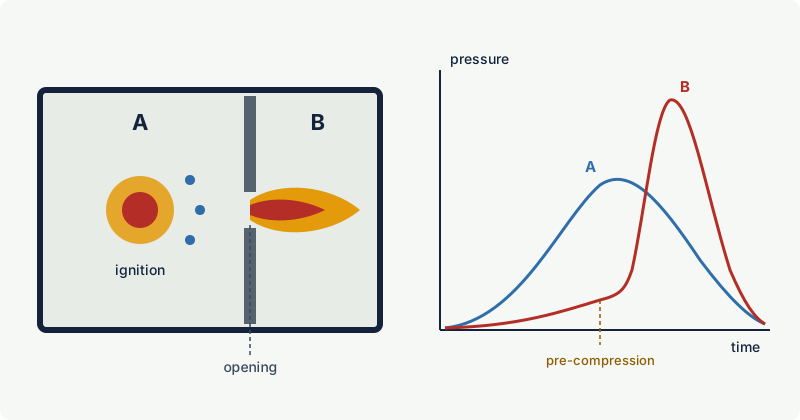
A numerical simulation of two flameproof chambers linked by an orifice (Li and Dai, Thermal Science, 2023), using 8 % ethylene in air as in IEC 60079-1 testing of Group IIB, found that the second chamber was pre-pressurised by only about 0.1 to 0.3 bar at the moment of ignition. With 10 to 20 mm holes its peak still reached about 8.6 to 9.1 bar, against about 5.7 to 7 bar in the first chamber. With the largest hole studied (45 mm) the first chamber peaked higher than the second and the authors found no pressure piling. The size of the connecting opening, and the timing of the ignition in the first cavity, decide how severe the effect is.
What the standard and the certificate require
IEC 60079-1 recognises that intercommunicating compartments, or subdivisions caused by the arrangement of internal parts, can produce pressures and rates of pressure rise higher than normal. The designer should avoid them as far as possible; where they cannot be avoided, the enclosure must be strong enough for the higher stresses.
The safeguard is the type test. The laboratory fills the enclosure, with its internal components fitted or simulated, with a specified test mixture for the gas group and ignites it at the positions that give the most severe result. The highest pressure measured becomes the reference pressure, and the enclosure is then proven by an overpressure test at a margin above it (1.5 times the reference pressure in the usual test). Pressure piling is therefore already inside the certified rating, but only for the layout that was tested. The 2014 edition of IEC 60079-1 also revised the explosion pressure determination for pressure piling in Group IIB. That edition has since been replaced by IEC 60079-1:2026, so check the edition named on the certificate.
| Situation | Risk of pressure piling | Who controls it |
|---|---|---|
| Empty enclosure or open layout | Low | Design and type test |
| Tightly packed components, mounting plates, partitions | Higher | Certified layout; manufacturer only |
| Two Ex d enclosures joined by conduit or duct | High | Conduit seals; certificate for assemblies |
| Motor terminal box open to the motor interior | Possible | Certified design; do not remove internal bushings |
What this means for installers and maintainers
Do not change the inside. Adding a relay, a larger transformer or a cable loop "because there is space" can create a new subdivision and change the free volume. The enclosure has not been tested in that state, so the certificate no longer covers it. Changes to internal layout belong to the manufacturer or a repair done under IEC 60079-19 with the manufacturer's data.
Do not join enclosures by open conduit. A conduit run between two flameproof boxes is a ready-made pressure piling path. Installation codes therefore require sealing fittings close to enclosures that contain ignition sources and between enclosures in a conduit system.
Keep internal barriers and bushings. Where a motor or a terminal compartment is separated by a bushing or a sealed wall, that wall is part of the protection. Removing it during repair links two volumes the test treated separately.
Common mistakes
- Treating spare space as usable. The certificate covers the tested layout, not any layout that fits.
- Removing an internal partition to make wiring easier, which turns two separately tested spaces into a linked pair.
- Linking Ex d enclosures by conduit without seals, or with seals placed too far from the enclosure.
Related on excodex
- Flameproof enclosures (Ex d): how flamepaths stop an internal explosion
- Deflagration, detonation and overpressure: what happens in a gas or dust explosion
- When are conduit sealing fittings required in Ex d installations?
- Can you drill an extra cable entry hole in an Ex d enclosure on site?
- Standards space: IEC 60079-1
Standards and further reading
- IEC 60079-1, equipment protection by flameproof enclosures "d" (definition of pressure piling, intercommunicating compartments, determination of explosion pressure).
- IEC 60079-1:2014 text (replaced by IEC 60079-1:2026), incorporated by reference in US federal regulations: law.resource.org
- MSHA comparison of IEC 60079-1 and US mining requirements (archived), pressure piling and explosion tests: webarchive.library.unt.edu
- D. Li and S. Dai, numerical simulation of the effect of orifice diameter in an interconnected flameproof enclosure during pressure piling, Thermal Science 27 (2B), 2023: thermalscience.vinca.rs
- D. Li, S. Dai and T. Lin, explosion pressure parameters in flameproof enclosures under pressure piling, Energies 14 (2021): ideas.repec.org
- M. Mitu et al., deflagration parameters of propane-air mixtures in a closed vessel (peak pressure linear in initial pressure), U.P.B. Sci. Bull. B 73 (2011): scientificbulletin.upb.ro
This article is general technical information prepared by the excodex editorial team. It does not replace the applicable standards, the equipment certificates and instructions, national regulations or the assessment of a competent person.