When are conduit sealing fittings required in Ex d installations?
Abstract
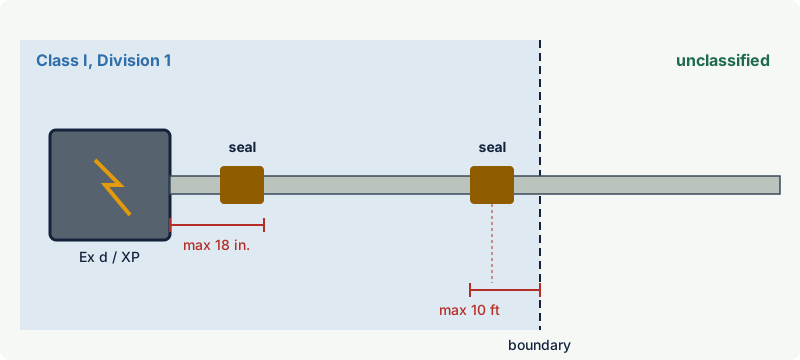
Wherever conduit enters an explosionproof or flameproof enclosure that holds arcing, sparking or hot parts, and where conduit leaves a hazardous location. Under the NEC the seal sits within 18 in. (450 mm) of the enclosure and within 10 ft of the boundary.
Conduit sealing fittings are required in two places: where a conduit enters an explosionproof (flameproof) enclosure that contains arcing, sparking or high-temperature parts, and where a conduit leaves a hazardous location. In North American practice under NEC 501.15 the first seal must be within 18 in. (450 mm) of the enclosure and the boundary seal within 10 ft of the boundary; IEC installations that use conduit follow IEC 60079-14 and the enclosure certificate.
Short answer
- Enclosures with ignition sources: seal each conduit entering an explosionproof enclosure that houses switches, breakers, fuses, relays, resistors or other parts that arc, spark or run hot in normal operation, within 18 in. of the enclosure (NEC 501.15, Class I Division 1).
- Enclosures with only terminals, splices or taps, or with arcing contacts that are hermetically sealed or oil-immersed: under the NEC a seal is needed only for conduit of trade size 2 or larger.
- Two enclosures close together: a run of 36 in. or less between them may use one seal, if it is within 18 in. of each enclosure.
- Boundaries: a conduit leaving a Division 1 or Division 2 location is sealed within 10 ft on either side of the boundary, with no union, coupling, box or fitting other than an explosionproof reducer between the seal and the boundary. A Division 2 boundary seal need not be explosionproof.
- Zone system (NEC 505, Canadian Code, IEC): the same idea applies, but distances and exceptions differ; some flameproof enclosures are marked "seal not required" or need a seal much closer to the entry. The equipment marking and the applicable code decide.
Why conduit needs sealing
A conduit run is a pipe that connects enclosures with each other and with other areas. Without a seal it lets three things travel along it:
- The explosion itself. A flame front from an internal ignition can run down the conduit to another enclosure or out of the hazardous area.
- Pressure piling. Gas pushed ahead of the flame pre-compresses the mixture in the next enclosure, which then explodes from a higher starting pressure. Successive explosions along a run can destroy the far enclosure.
- Gas and vapour. Flammable gas can migrate through the conduit from a hazardous to a non-hazardous location, or into an enclosure.
A sealing fitting is a short chamber filled on site with a setting compound around the conductors. It stops the flame and the piling and limits gas flow at atmospheric pressure. It is not a pressure barrier: process fluid at higher pressure, for example from a failed instrument seal, needs a process (primary) seal in the instrument and the further measures the applicable code requires.
NEC Article 501 (Class I divisions): where seals go
The NFPA summary of NEC 2023 section 501.15 sets out the main cases. The 2026 edition of NFPA 70 has since been published, so check the edition your jurisdiction has adopted.
| Location | Where | Distance |
|---|---|---|
| Division 1, enclosure with arcing, sparking or high-temperature devices | Each conduit entry | Within 18 in. of the enclosure |
| Division 1, enclosure with terminals, splices or taps only, or with hermetically sealed or oil-immersed contacts | Conduit trade size 2 and larger | Within 18 in. of the enclosure |
| Two explosionproof enclosures, run of 36 in. or less | One seal in that run | Within 18 in. of each enclosure |
| Conduit leaving Division 1 or Division 2 | At the boundary (Division 2 seal need not be explosionproof) | Within 10 ft on either side |
| Division 2, enclosure required to be explosionproof | As for Division 1 | As for Division 1 |
Between an enclosure seal and the enclosure, the NEC allows only explosionproof unions, couplings, reducers, elbows, capped elbows and L, T or cross-type conduit bodies no larger than the conduit trade size. An unbroken metal conduit that passes straight through a classified location, with no fittings less than 12 in. beyond each boundary and both ends in unclassified locations, needs no boundary seal. In Division 2 there are further exemptions, for example for conduit leaving a pressurised room, or ending at an unclassified location where the wiring changes to cable tray, cablebus, ventilated busway, Type MI cable or open wiring under the conditions of 501.15.
Zone system and IEC practice
NEC Article 505 (zones). In the 2008 NEC, conduit entering an enclosure with type of protection "d" or "e" needed a seal within 50 mm (2 in.), unless a "d" enclosure is marked to show that no seal is needed; explosionproof (US-style) equipment in a zone area followed the 450 mm rule. Check the edition your jurisdiction has adopted.
Canada. As described for Rule 18-108 of the Canadian Electrical Code, Zone 1 practice uses 450 mm for seals at explosionproof or flameproof enclosures with sparking, arcing or hot equipment in Zone 1, and requires seals at enclosures with only terminals, splices or taps only for conduit of trade size 53 or larger.
IEC 60079-14. Conduit is uncommon in IEC practice, where cable glands do most of the work. Where conduit is used with flameproof enclosures, IEC 60079-14 has a clause on conduit systems with additional requirements for flameproof sealing devices for conduit, and further clauses on penetrations in structures and on preventing the passage of flammable material along wiring systems. The certified sealing device, its position relative to the enclosure and the compound are taken from the standard, the enclosure certificate and the sealing device instructions.
Common mistakes
- Seal too far from the enclosure, or a junction box placed between the enclosure and its seal.
- No compound poured after the cables are pulled, so the seal is an empty fitting.
- Treating a seal as gas-tight against process pressure instead of providing a primary seal or vent.
- Forgetting the boundary seal where the conduit leaves the classified area towards a control room.
Related on excodex
- Flameproof enclosures (Ex d): how flamepaths stop an internal explosion
- North American hazardous location approvals: NEC 500/505/506, UL, CSA and FM
- Ex installation basics under IEC 60079-14
- What is pressure piling in a flameproof enclosure?
- Standards spaces: NEC 500 to 506, IEC 60079-14
Standards and further reading
- NFPA 70, National Electrical Code, section 501.15 (sealing in Class I locations) and section 505.16 (zone locations).
- IEC 60079-14, design, selection and installation of electrical installations (conduit systems, flameproof sealing devices).
- NFPA summary of NEC 2023 conduit sealing requirements in Class I locations: nfpa.org resource PDF
- NFPA 70 (2008), public copy with section 505.16: archive.org
- IAEI Magazine, sealing in Class I hazardous locations (Canadian Electrical Code, purposes of seals): iaeimagazine.org
- IEC 60079-14:2024 preview (table of contents: conduit systems, flameproof sealing devices, penetrations in structures): standards.iteh.ai
This article is general technical information prepared by the excodex editorial team. It does not replace the applicable standards, the equipment certificates and instructions, national regulations or the assessment of a competent person.