Is a 4-20 mA transmitter automatically intrinsically safe?
Abstract
No. 4-20 mA is only a signal convention. A transmitter is intrinsically safe only if it is certified Ex ia, ib or ic and is powered through suitable associated apparatus, with the loop and cable parameters checked; otherwise it needs another type of protection.
No. "4-20 mA" only says how the measurement is transmitted: a direct current between 4 and 20 mA on a two-wire loop. A transmitter is intrinsically safe only if it is certified to a level of intrinsic safety (Ex ia, Ex ib or Ex ic) and is supplied through suitable associated apparatus, such as a barrier or isolator, with the loop parameters checked.
Short answer
- The signal type and the type of protection are independent. 4-20 mA transmitters are built as intrinsically safe, flameproof (
Ex db), increased safety or non-sparking (Ex ec,Ex nA) or as ordinary industrial devices. - The Ex marking and the certificate decide. An intrinsically safe transmitter carries a marking such as
Ex ia IIC T4 Gaand input parameters Ui, Ii, Pi, Ci and Li. - Even a certified
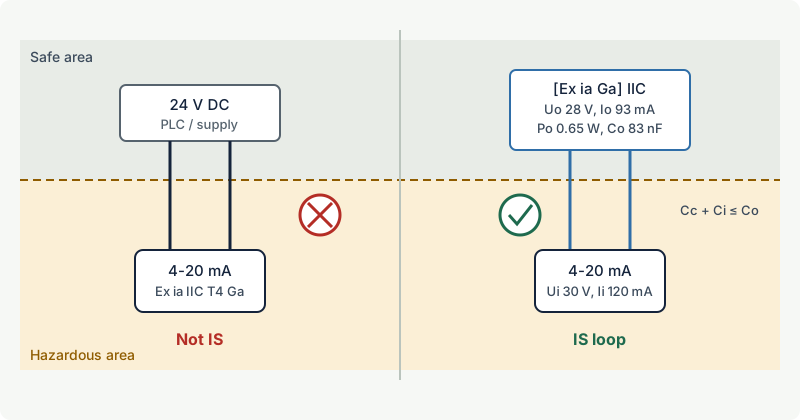
Ex iatransmitter forms an intrinsically safe circuit only when it is powered from associated apparatus, marked for example[Ex ia Ga] IIC, whose output parameters it can accept. - The supply's Uo, Io and Po must not exceed the transmitter's Ui, Ii and Pi, and the cable must stay within the remaining capacitance and inductance. The result is recorded in a descriptive system document (IEC 60079-25).
- A low working voltage and a small signal current do not make a circuit intrinsically safe: what matters is the energy available under fault conditions.
Why a 24 V, 20 mA loop is not safe by itself
In normal operation a 4-20 mA loop carries about 20 mA at most (slightly more in some alarm states), from a supply of typically 24 V. That sounds harmless, but intrinsic safety is not judged on the working current. It is judged on what the circuit can deliver when something goes wrong: a cable is cut, shorted or earthed, or a component inside the transmitter fails.
An ordinary 24 V DC supply or PLC input card can push far more than 20 mA into a short circuit, and nothing stops a spark from drawing that energy. The cable and the transmitter's internal capacitors and inductors store energy too, and release it into the same spark. In an intrinsically safe loop, the associated apparatus limits the voltage and current that can ever reach the hazardous area, with infallible resistors and redundant voltage-limiting components, and the transmitter is designed and certified so that its own stored energy and surface temperatures stay within the limits for its level of protection.
Direct current analogue signals of this kind are the subject of IEC 60381-1, a process control standard that deals with the signal, not with explosion protection.
How to recognise what you have
The datasheet wording "suitable for hazardous areas" is not enough. Read the marking on the nameplate and the certificate:
| Marking example | What it means for the loop |
|---|---|
Ex ia IIC T4 Ga | Intrinsically safe apparatus. Needs ia associated apparatus for Zone 0; check Ui, Ii, Pi, Ci, Li. |
Ex ib IIC T4 Gb | Intrinsically safe for Zone 1 and Zone 2, on ia or ib associated apparatus. |
Ex ic IIC T4 Gc | Intrinsically safe for Zone 2 only, on ic or better associated apparatus. |
Ex db IIC T6 Gb | Flameproof, not intrinsically safe. Ordinary supply, but Ex d cable entries and no opening live. |
Ex ec IIC T4 Gc | Increased safety for Zone 2. Not intrinsically safe. |
| No Ex marking | Non-hazardous area only. |
Some transmitters are certified for more than one concept, for example both Ex ia and Ex db. The installer chooses one, and the whole installation then follows the rules of that concept. A loop level is also only as good as its weakest part: an ia transmitter on an ib barrier forms an ib circuit, and a IIC transmitter on a source with IIB output parameters forms a IIB circuit.
Worked example: checking a transmitter loop
The informative example in IEC 60079-25 (2010 edition) compares a temperature transmitter with an intrinsically safe interface. Using its values:
| Check | Interface (associated apparatus) | Transmitter | Result |
|---|---|---|---|
| Group and level | IIC, ia | IIC, ia | IIC, ia |
| Voltage | Uo 28 V | Ui 30 V | 28 V does not exceed 30 V |
| Current | Io 93 mA | Ii 120 mA | acceptable |
| Power | Po 650 mW | Pi 1 W | acceptable |
| Capacitance | Co 83 nF | Ci 3 nF | cable may add 80 nF |
| Inductance | Lo 4.2 mH | Li 10 µH | cable may add about 4.2 mH |
If the cable data are not known, IEC 60079-25 (2010 edition) allows conservative values of 200 pF/m and 1 µH/m for a conventional two- or three-core cable. Here Ci is more than 1 % of Co but Li is less than 1 % of Lo, so the rule that halves Co and Lo when both lumped values exceed 1 % does not apply. 80 nF divided by 200 pF/m gives about 400 m of cable by capacitance; the inductance limit allows more, so capacitance governs.
Connect the same transmitter straight to a 24 V PLC card in the control room and none of this holds: there is no Uo or Io to compare, so the circuit is not intrinsically safe, even though the transmitter is certified. For an Ex ia-only device in Zone 0 or Zone 1, that installation is simply not acceptable. The checks themselves are explained in Intrinsic safety loop verification.
Common mistakes
- Buying on the signal, not the certificate. "4-20 mA, HART, two-wire" describes the electronics, not the protection.
- Using an IS transmitter on a non-IS supply because "it is only 24 V". Without associated apparatus nothing limits the fault energy.
- Forgetting other devices on the loop. Indicators, surge protectors or a hand-held configurator connected in the hazardous area are part of the system and must be suitable and included in the assessment.
- Mixing concepts on a dual-certified device, for example wiring it as Ex d with Ex i cable rules, or the reverse.
Related on excodex
- Intrinsic safety (Ex i): ia, ib and ic and the energy limitation principle
- Zener barriers vs galvanic isolators: choosing intrinsic safety interfaces
- Does a 24 V circuit need to be intrinsically safe in Zone 1?
- [What does [Ex ia] mean, and can associated apparatus be installed in Zone 1?](/article/1295)
- Ex marking check: /tools/ex; standards spaces IEC 60079-11 and IEC 60079-25
Standards and further reading
- IEC 60079-11, equipment protection by intrinsic safety "i" (levels ia, ib, ic; apparatus and associated apparatus).
- IEC 60079-25, intrinsically safe electrical systems (descriptive system document, parameter comparison, cable parameters); current edition 3.0 (2020) with Amendment 1 (2025): webstore.iec.ch
- IEC 60079-14, design, selection and installation of electrical installations in explosive atmospheres.
- IEC 60381-1, analogue signals for process control systems, direct current signals: scc-ccn.ca
- IEC 60079-25:2010 text with the transmitter loop example (Annex A): law.resource.org
- Health and Safety Authority (Ireland), instrumentation guidance on intrinsic safety: hsa.ie
This article is general technical information prepared by the excodex editorial team. It does not replace the applicable standards, the equipment certificates and instructions, national regulations or the assessment of a competent person.