What is the difference between ambient temperature and process temperature on an Ex device?
Abstract
Ambient temperature (Ta) is the air around the device; process temperature is the medium in the pipe or vessel it is fitted to, which heats or cools it by conduction. Ta is the marked range; process limits are stated separately, often as a T-class table. Both must be met.
The ambient temperature (Ta) is the temperature of the air around the device: the marked range, such as -40 °C ≤ Ta ≤ +60 °C, within which it is certified. The process temperature is the temperature of the medium in the pipe, vessel or pump that the device is mounted on or in contact with; it heats or cools the device by conduction, independently of the air. Both raise or lower the device's surface temperature, so the certificate treats them separately and both limits must be met.
Short answer
- Ta: the temperature of the air (or other medium) immediately around the device. IEC 60079-0 states that it does not mean the process medium, unless the device is totally immersed in it.
- Process temperature: an external source of heating or cooling. IEC 60079-0 requires the manufacturer to state its permitted ratings when a device is meant to be connected to one.
- Instrument certificates often give a table: temperature class against ambient range and maximum process temperature.
- A device within its Ta range but on a line hotter than its process limit has no valid temperature class.
- Cold processes matter too: they set the minimum service temperature of seals and other parts.
Two different heat paths
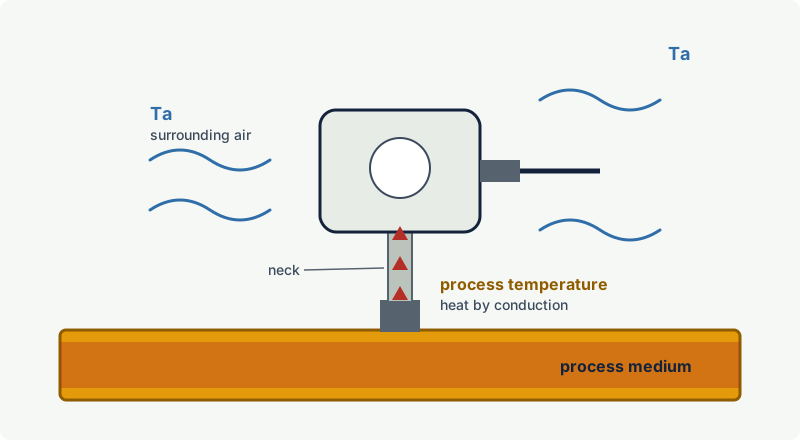
The ambient rating describes the environment the equipment can tolerate. When the temperature class is proven, the hottest surface is measured at rated conditions and corrected to the maximum rated ambient. A device bolted to a 200 °C pipe, however, receives heat by conduction through its process connection, and that heat is not in the ambient test.
IEC 60079-0 therefore has a separate clause for external sources of heating or cooling. In the wording of the 2004 edition, where equipment is intended to be physically connected to a separate source of heating or cooling, such as a heated or cooled process vessel or pipeline, the ratings of that source must be stated. A note adds that for large sources a maximum or minimum temperature is usually enough, while for small sources or heat passing through insulation a rate of heat flow may be more suitable. The maximum surface temperature and the service temperatures are then determined at the maximum ambient and the maximum rated external heating. The 2026 edition keeps a clause with the same title.
For non-electrical equipment, ISO 80079-36 deals with the case where the surface temperature depends mainly on operating conditions, such as a heated fluid in a pump. The manufacturer cannot then mark a single temperature class, so the marking shows a range, for example T6…T4 or 85 °C…150 °C, and the instructions explain which applies at which product temperature.
Reading a certificate table
A typical table for a transmitter (illustrative values) looks like this:
| Temperature class | Ambient range Ta | Maximum process temperature |
|---|---|---|
| T6 | -40 °C to +40 °C | +70 °C |
| T5 | -40 °C to +55 °C | +85 °C |
| T4 | -40 °C to +60 °C | +120 °C |
| T3 | -40 °C to +60 °C | +185 °C |
Pick the row that satisfies all three conditions at your site: the temperature class the gas needs, your maximum ambient, and your maximum process temperature, including upsets, steam-out and cleaning cycles. Some certificates add conditions such as a minimum neck length or a remote seal; they are part of the conditions of use.
Practical case. A pressure transmitter is to be fitted to a line handling hexane (autoignition temperature 225 °C, so T3 is needed) at up to +150 °C. The highest ambient at the mounting point is +45 °C. In the table above, T3 allows +60 °C ambient and +185 °C process. Both are met, so the device may be used with a valid T3 rating. If the line were steamed out at +200 °C, the process limit would be exceeded and the transmitter would have to be removed or isolated during steaming, or a design with a longer neck or remote seal chosen.
The pipe is a separate question
The hot pipe or vessel is not Ex equipment and carries no temperature class. ISO 80079-36 notes that an item which becomes hot only because of an external process, like a pipe, is not considered equipment on its own. Its surface is still a possible ignition source, though, and the explosion risk assessment must make sure that surfaces the atmosphere can reach stay below the autoignition temperature of the gas.
What the installer must document
The 2007 text of IEC 60079-14 required that, where the process temperature or exposure to solar radiation influences the equipment, the effect be considered and the measures documented. The European Commission's ATEX guidelines list "the effect of additional sources of heat or cooling (such as mounting on a heated process vessel)" among the surrounding conditions that manufacturer and user should communicate about. In practice, record for each instrument its design ambient, its maximum and minimum process temperature and the certificate row that covers them.
Common mistakes
- Using the process temperature as the ambient, or the reverse. They are separate limits.
- Checking only normal operation. Steam-out, start-up and upsets can push the process above the table.
- Adding insulation around a device on a hot pipe. It changes how heat leaves the housing and can raise the temperatures the certificate was based on.
Related on excodex
- Ambient temperature range Ta: what -20 °C to +40 °C really means
- Hot surfaces in hazardous areas: luminaires, motors, heat tracing and process heat
- Why does a certificate list different temperature classes for different ambient temperatures?
- Does solar radiation count when checking the ambient temperature Ta?
- Tools and spaces: Ex marking check, IEC 60079-0, ISO 80079-36
Standards and further reading
- IEC 60079-0:2004, ambient temperature, external source of heating or cooling, service temperature and maximum surface temperature, public copy: law.resource.org
- IEC 60079-0 edition 8 (2026), preview with contents and the scope note on the normal ambient range: webstore.ansi.org
- ISO 80079-36:2016, non-electrical equipment, temperature range marking where the surface temperature depends on operating conditions, public copy: law.resource.org
- IEC 60079-14:2007 text as AS/NZS 60079.14:2009, selection by ambient temperature and process temperature: archive.org
- European Commission, ATEX 2014/34/EU Guidelines, 6th edition (January 2026), surrounding area conditions: single-market-economy.ec.europa.eu
This article is general technical information prepared by the excodex editorial team. It does not replace the applicable standards, the equipment certificates and instructions, national regulations or the assessment of a competent person.