Why does a certificate list different temperature classes for different ambient temperatures?
Abstract
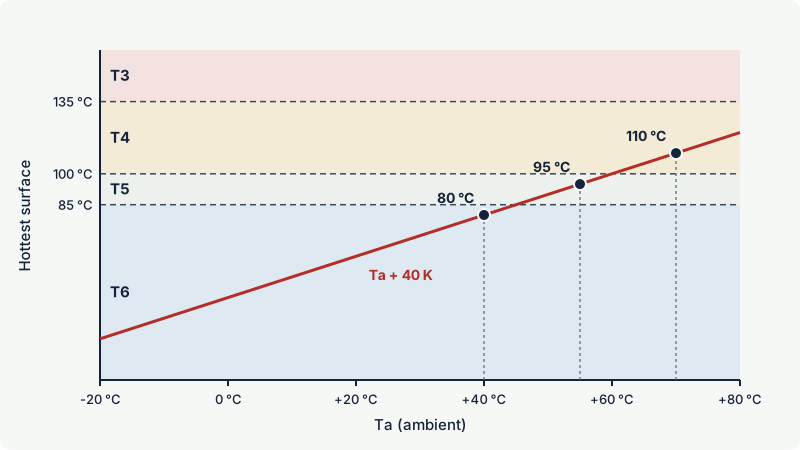
Because the hottest surface of the equipment rises with the surrounding air. A device whose hot spot stays within 85 °C (T6) at +40 °C ambient may reach 95 °C at +55 °C, so the certificate gives T6 up to +40 °C and only T5 up to +55 °C. The line for your site ambient applies.
Because the temperature of the hottest surface rises with the temperature of the surrounding air. The temperature class is proven at the maximum ambient the equipment is rated for, so the same device can stay within the T6 limit (85 °C) up to +40 °C but only within the T5 limit (100 °C) up to +55 °C. The certificate then lists both, and the line that matches the highest ambient at your site is the one that applies.
Short answer
- Surface temperature follows ambient. A heat-producing device (luminaire, solenoid, heater, transmitter electronics) runs a roughly fixed number of kelvin above its surroundings, so a hotter ambient means a hotter surface.
- The class is proven at the top of the range. IEC 60079-0 requires the maximum surface temperature to be determined at rated duty and at the maximum rated ambient, and the test result is corrected to that ambient.
- More than one class is allowed. The standard expressly permits different temperature classes for different ambient temperatures and for different external heat sources such as a hot process.
- Pick the line, not the best number. The applicable class is the one for an ambient range that covers your hottest credible local air temperature. That class must be safe for the gas.
- Outside every listed range, nothing is proven. Equipment must not be used above the highest maximum ambient on the certificate.
Why surface temperature depends on ambient
An electrical device turns some of its power into heat. In steady state its hottest point sits at the ambient temperature plus a temperature rise that depends on the power dissipated and on how well the heat gets away. Over the usual range of air temperatures that rise changes little, so the hot spot moves up almost degree for degree with the air around it.
The temperature class is a promise about that hot spot: T6 means it never exceeds 85 °C, T5 100 °C, T4 135 °C, T3 200 °C, T2 300 °C and T1 450 °C. A promise like that is only valid up to a stated air temperature. That is why the public 2004 edition of IEC 60079-0 already said that surface temperature is determined with the equipment at maximum ambient, and that more than one temperature class may be established for different ambient temperatures and for different external sources of heating or cooling. Later editions keep this principle. Edition 8 (2026) also requires the rated ambient range to be marked on every Ex marking.
The test also builds in a margin. In the 2004 text, a type-tested result had to stay 5 K below the class limit for T6 to T3 and 10 K below for T2 and T1, after correction to the maximum rated ambient.
A worked example
Take a device whose hottest point runs 40 K above ambient (illustrative values). Applying the 5 K test margin:
| Rated maximum ambient | Hottest surface | Limit with 5 K margin | Class that can be claimed |
|---|---|---|---|
| +40 °C | 80 °C | T6: 80 °C | T6 |
| +55 °C | 95 °C | T5: 95 °C | T5 |
| +70 °C | 110 °C | T4: 130 °C | T4 |
The certificate or instructions would then show something like T6 for -20 °C ≤ Ta ≤ +40 °C, T5 for Ta ≤ +55 °C and T4 for Ta ≤ +70 °C. The upper end of the widest range can also be set by something other than surface temperature, for example the rating of seals, cable insulation or electronic components.
Now apply it to a site. In a pump house where the design ambient is +50 °C, the +40 °C line does not apply. The +55 °C line gives T5, which is fine for diethyl ether (autoignition 175 °C, T4) but not for carbon disulfide (autoignition 90 °C, T6). For carbon disulfide at +50 °C this device is not suitable at all: the T6 rating ends at +40 °C.
Where the table appears and what else can change the class
The ambient range is marked as Ta or Tamb with its limits. When the full table does not fit on the nameplate, it is in the certificate and in the instructions; the US Coast Guard's guidance on certificate numbers lists complete temperature class information that cannot fit on the marking among the items a certificate carries. Under the 2004 edition, where marking the range was impracticable, the manufacturer could instead put an X after the certificate number to point to a special ambient range. The Coast Guard's guidance on temperature class markings also notes that more than one temperature class may be marked for gases, dusts and different ambient temperatures. Its example makes the practical point: equipment rated only up to +40 °C would not be safe in a location with a 48 °C ambient, whatever its temperature class.
Ambient is not the only variable. Certificates may tie the class to:
- process temperature, for instruments mounted on hot pipes or vessels, often with a required neck length;
- electrical load or input power, for example lamp wattage in a luminaire or supply parameters for intrinsically safe apparatus;
- mounting orientation or added insulation, where heat dissipation depends on it.
The European Commission's ATEX Guidelines (6th edition, January 2026) list exactly these surrounding conditions, the ambient temperature range and additional sources of heat or cooling, among the conditions the manufacturer must design for and communicate to the user.
Common mistakes
- Quoting the best class on the certificate. "It is a T6 product" is only true up to the ambient that goes with T6.
- Using the weather station figure. The relevant ambient is the local air at the equipment, which can be higher in shelters, near hot plant or in sun.
- Extrapolating a rating beyond its range. A T6 rating up to +40 °C says nothing about +45 °C; the device must be used within one of the listed ranges.
- Forgetting the dust rating. Dust markings use a maximum surface temperature in °C (for example
T85 °C), and it moves with ambient in the same way.
Related on excodex
- Ambient temperature range Ta: what -20 °C to +40 °C really means
- Temperature classes T1 to T6: matching surface temperature to autoignition temperature
- Can Ex equipment be used above +40 °C ambient?
- Ambient temperature versus process temperature on Ex devices
- Tool: Ex marking check; standard: IEC 60079-0
Standards and further reading
- IEC 60079-0, explosive atmospheres, general requirements for equipment: ambient range, determination of maximum surface temperature at maximum ambient, temperature classes (edition 8, 2026). Principles paraphrased from the public 2004 edition: law.resource.org (PDF)
- US Coast Guard OCS National Center of Expertise, Drill Down 27, temperature class and ambient temperature marking: dco.uscg.mil
- US Coast Guard OCS National Center of Expertise, Drill Down 29, certificate numbers and the information certificates carry: dco.uscg.mil
- European Commission, ATEX 2014/34/EU Guidelines, 6th edition (January 2026), surrounding area conditions and design ambient range: single-market-economy.ec.europa.eu (PDF)
This article is general technical information prepared by the excodex editorial team. It does not replace the applicable standards, the equipment certificates and instructions, national regulations or the assessment of a competent person.