How do IEC gas groups IIA, IIB and IIC compare with NEC Groups A, B, C and D?
Abstract
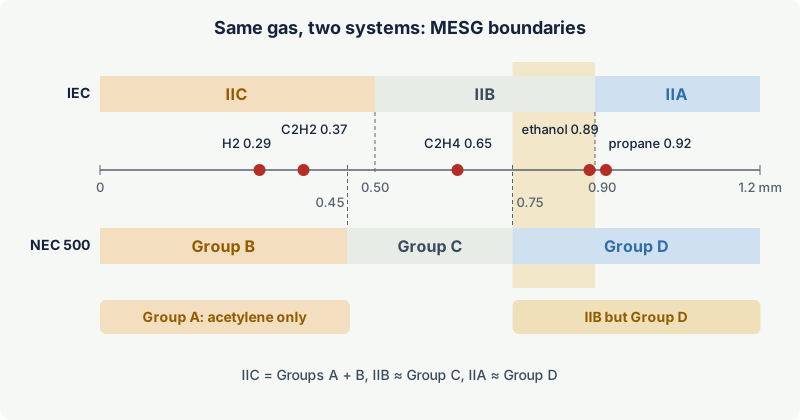
Roughly, IIA corresponds to NEC Group D (propane), IIB to Group C (ethylene) and IIC to Groups A (acetylene) and B (hydrogen) together. The letters run in opposite directions and the MESG boundaries differ, so a few substances fall into different groups.
IIA corresponds approximately to NEC Group D, IIB to Group C, and IIC to Groups A and B together: acetylene is Group A, hydrogen Group B, and both are IIC. The US National Electrical Code (NEC, NFPA 70) itself describes these pairs as equivalent, but the letters run in opposite directions and the gap boundaries are not identical, so a few substances near a boundary are grouped differently.
Short answer
| IEC / NEC Article 505 | NEC Article 500 (Divisions) | Representative gas | Severity |
|---|---|---|---|
| IIC | Group A | acetylene | most severe |
| IIC | Group B | hydrogen | most severe |
| IIB | Group C | ethylene | middle |
| IIA | Group D | propane | least severe |
- IEC groups run IIA (least severe) to IIC (most severe); NEC Division groups run A (most severe) to D (least severe). IIA and Group A are opposite ends.
- The NEC Zone system (Article 505) uses IIA, IIB and IIC directly, with practically the same boundaries as IEC.
- Always write the full designation, such as "Class I, Group D" or "IIA", never just "A" or "D".
How each system defines its groups
Both systems use the same two laboratory values: the maximum experimental safe gap (MESG), which describes how easily a flame passes a narrow joint, and the minimum igniting current (MIC) ratio, which describes how easily a spark ignites the gas. The boundaries differ.
| Group | MESG criterion | MIC ratio criterion |
|---|---|---|
| IIA (ISO/IEC 80079-20-1) | 0.90 mm or more | above 0.80 |
| IIB (ISO/IEC 80079-20-1) | above 0.50 and below 0.90 mm | 0.45 to 0.80 |
| IIC (ISO/IEC 80079-20-1) | 0.50 mm or less | below 0.45 |
| Group A (NEC 500) | acetylene only | |
| Group B (NEC 500) | 0.45 mm or less | 0.40 or less |
| Group C (NEC 500) | above 0.45 up to 0.75 mm | above 0.40 up to 0.80 |
| Group D (NEC 500) | above 0.75 mm | above 0.80 |
NEC Article 505 uses IIA, IIB and IIC with the IEC boundaries. The only differences are at the exact boundary values: an MESG of exactly 0.90 mm is IIB in Article 505 but IIA in ISO/IEC 80079-20-1, and an MIC ratio of exactly 0.45 is IIC in Article 505 but IIB in ISO/IEC 80079-20-1.
Where the two systems disagree
Because the IIB/IIA boundary sits at 0.90 mm and the C/D boundary at 0.75 mm, a substance with an MESG between 0.75 and 0.90 mm is IIB in IEC terms but Group D in the Division system. Ethanol is the usual example: IEC data give an MESG of 0.89 mm and group IIB, while the NEC lists ethyl alcohol with the IIA (Group D) gases. The NEC lists of typical gases also put acetaldehyde under IIB, while IEC data give an MESG of 0.92 mm and IIA. The NEC groups come from North American data compilations, so the group must be taken from the table that belongs to the code being applied.
At the top of the scale, IIC is one group in IEC terms, but the NEC separates acetylene (Group A) from hydrogen and similar gases (Group B). The IEC system handles the same difference with the intermediate marking IIB + H2: equipment suitable for IIB and hydrogen but not for acetylene or carbon disulphide. Under the NEC Division system, equipment is listed for the groups printed on its label, so "Class I, Group B, C, D" equipment does not cover acetylene.
Applying it on a North American project
- Find which system the location uses. A Division classification gives Class I, Division 1 or 2, Group A to D; a Zone classification under Article 505 gives Zone 0, 1 or 2 with IIA, IIB or IIC.
- Check the equipment marking against that system. Division equipment is marked with the groups it is listed for, such as "Class I, Div 1, Groups C, D". Zone equipment is marked with IIA, IIB or IIC, as in IEC markings.
- Do not convert a group without checking the substance. For a substance near a boundary, look up its group in the data the applicable code uses.
- Certification is a separate question. The NEC accepts equipment listed for North America; an IEC or ATEX certificate alone is generally not accepted for onshore installations in the US and Canada, whatever the group.
Example: An ethanol tank area in the US is classified Class I, Division 2, Group D. A light fitting listed for "Class I, Div 2, Groups C, D" is acceptable. If the same tank area is in Europe, the IEC data put dry ethanol in IIB, so an ATEX luminaire marked IIA would not be acceptable, while one marked IIB or IIC would be. (ISO/IEC 80079-20-1:2017 has a second ethanol entry, IIA, for air with at least 4 % water vapour; the area classification must state which applies.)
Common mistakes
- Reading "Group A" as the IEC IIA. Group A is acetylene, the most severe NEC group.
- Treating the equivalence as exact. It is approximate; substances with an MESG between 0.75 and 0.90 mm are grouped differently.
- Assuming Group B equipment covers acetylene. Only Group A equipment does, just as IIB + H2 does not cover acetylene.
Related on excodex
- Gas groups IIA, IIB and IIC explained with typical gases
- Zones vs Divisions: IEC and ATEX zones compared with NEC Class I Division 1 and 2
- How do North American T-codes such as T2A or T3C differ from IEC T-classes?
- Can ATEX or IECEx equipment be used in the United States?
- Tools: Ex marking check; standards spaces NEC Articles 500 to 506, ISO/IEC 80079-20-1
Standards and further reading
- NFPA 70, National Electrical Code, Article 500 (Class I Groups A to D) and Article 505 (Class I Zones, groups IIA to IIC).
- ISO/IEC 80079-20-1, material characteristics for gas and vapour classification (IEC group boundaries and data).
- US Coast Guard OCS National Center of Expertise, The Drill Down 25, Material Groups (2023), with the NEC group definitions and equivalences: dco.uscg.mil
- IS/IEC 60079-20-1:2010 (Indian adoption of IEC 60079-20-1:2010), data table with MESG values: law.resource.org
- ISO/IEC 80079-20-1:2017 preview with the classification clauses: cdn.standards.iteh.ai
- OSHA hazardous locations training page (archived), Groups A to D in practice: webarchive.library.unt.edu
This article is general technical information prepared by the excodex editorial team. It does not replace the applicable standards, the equipment certificates and instructions, national regulations or the assessment of a competent person.