How do North American T-codes such as T2A or T3C differ from IEC T-classes?
Abstract
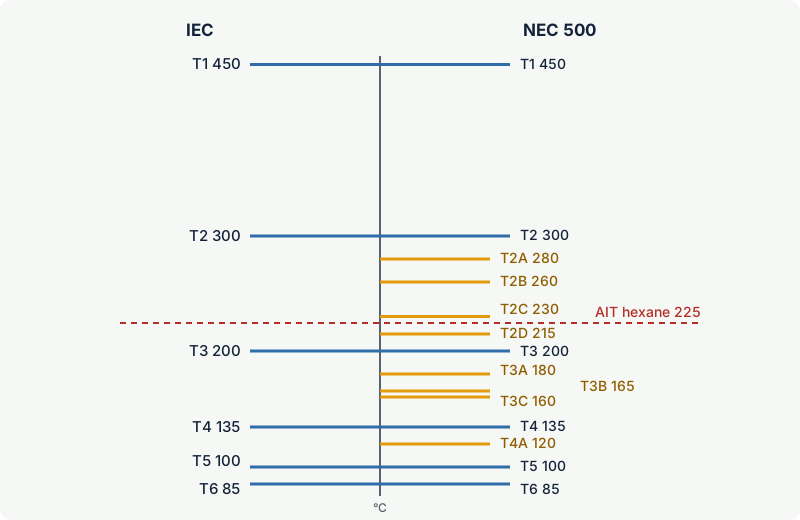
The NEC Division system adds eight codes between the IEC classes: T2A 280, T2B 260, T2C 230, T2D 215, T3A 180, T3B 165, T3C 160 and T4A 120 °C. T1 to T6 keep the IEC limits. The finer steps allow hotter equipment where a gas AIT sits just above a class limit.
They use the same principle and the same six main limits, but the North American Class and Division system adds eight intermediate codes. T2A to T2D (280 to 215 °C), T3A to T3C (180 to 160 °C) and T4A (120 °C) give finer steps between the IEC classes. A T-code is acceptable when its temperature does not exceed the autoignition temperature (AIT) of the gas, so the extra steps let somewhat hotter equipment be used for gases whose AIT lies just above a class limit.
Short answer
- IEC (and NEC Article 505 for Zones): six classes, T1 450, T2 300, T3 200, T4 135, T5 100 and T6 85 °C.
- NEC Article 500 (Divisions), Table 500.8(C): the same six plus T2A 280, T2B 260, T2C 230, T2D 215, T3A 180, T3B 165, T3C 160 and T4A 120 °C.
- Rule in both systems: the marked temperature must not exceed the AIT of the gas or vapour.
- In IEC terms a T2A to T2D device is only T2, a T3A to T3C device is T3 and a T4A device is T4.
- US temperature markings are based on operation in a 40 °C ambient (29 CFR 1910.307); equipment for hotter ambients is marked with its ambient range.
- Under the 2017 NEC, non-heat-producing equipment (junction boxes, conduit, fittings) and heat-producing equipment that stays at or below 100 °C need no temperature marking at all.
The two tables side by side
| Maximum surface temperature | IEC class | NEC Article 500 code |
|---|---|---|
| 450 °C | T1 | T1 |
| 300 °C | T2 | T2 |
| 280 °C | (none) | T2A |
| 260 °C | (none) | T2B |
| 230 °C | (none) | T2C |
| 215 °C | (none) | T2D |
| 200 °C | T3 | T3 |
| 180 °C | (none) | T3A |
| 165 °C | (none) | T3B |
| 160 °C | (none) | T3C |
| 135 °C | T4 | T4 |
| 120 °C | (none) | T4A |
| 100 °C | T5 | T5 |
| 85 °C | T6 | T6 |
Values from the 2017 edition of NFPA 70, the National Electrical Code (NEC), Tables 500.8(C) and 505.9(D)(1); the 2026 edition is now current, so check the table and section numbers in the edition adopted locally. Article 505, which applies the IEC-style Zone system in the United States, uses only T1 to T6, but it allows equipment identified for Divisions, and marked with Division codes, where 505.20 permits it.
Why the intermediate codes matter
The selection rule is the same in both systems: NEC 500.8(D)(1) states that the temperature marking must not exceed the AIT of the specific gas or vapour, and IEC 60079-0 states that the maximum surface temperature must not exceed the lowest ignition temperature. The difference is only resolution.
The IEC scale jumps from 300 to 200 °C. A gas with an AIT of 225 °C therefore needs T3 equipment, even though a device that never exceeds 215 °C would be safe by the same rule. The NEC scale can express that: a luminaire marked T2D (215 °C) is acceptable for hexane (AIT 225 °C in the excodex library), and one marked T2C (230 °C) is not. For lighting, heaters and motors, where every degree costs power, the finer codes can make a real difference.
Converting between the systems
NEC code to IEC requirement. Round down to the main number: T2A to T2D are hotter than 200 °C and only satisfy an IEC T2 requirement; T3A to T3C satisfy T3; T4A satisfies T4. A T3C device (160 °C) does not satisfy T4 (135 °C).
IEC class to NEC requirement. Each IEC class has an NEC code with the same limit, so IEC T3 equipment satisfies a T3 requirement and every hotter code (T2D, T2C and so on up to T1), but not T3A, T3B or T3C.
Gas data to code. Use the AIT, not the IEC class of the gas. A North American area drawing may say "Class I, Division 1, Group D, T2D" because the actual AIT allows it, while the same substance in an IEC drawing is "IIA T3".
Example: A US plant handles a solvent with an AIT of 235 °C. The area is marked T2C (230 °C). A listed explosionproof luminaire marked T2B (260 °C) is not acceptable; one marked T2C, T2D or T3 is. If the plant later buys IECEx-certified equipment for a Zone area, the same solvent needs IEC T3, because a T2C rating does not exist in IEC.
Common mistakes
- Reading T2A as cooler than T2D. Within a group the letters go from hotter to cooler: T2A 280 °C, T2D 215 °C.
- Treating T3C as T4. 160 °C is still above the T4 limit of 135 °C.
- Comparing the area code instead of the AIT. A T2D area requirement is met by T2D, T3, T4 and cooler equipment, not by T2C.
- Forgetting the ambient reference. Both systems mark the class for a stated ambient range. The 2017 NEC needs no ambient marking for -25 to +40 °C (Article 500) or -20 to +40 °C (Article 505); other ranges are marked with Ta or Tamb.
- Assuming certificates are interchangeable. Onshore US and Canada do not accept IECEx certificates directly; the temperature marking is only one of the differences.
Related on excodex
- Temperature classes T1 to T6: matching surface temperature to autoignition temperature
- North American hazardous location approvals: NEC 500/505/506, UL, CSA and FM
- How do IEC gas groups IIA, IIB and IIC compare with NEC Groups A, B, C and D?
- What does a marking like T85 °C or T135 °C mean instead of T1-T6?
- Tools: Ex marking check, standards space NEC 500 to 506
Standards and further reading
- NFPA 70, National Electrical Code, Articles 500 and 505 (temperature marking tables; 2017 edition checked, 2026 edition current; check the edition adopted locally).
- IEC 60079-0, general requirements (temperature classes T1 to T6).
- ISO/IEC 80079-20-1, AIT data and temperature class of gases and vapours.
- NFPA 70 (2017), public copy: archive.org
- 29 CFR 1910.307, hazardous (classified) locations, marking at 40 °C ambient and temperature not above the ignition temperature: ecfr.gov
- IS/IEC 60079-20-1:2010 public copy (temperature class table for gases): law.resource.org
This article is general technical information prepared by the excodex editorial team. It does not replace the applicable standards, the equipment certificates and instructions, national regulations or the assessment of a competent person.