Do small hot components have to meet the full temperature class limit?
Abstract
Not always. IEC 60079-0 lets very small components exceed the class limit if an ignition test shows they cannot ignite the gas, or, for T4 and T5, if they meet size-based limits such as 275 °C below 20 mm2. The certifier applies these rules; users go by the marked class.
Not always. IEC 60079-0 allows small components, such as transistors, resistors or sensor elements, to run hotter than the temperature class limit under defined conditions: either a small component ignition test shows that they cannot ignite the gas, or, for classes T4 and T5, they stay within limits that depend on their surface area. Everything else must meet the full limit. These are certification rules applied by the manufacturer and the certifier; the user simply relies on the marked class.
Short answer
- Why it is allowed: a tiny hot surface heats only a thin, moving layer of gas and needs a higher temperature to ignite it than the tabulated autoignition temperature.
- Route 1, any class: a small component ignition test in a specified gas-air mixture shows no ignition, and the heat does not impair the type of protection.
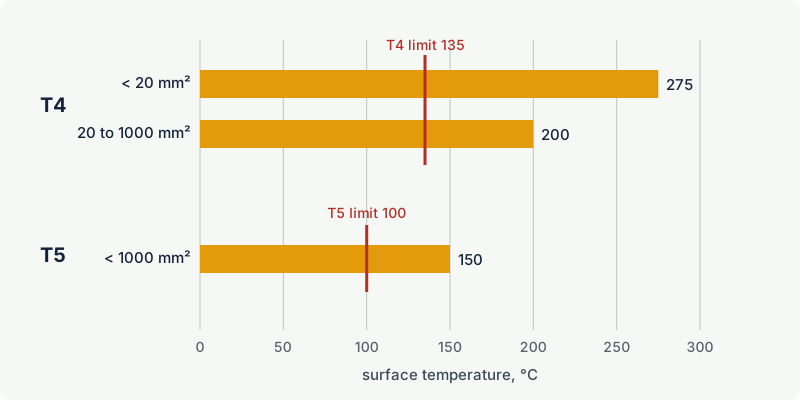
- Route 2, T4: in the published tables, components below 20 mm2 may reach 275 °C; from 20 to 1,000 mm2, 200 °C, or the component must dissipate no more than 1.3 W at 40 °C ambient.
- Route 3, T5: components below 1,000 mm2 may reach 150 °C.
- Limits: the rules are for gas (Group II) and mining (Group I) equipment, not for dust. Edition 8 of IEC 60079-0 (2026) changed the small component clause, so the current edition decides the details.
The size-based limits
| Class | Class limit | Total surface area (without leads) | Permitted for the small component |
|---|---|---|---|
| T4 | 135 °C | below 20 mm2 | 275 °C |
| T4 | 135 °C | 20 to 1,000 mm2 | 200 °C, or at most 1.3 W dissipated |
| T4 | 135 °C | above 1,000 mm2 | at most 1.3 W dissipated |
| T5 | 100 °C | below 1,000 mm2 | 150 °C |
| Group I (coal dust excluded) | 150 °C or 450 °C | below 20 mm2 | 950 °C |
These values come from the public 2004 and 2007 editions of IEC 60079-0. The 1.3 W limit falls with ambient temperature, to 1.2 W at 60 °C and 1.0 W at 80 °C. IEC 60079-11:2011 still refers to the 200 °C, 275 °C and 950 °C values and states that the usual 5 K and 10 K test margins do not apply to them. ISO 80079-36:2016 uses the same surface-area limits for small hot surfaces of non-electrical equipment.
There is no size table for T1 to T3 or for T6. For those classes, a component may exceed the limit only through the small component ignition test or the smooth-surface allowance described below, which rests on tests in the explosive mixture or, in the older public editions, on experience with similar components.
How the rules have changed
- Edition 7 (2017) clarified that the temperature used in these rules is that of the air around the component, and corrected the separate allowance for slightly larger smooth surfaces from 1,000 to 10,000 mm2. That allowance needs evidence of no ignition with a safety margin, given in the older public editions as 50 K for T1 to T3 and 25 K for T4 to T6 and Group I.
- Edition 8 (2026) keeps two assessment tables (by component size, and for surface areas of 20 mm2 and more), moved the definition of the local temperature out of the table into the terms and definitions, extended the requirements to components whose connection leads or heat transfer connections are integrated into the component body, clarified how the safety margin is applied to smooth surfaces, and clarified the ignition test procedure.
Because the edition 8 text is not public, check the values against the edition the equipment was certified to.
Where it matters in practice
- Electronics in intrinsically safe and Ex e equipment. Resistors, diodes and voltage regulators in fault conditions can run hotter than 135 °C; the small component rules let the equipment still be T4.
- Lamps. IEC 60079-7 lets a lamp in an Ex e luminaire exceed the class under the small component rules, or, for larger lamps, only after ignition tests showing its surface stays at least 50 K below the autoignition temperature of the specific gas marked on the luminaire.
- Catalytic surfaces. IEC 60079-11 advises specialist advice where a catalytic or other chemical reaction can occur; small size does not help if the surface promotes reaction.
Example: A T4 transmitter contains a 10 mm2 resistor that reaches 240 °C under the fault conditions of its intrinsic safety level. It is below 20 mm2 and below 275 °C, so the T4 marking can stand. The same resistor in a T5 or T6 design would need the ignition test or a cooler design.
Common mistakes
- Applying the rule on site. A user cannot accept a hot spot on uncertified plant because "it is small". Uncertified surfaces must meet the autoignition temperature with margin; see Why can a small hot surface exceed the autoignition temperature without igniting gas?.
- Using it for dust. Dust equipment is judged by the enclosure surface temperature.
Related on excodex
- Temperature classes T1 to T6: matching surface temperature to autoignition temperature
- Hot surfaces in hazardous areas: luminaires, motors, heat tracing and process heat
- Why can a small hot surface exceed the autoignition temperature without igniting gas?
- Is the temperature class based on normal operation or also on faults?
- IEC 60079-0 standards space
Standards and further reading
- IEC 60079-0, equipment general requirements (small component temperature and small component ignition test; edition 8, 2026). Edition 8 change list: cdn.standards.iteh.ai; edition 7 change list: vde-verlag.de
- IEC 60079-0:2004 and IS/IEC 60079-0:2007, public texts with the small component tables: law.resource.org, archive.org
- IEC 60079-11:2011, intrinsic safety, temperature of small components: law.resource.org
- IEC 60079-7:2015, increased safety, lamp surface temperatures: law.resource.org
- ISO 80079-36:2016, non-electrical equipment, small surface areas: law.resource.org
This article is general technical information prepared by the excodex editorial team. It does not replace the applicable standards, the equipment certificates and instructions, national regulations or the assessment of a competent person.