Why can a small hot surface exceed the autoignition temperature without igniting gas?
Abstract
Autoignition temperature is measured with the whole mixture in a heated vessel for up to 5 minutes. A small hot spot in open gas heats only a thin, moving layer that loses heat fast, so it needs more. IEC 60079-0 credits this only via its small component rules or a test.
Because the autoignition temperature (AIT) is measured under conditions that favour ignition: the whole fuel and air mixture sits inside a uniformly heated vessel and is given up to 5 minutes to ignite. A small hot surface in open gas heats only a thin layer of mixture next to it, that layer rises away by natural convection and loses its heat to the cold gas around it, so a higher surface temperature is needed, and the smaller the surface, the higher it is. Equipment standards use this effect only in a controlled way: IEC 60079-0 has specific small component rules and an ignition test, not a general allowance.
Short answer
- AIT is a test result, not a fixed property. ISO/IEC 80079-20-1 says the value depends on the test method, and the US test method ASTM E659 notes that larger vessels give lower values.
- German rule TRGS 723 states that thin tubes, spheres and other convex hot bodies need a higher wall temperature to ignite gas, rising as the diameter falls.
- IEC 60079-0 allows small components to be assessed against tables based on their surface area, or by a small component ignition test. Outside those rules the temperature class limit applies to every surface.
- The reverse also holds: TRGS 723 warns that large hot vessels with a uniform wall temperature may ignite a mixture below the tabulated AIT.
How the autoignition temperature is measured
ISO/IEC 80079-20-1 (formerly IEC 60079-20-1) defines the AIT as the lowest surface temperature at which, under specified test conditions, a flammable gas or vapour mixed with air ignites, shown by a clearly perceptible flame or explosion within an ignition delay of up to 5 minutes. The sample is injected into a flask inside a heated oven, and the lowest temperature that gives ignition is recorded.
These conditions are deliberately severe: walls and gas are all at the test temperature, the mixture is confined so the heat of slow early reactions stays in it, and it has minutes to react. That makes the AIT a conservative basis for temperature classes.
Why a small hot surface needs a higher temperature
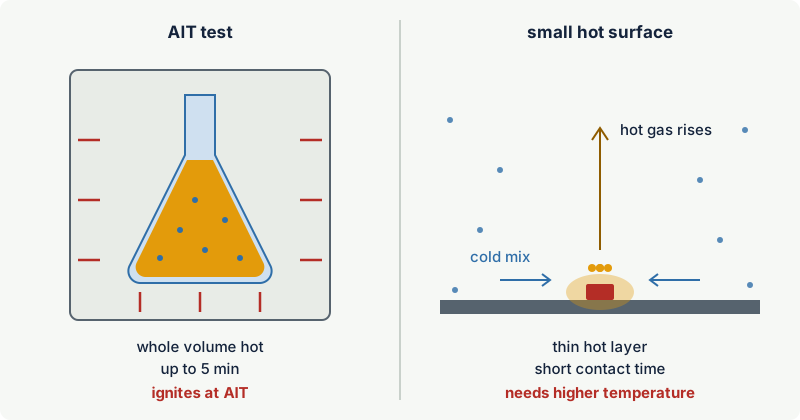
Around a small hot body, the situation is reversed:
- Only a thin layer is hot. The temperature falls steeply within a short distance of the surface, so only a small volume of mixture reaches a reacting temperature.
- The gas does not stay. Heated gas is lighter and rises in a convection plume, so each small parcel is in contact with the surface for a short time and is replaced by cold mixture. Forced air flow has the same effect.
- Heat is lost in all directions. A convex body such as a wire, a small resistor or a thin tube is surrounded by cold gas, which absorbs the heat released by the first reactions before a flame can form.
The smaller the hot body, the stronger these effects, so a hot spot of a few square millimetres above the AIT may not ignite a mixture that a large hot plate at the same temperature would.
Warning: This explains why small hot spots can be safe. It does not prove that a particular one is. The margin depends on the gas, the size and shape of the hot body, its material and the air movement.
What the standards allow
Equipment design. IEC 60079-0 (edition 8, 2026) contains a clause on small component temperature for Group I and Group II equipment, with tables that relate the permissible temperature for a given temperature class to the component's surface area, and a separate small component ignition test. Edition 8 changed the rules for components whose electrical connection leads or thermal connections are built into the component body, and clarified the ignition test procedure. Designers of sensors with small heated elements use these rules; the assessment is part of certification, with values from the current edition.
Plant operation. TRGS 723 allows the surface temperature limits to be exceeded for very small hot surfaces only where reliable evidence shows that no ignition is to be expected. It also warns about the opposite case: large concave structures such as vessels with a uniform surface temperature may ignite a mixture below the standard ignition temperature, so permissible temperatures must be set individually there.
Open-air hot surfaces in hydrocarbon plants. API RP 2216, as quoted by the Australian offshore regulator NOPSEMA, concludes that ignition of hydrocarbons by a hot surface in the open air should not be assumed unless the surface is roughly 360 °F above the accepted minimum ignition temperature of the hydrocarbon (stated in the API text as 182 °C; as a temperature difference 360 °F is about 200 K). The Energy Institute stresses that this is a rule of thumb and not a definite limit. It is used in assessing process hot surfaces, never for certifying equipment.
Common mistakes
- Treating the AIT as an exact threshold. It depends on the test vessel and conditions; it is a conservative reference, not a physical constant.
- Using the open-air rule of thumb for enclosures. In enclosed, poorly ventilated spaces the gas stays in contact much longer.
- Assuming any small hot part is acceptable. Only the small component rules or the ignition test of IEC 60079-0 justify exceeding the class limit.
Related on excodex
- Flash point, autoignition temperature and minimum ignition energy: what is the difference?
- Temperature classes T1 to T6: matching surface temperature to autoignition temperature
- Hot surfaces in hazardous areas: luminaires, motors, heat tracing and process heat
- Do small hot components have to meet the full temperature class limit?
- IEC 60079-0 standards space
Standards and further reading
- IEC 60079-0, Explosive atmospheres: equipment, general requirements (edition 8, 2026), clauses on small component temperature and the small component ignition test.
- ISO/IEC 80079-20-1, Explosive atmospheres: material characteristics for gas and vapour classification, test methods and data (2017); public preview: https://standards.iteh.ai/catalog/standards/iec/1bf4ec16-63c8-413f-9547-99bad8173a93/iso-iec-80079-20-1-2017
- ASTM E659, Standard test method for autoignition temperature of chemicals: https://store.astm.org/e0659-15r23.html
- API RP 2216, Ignition risk of hydrocarbon liquids and vapours by hot surfaces in the open air.
- TRGS 723 (Germany), Hazardous explosive mixtures: avoidance of ignition sources, section 5 (hot surfaces): https://vorschriften.bgn-branchenwissen.de/daten/tr/trgs723/5.htm
- NOPSEMA (Australia), Management of hot surfaces, information paper (2021): https://www.nopsema.gov.au/sites/default/files/documents/2021-10/Management%20of%20Hot%20Surfaces%20%28A779428%29.pdf
This article is general technical information prepared by the excodex editorial team. It does not replace the applicable standards, the equipment certificates and instructions, national regulations or the assessment of a competent person.