What does the four-digit number after the CE mark on ATEX equipment mean?
Abstract
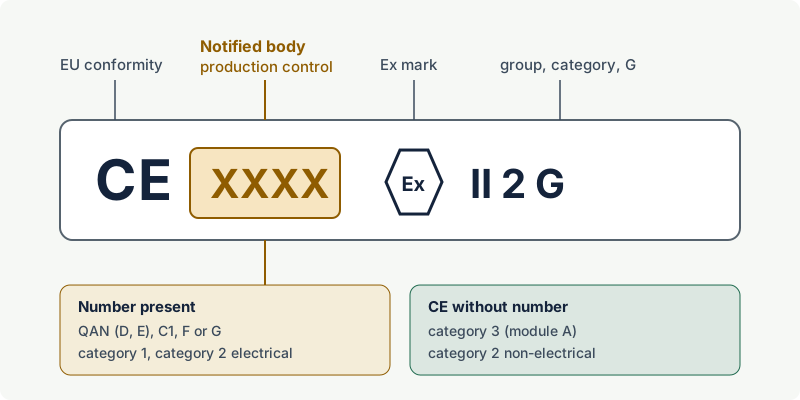
It identifies the notified body involved in production control, usually the body that issued and audits the manufacturer's QAN, not necessarily the one that issued the EU-type examination certificate. Category 3 and category 2 non-electrical equipment carry no number.
The four-digit number is the identification number of a notified body, assigned by the European Commission. Under Article 16(3) of Directive 2014/34/EU it follows the CE marking only when that body is involved in the production control phase: in most cases it is the body that approved and audits the manufacturer's production quality system (the QAN). It is not necessarily the body that issued the EU-type examination certificate for the design.
Short answer
- Format: the Commission gives each notified body one four-digit number ("NB xxxx"), the same for all EU acts under which it is notified (Article 26 of the directive).
- Meaning on an ATEX label: the body responsible for production control under module D (Annex IV, production quality assurance), module E (Annex VII, product quality assurance), module C1 (Annex VI, supervised product testing), module F (Annex V, product verification) or module G (Annex IX, unit verification).
- Different from the type certificate: the EU-type examination certificate can come from another notified body; that body is identified on the certificate and in the EU declaration of conformity, not after the CE marking.
- No number for category 3 equipment (except after unit verification), for category 2 non-electrical equipment whose file was only deposited with a notified body, and for voluntary certifications.
- Components carry the notified body number where required, but no CE marking.
- Order on the label: CE, the notified body number, the Ex hexagon, then the group and category, for example
CE XXXXfollowed by the hexagon andII 2 G.
Why the number shows production control, not the design approval
ATEX conformity assessment for category 1 and category 2 electrical equipment has two parts. The design is examined once (module B, EU-type examination), and then production is controlled for as long as the product is made. The Commission's ATEX Guidelines point out that a notified body may be involved in the design phase, the production phase or both, and that its number only accompanies the CE marking if it is involved in production control. The number thus tells market surveillance authorities and users which body is currently watching the factory.
Often the same body does both, and the type certificate number and the number after CE then refer to the same organisation. But they can differ. The Guidelines describe a trade agent who obtains its own type examination certificate based on another manufacturer's certificate and whose quality system is approved by a second notified body: the CE marking on its products carries the second body's number. More generally, Annexes IV and VII let the manufacturer apply for the assessment of its quality system to the notified body of its choice, which need not be the body that issued the type certificate.
The directive also says who applies the number: the notified body itself or, under its instructions, the manufacturer or its authorised representative. The CE marking and the number need not be applied in the EU; they may be applied in the country of manufacture.
When CE appears without a number
| Equipment | Procedure | Number after CE? |
|---|---|---|
| Category 1 or M1 | B + D or F | Yes |
| Category 2 or M2, electrical or engine | B + E or C1 | Yes |
| Category 2 or M2, non-electrical | A + deposit of technical file | No |
| Category 3 | A | No |
| Any category, single unit | G | Yes |
The Guidelines warn against misleading numbers: a notified body number should not be affixed where the directive does not foresee it, such as on category 3 equipment under internal production control or on the basis of a voluntary assessment.
Example: A pressure transmitter is marked CE XXXX with the hexagon and II 1/2 G. Its EU-type examination certificate was issued by a notified body with the number YYYY. The buyer looks up both numbers in the Commission's notified bodies list (NANDO): XXXX is notified under 2014/34/EU for Annex IV and holds the factory's QAN, YYYY is notified for Annex III. The combination is plausible. The EU declaration of conformity names the type examination body and, as the Guidelines recommend where the bodies differ, the QAN body as well; naming the production body is not mandatory.
How to check a notified body number
- Search the number in the Commission's list of notified bodies (NANDO, now part of the Single Market Compliance Space).
- Confirm that the body is notified under Directive 2014/34/EU and for the module that matches the product (for example Annex IV for a QAN).
- Compare with the EU declaration of conformity and, if available, the QAN.
Common mistakes
- Assuming the number is the certificate issuer. It identifies the production control body.
- Treating a number on category 3 equipment as extra quality. Unless the unit was individually verified, it is misleading.
- Searching the number on the IECEx website. Notified bodies are listed by the European Commission.
Related on excodex
- EU-Type Examination Certificates and Notified Bodies explained
- The ATEX Declaration of Conformity and the CE and Ex marking: what must be on the label
- How to read an Ex marking: decoding II 2 G Ex db IIC T4 Gb step by step
- How do I check that the notified body number on an ATEX label is real?
- Tool: Ex marking check
Standards and further reading
- Directive 2014/34/EU, Article 16 (rules for affixing the CE marking and the notified body number) Article 13, and Article 26 (identification numbers): legislation.gov.uk, Article 13 and Article 26
- European Commission, ATEX 2014/34/EU Guidelines, 6th edition, January 2026 (identification numbers, marking of components, trade agent cases): ec.europa.eu
- European Commission, notified bodies and the NANDO list: ec.europa.eu
This article is general technical information prepared by the excodex editorial team. It does not replace the applicable standards, the equipment certificates and instructions, national regulations or the assessment of a competent person.