Is the CE mark alone enough to show equipment is ATEX compliant?
Abstract
No. A CE mark can relate to other EU laws only. ATEX equipment must also carry the Ex hexagon with equipment group, category and G or D, the other Annex II particulars, and come with an EU declaration of conformity that names Directive 2014/34/EU.
No. The CE mark only says that the manufacturer declares conformity with whichever EU laws apply to the product, and for many products that never includes the ATEX directive. Equipment for explosive atmospheres must also carry the specific marking of explosion protection (the Ex hexagon) followed by the equipment group, the category and the letter G and/or D. It must also come with an EU declaration of conformity that names Directive 2014/34/EU.
Short answer
- CE alone is not enough. A pressure transmitter or a motor may be CE marked under the low voltage, EMC or machinery rules and still not be ATEX equipment.
- The ATEX label needs more. Directive 2014/34/EU, Annex II point 1.0.5, requires as a minimum: the manufacturer's name and address, the CE marking, series or type, serial or batch number if any, year of construction, and the Ex hexagon with group and category (and G or D for group II). Any other information essential for safe use must be marked too.
- The notified body number after CE is not always there. It is required only where a notified body takes part in the production control phase, for example category 1 equipment and category 2 electrical equipment. Category 3 equipment correctly has no number.
- Paperwork must come with the product. Each product, or each batch delivered to one user, must be accompanied by a copy of the EU declaration of conformity and by instructions in a language the users understand.
- Compliant is not the same as suitable. Even with all the marks, check that the category, gas or dust group, temperature class, ambient range and any specific conditions (
X) fit the zone.
Why the CE mark says too little
The CE marking is a single mark for all EU product legislation. When a product falls under several directives, the CE mark means the manufacturer declares conformity with all of them. It does not show which ones. The European Commission's ATEX Guidelines (6th edition, January 2026) describe the CE marking as the manufacturer's declaration that the product conforms to the applicable requirements and has passed the appropriate conformity assessment procedures. It is the manufacturer's own declaration, not an approval issued by an authority.
That is why the ATEX directive adds its own marking. Article 16 says that the CE marking, and where applicable the notified body number, shall be followed by the specific marking of explosion protection, the symbols of the equipment group and category and the other information of Annex II. Article 6 requires the manufacturer to put the Ex hexagon on every product other than a component. Without the hexagon, group and category, nothing on the label claims that the product may be used in a potentially explosive atmosphere.
Components are the exception the other way round. An ATEX component, such as an empty flameproof enclosure or a terminal block, carries no CE marking. It is delivered with a written attestation of conformity, and the manufacturer who builds it into equipment takes responsibility for the result.
What to check when ATEX equipment is delivered
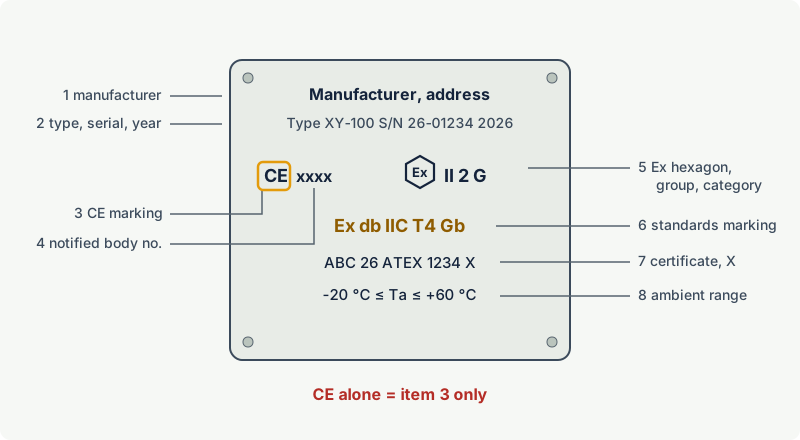
| Item | Where | What to check |
|---|---|---|
| CE marking | Nameplate | Present, legible, at least 5 mm high unless the product is very small |
| Notified body number | Directly after CE | Expected for category 1 and category 2 electrical equipment; normally absent for category 3 |
| Ex hexagon, group, category, G/D | Nameplate | For example II 2 G; category fits the zone (Zone 1 needs category 1 or 2) |
| Standards marking | Nameplate | For example Ex db IIC T4 Gb: protection type, gas group, temperature class, EPL |
| Certificate number | Nameplate | EU-type examination certificate where required; a final X means read the specific conditions of use |
| Manufacturer, type, serial, year | Nameplate | Match the delivery note and the declaration |
| EU declaration of conformity | With the delivery | Names Directive 2014/34/EU, lists the harmonised standards, the notified body where involved, the marking, and is signed |
| Instructions | With the delivery | In a language end users easily understand, as set by the country of use; repeat the marking; give safe use, installation and maintenance information |
The standards marking (the Ex db IIC T4 Gb line) comes from the harmonised EN IEC 60079 and EN ISO 80079 standards rather than from the directive itself. The directive only says that information essential for safe use must be marked. In practice it is the line you use to match the equipment to the gas group and temperature class of the area.
Example: A level transmitter arrives for a Zone 1 tank. The nameplate shows CE, IP66 and the supply voltage, and the declaration lists the EMC and low voltage directives only. There is no Ex hexagon and no reference to Directive 2014/34/EU. The product may be perfectly legal for a non-hazardous area, but it is not ATEX equipment and must not be installed in Zone 1. The correct variant would show, for example, CE with a four-digit body number, II 2 G and Ex db IIC T4 Gb, with a declaration naming 2014/34/EU.
Common mistakes
- Accepting a CE mark plus a certificate in place of the declaration. An EU-type examination certificate or a test report supports conformity but does not declare it. Only the manufacturer's EU declaration of conformity does that, and it must come with the product.
- Expecting a notified body number on every ATEX product. Category 3 equipment is self-certified and correctly has none.
- Accepting an Ex marking without the hexagon. A product marked only
Ex db IIC T4 Gbunder an IECEx certificate is not ATEX compliant for the EU market. - Stopping at the marking. The specific conditions behind an
Xand the instructions also form part of what makes the equipment safe in use.
Related on excodex
- The ATEX Declaration of Conformity and the CE and Ex marking: what must be on the label
- How to read an Ex marking: decoding II 2 G Ex db IIC T4 Gb step by step
- What does the four-digit number after the CE mark on ATEX equipment mean?
- Is IECEx certification accepted in the EU instead of ATEX?
- Tool: Ex marking check; standards space: ATEX 2014/34/EU
Standards and further reading
- Directive 2014/34/EU, Annex II point 1.0.5 (marking) and 1.0.6 (instructions): legislation.gov.uk
- Directive 2014/34/EU, Article 16 (rules for the CE marking), Article 14 (EU declaration of conformity) and Article 6 (obligations of manufacturers): Article 16, Article 14, Article 6
- European Commission, ATEX 2014/34/EU Guidelines, 6th edition (January 2026), sections on CE marking, supplementary marking and the EU declaration of conformity: single-market-economy.ec.europa.eu (PDF)
- IEC 60079-0, explosive atmospheres, general requirements for equipment (marking of Ex equipment)
This article is general technical information prepared by the excodex editorial team. It does not replace the applicable standards, the equipment certificates and instructions, national regulations or the assessment of a competent person.