Does a skid or panel built from ATEX-certified parts need its own ATEX certification?
Abstract
Yes, if placed on the market as one functional unit: it is then an ATEX assembly. The builder assesses the combination, keeps a technical file, marks it and signs one EU declaration. A notified body is needed only for new hazards or unproven parts, if the category requires it.
Usually yes. If you place the skid or panel on the market as a single functional unit, the European Commission treats it as an ATEX assembly and you become its manufacturer. You must assess the ignition hazards created by the combination, keep a technical file, mark the assembly and sign one EU declaration of conformity for it. A notified body is needed only if the combination adds ignition hazards or contains parts without proven conformity, and then only where the category requires one.
Short answer
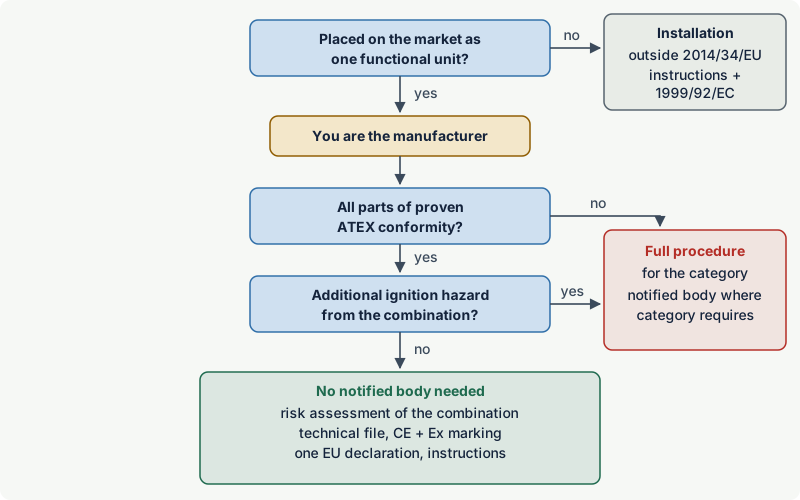
- Assembly or installation decides. Parts combined and supplied by one person as a single functional unit form an assembly within Directive 2014/34/EU. Compliant items that the end user integrates into the plant, after its own risk assessment, form an installation, which the directive does not cover.
- All parts compliant, no new ignition hazard: the assembler may presume conformity of the CE-marked equipment and of components with a written attestation. The assembler still does an ignition risk assessment of the combination, draws up a technical file, affixes CE and Ex marking and signs an EU declaration for the whole assembly. No notified body is required.
- New ignition hazard, or a part without proven conformity: the assembly goes through the conformity assessment procedure for its category. For category 1 and for category 2 electrical equipment that involves a notified body.
- Components are not finished equipment. An Ex component, such as an empty enclosure, has no CE marking. Equipment built from components is new equipment and needs its own conformity assessment.
- Installations are not free of rules. The installer must follow every manufacturer's instructions, and the employer's duties under Directive 1999/92/EC apply.
How the ATEX Guidelines define an assembly
The Commission's ATEX 2014/34/EU Guidelines (6th edition, January 2026) explain this in their section on combined equipment. Two or more pieces of equipment, with components and other parts as needed, that are electrically and mechanically interconnected into a complete functional assembly are a product within the directive. The person who places that assembly on the market or puts it into service as a single functional unit is its manufacturer.
Where every part already conforms, the assembler may limit the risk assessment to the additional ignition and other hazards that arise from the combination. The Guidelines use a pump and motor as the example. A canned or split-tube motor pump is one item of equipment and is assessed as electrical equipment. A separate pump and motor, coupled with no added ignition hazard, may be supplied either with two declarations or with one declaration for the assembly. In the second case the assembler takes complete responsibility, which needs no notified body. If the coupling adds an ignition hazard, or one item does not fully conform, the assembly needs the complete procedure for its category.
What the assembler must produce
- Ignition risk assessment of the combination: hot surfaces from heat transferred between parts, mechanical sparks at couplings or guards, static charge on added plastic parts, electrical interconnection (for example how intrinsically safe circuits are combined), and the effect of the frame or enclosure on ventilation and temperatures.
- Technical file: the assessment, the parts list with each part's declaration or attestation, drawings, the standards applied to the interconnection and any tests.
- Marking: one marking on the assembly, for example on the outer housing, so that there is no doubt it describes the whole. Where the whole assembly is intended for one zone, the weakest part defines the marking: a skid with T6 and T3 items is marked T3.
- EU declaration of conformity: covering the whole assembly and listing the items that are ATEX equipment in their own right.
- Instructions: installation, use and maintenance information for the assembly, so that it can be installed without a further conformity assessment.
Assemblies built as a modular system, such as a range of flameproof enclosures and switching devices that are combined to order, can be assessed through their worst-case configurations. The manufacturer must then define which parts may be combined and how.
Practical cases
Example: A fabricator builds a dosing skid from an ATEX pump, an ATEX motor with its own EU-type examination certificate, two ATEX pressure transmitters and an ATEX junction box. The skid is sold as one unit for Zone 1. The fabricator assesses the coupling (guarded and aligned), the cable routing and earthing, and the heat from the motor flowing into the pump. No new ignition source is found. The fabricator compiles the file, marks the skid II 2 G with the lowest temperature class of its parts and signs one EU declaration naming each ATEX item. No notified body is needed.
A panel builder who fits switchgear and terminals into an empty flameproof or increased safety enclosure certified as an Ex component is in a different position. The result is new electrical equipment, not a combination of finished equipment, so it needs the full procedure for its category. For category 2 electrical equipment that means EU-type examination by a notified body plus a production module, and the body can take the component certificates into account. The Guidelines themselves warn that a component's attestation cannot guarantee the safety of the equipment it is built into, because not every use of a component can be foreseen.
Common mistakes
- "Every part is ATEX, so the skid is ATEX." Compliant parts do not prove that the combination is safe. The assessment of interactions is the assembler's legal duty.
- Leaving the skid unmarked because the parts are marked. Sub-assembly labels may be hidden after construction; the final product needs a single marking for the assembly.
- Treating an Ex component enclosure as finished equipment. Its certificate covers the empty enclosure only.
Related on excodex
- The ATEX Declaration of Conformity and the CE and Ex marking: what must be on the label
- Combined protection concepts: Ex db eb, Ex d e terminal boxes and multiple markings
- Which ATEX equipment needs a notified body and which can be self-certified?
- Do Ex components with a U certificate carry the CE mark?
- Standards space: ATEX 2014/34/EU
Standards and further reading
- European Commission, ATEX 2014/34/EU Guidelines, 6th edition (January 2026), sections on installations, combined equipment (assemblies) with Table 1, and marking of assemblies: single-market-economy.ec.europa.eu (PDF)
- Directive 2014/34/EU, Article 6 (obligations of manufacturers) and Annex II (essential requirements, marking and instructions): Article 6, Annex II
- Directive 1999/92/EC, Annex II (minimum requirements for workplaces): legislation.gov.uk
- IEC 60079-0 and the protection type standards (for example IEC 60079-1, IEC 60079-7, IEC 60079-11) for the assessment of electrical interconnection; ISO 80079-36 and -37 for non-electrical equipment
This article is general technical information prepared by the excodex editorial team. It does not replace the applicable standards, the equipment certificates and instructions, national regulations or the assessment of a competent person.