Which ATEX equipment needs a notified body and which can be self-certified?
Abstract
Under 2014/34/EU a notified body must examine category 1 equipment, protective systems and category 2 electrical equipment and engines. Category 2 non-electrical equipment is self-assessed with the file deposited at a notified body; category 3 is fully self-assessed.
Under Directive 2014/34/EU, a notified body must examine the type and take part in production control for all category 1 (and M1) equipment, for autonomous protective systems, and for category 2 (and M2) electrical equipment and internal combustion engines. Category 2 non-electrical equipment is assessed by the manufacturer, who must deposit the technical file with a notified body. Category 3 equipment is assessed by the manufacturer alone. Unit verification by a notified body is an alternative for any of them.
Short answer
- Category 1 and M1 (Zone 0 or 20 equipment, electrical or not): EU-type examination (module B) plus production quality assurance (module D) or product verification (module F).
- Protective systems (for example flame arresters, explosion vents, suppression systems): the category 1 route or unit verification.
- Category 2 and M2 electrical equipment and internal combustion engines: EU-type examination plus product quality assurance (module E) or supervised product testing (module C1).
- Category 2 and M2 non-electrical equipment: internal production control (module A) by the manufacturer, and the technical documentation is sent to a notified body, which checks only that it is legible and complete, acknowledges receipt and keeps it (generally for 10 years). The body does not assess or certify conformity.
- Category 3: internal production control only. No notified body, no notified body number on the label.
- Components follow the procedure of the equipment they are for, but get an attestation of conformity instead of the CE marking and EU declaration.
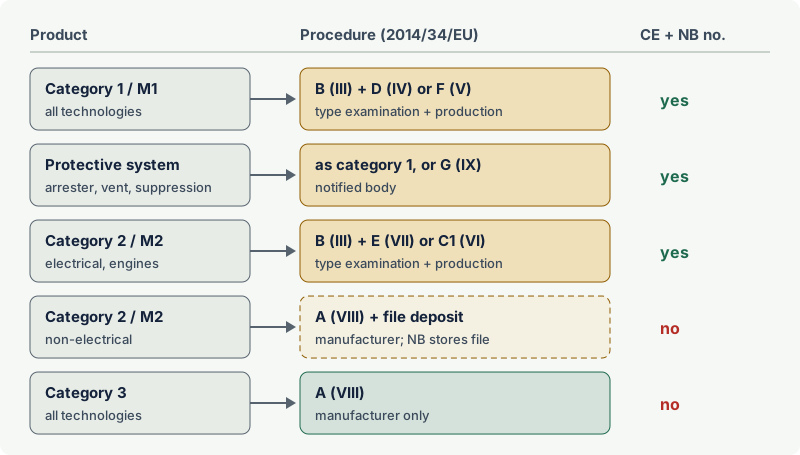
The routes in Article 13
| Product | Procedure (Annex of 2014/34/EU) | Notified body role | Number after CE? |
|---|---|---|---|
| Category M1 or 1, any technology | B (III) + D (IV) or F (V) | Type examination and production surveillance | Yes |
| Autonomous protective system | As category 1, or G (IX) | As category 1 | Yes |
| Category M2 or 2, electrical or engine | B (III) + E (VII) or C1 (VI) | Type examination and production surveillance or product test supervision | Yes |
| Category M2 or 2, non-electrical | A (VIII) + deposit of technical file | Checks the file is complete, acknowledges and keeps it; no conformity assessment | No |
| Category 3 | A (VIII) | None | No |
| Any of the above | G (IX) unit verification | Examines the individual unit | Yes |
"Self-certified" is a loose term: in module A the manufacturer does not certify anything, he draws up the technical documentation, carries out or commissions the tests, issues the EU declaration of conformity and affixes the CE and Ex marking. The legal responsibility is his alone.
The Commission's ATEX Guidelines add two clarifications that matter in practice. First, a notified body cannot issue an EU-type examination certificate for category 2 non-electrical or category 3 products, and may not list them on a certificate for other categories, because those products do not go through type examination. Second, the number of a notified body should not appear after the CE marking of category 3 equipment (except after unit verification), of category 2 non-electrical equipment, or on the basis of any voluntary certification.
How to tell which route applies
- Find the category from the intended zone. Directive 1999/92/EC links category 1 to Zone 0 or 20, category 2 to Zone 1 or 21 and category 3 to Zone 2 or 22.
- Decide whether the product is electrical. A mechanical product with only a thermocouple that counts as simple apparatus follows the non-electrical route; a pump placed on the market with its electric motor is often an assembly, and each part can follow its own route.
- Check for higher-category parts. A vapour recovery pump connected to Zone 0 pipework must meet category 1 requirements for its inlet and outlet side, so a notified body carries out an EU-type examination even though the ignition sources are mechanical (an example from the ATEX Guidelines).
- Check whether it is a protective system, which always follows the category 1 route or unit verification.
Example: A gearbox for Zone 1 (category 2 G, non-electrical, Ex h to ISO 80079-36 and -37). The manufacturer performs the ignition hazard assessment, writes the technical file, sends it to a notified body for deposit and receives a confirmation of receipt. The label shows CE and II 2 G Ex h IIB T4 Gb but no notified body number. The same gearbox with a built-in electric speed sensor that is not simple apparatus becomes an assembly, and the sensor needs its own category 2 electrical route with an EU-type examination.
Common mistakes
- Treating a deposit receipt as a certificate. For category 2 non-electrical equipment the notified body checks only that the file is complete and keeps it; it does not confirm conformity.
- Asking for an "ATEX certificate" for category 3. It does not exist under the directive; voluntary third-party reports are allowed but carry no legal status and no notified body number.
- Assuming non-electrical means no notified body. Category 1 non-electrical equipment and protective systems need one.
Related on excodex
- EU-Type Examination Certificates and Notified Bodies explained
- ATEX equipment categories 1, 2 and 3 and how they relate to EPLs
- Do non-electrical ATEX category 2 products need a notified body?
- What does the four-digit number after the CE mark on ATEX equipment mean?
- Standards space: ATEX 2014/34/EU
Standards and further reading
- Directive 2014/34/EU, Article 13 (conformity assessment procedures) and Article 16 (CE marking and notified body number): legislation.gov.uk and Article 16
- European Commission, ATEX 2014/34/EU Guidelines, 6th edition, January 2026 (Table 3 of procedures, documents issued by notified bodies, retention of technical documentation): ec.europa.eu
- Directive 1999/92/EC, Annex II part B (categories by zone): legislation.gov.uk
- ISO 80079-36 and ISO 80079-37, non-electrical equipment for explosive atmospheres: basic method and requirements, and constructional safety, control of ignition sources and liquid immersion
This article is general technical information prepared by the excodex editorial team. It does not replace the applicable standards, the equipment certificates and instructions, national regulations or the assessment of a competent person.