Do non-electrical ATEX category 2 products need a notified body?
Abstract
Only to hold the technical file. Under Article 13(1)(b)(ii) of 2014/34/EU the manufacturer uses internal production control and sends the technical documentation to a notified body, which confirms receipt and keeps it. No EU-type examination, and no body number after CE.
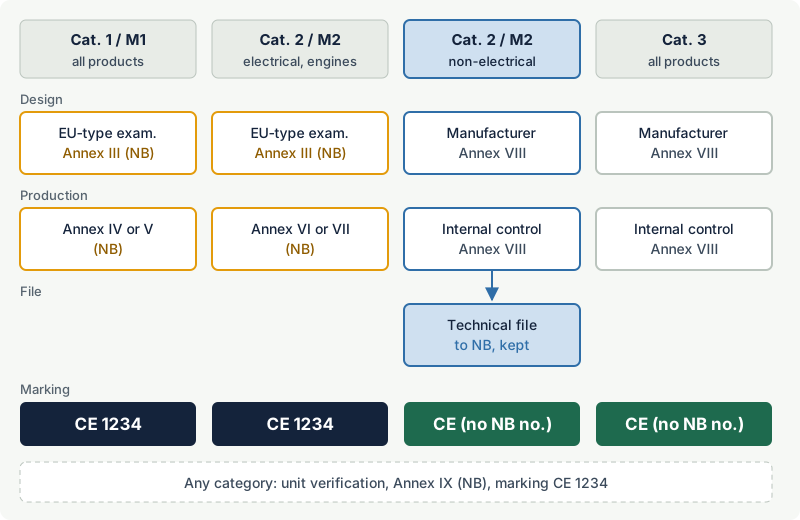
A notified body is involved, but it does not certify the product. For category 2 (and M2) equipment that is neither electrical nor an internal combustion engine, Directive 2014/34/EU requires internal production control (Module A, Annex VIII) and the communication of the technical documentation to a notified body. The body acknowledges receipt and keeps the file. The manufacturer alone assesses and declares conformity, no EU-type examination certificate is issued, and no notified body number follows the CE marking.
Short answer
- Legal basis: Article 13(1)(b)(ii) of Directive 2014/34/EU, for equipment groups I and II, categories M2 and 2, other than electrical equipment and internal combustion engines.
- Procedure: the manufacturer prepares the technical documentation, including the ignition hazard assessment, and controls production. It then draws up the EU declaration of conformity and affixes the CE marking.
- Role of the notified body: it receives the file, acknowledges receipt as soon as possible and retains it. The Commission's ATEX Guidelines say it checks legibility and completeness against the manufacturer's index but does not examine conformity.
- Marking: CE without a notified body number, then the hexagon Ex mark and
II 2 GorII 2 D. The Ex marking under ISO 80079-36 and -37 uses type of protection "h". - Exceptions: electrical equipment and internal combustion engines in category 2 need EU-type examination, and every category 1 product needs it. A measuring device that counts as simple apparatus does not make mechanical equipment electrical. Unit verification (Annex IX) is an alternative for any category.
What the procedure looks like
- Ignition hazard assessment. The manufacturer identifies every potential ignition source of the equipment (hot surfaces, mechanical sparks, static electricity, adiabatic compression and others) and the measures that keep them from becoming effective in normal operation and expected malfunction, as category 2 requires. ISO 80079-36 gives the method and ISO 80079-37 the types of protection "c" (constructional safety), "b" (control of ignition sources) and "k" (liquid immersion).
- Technical documentation. Annex VIII lists the content: product description, design and manufacturing drawings, explanations, the standards applied (or other solutions), design calculations and examinations, and test reports. The ATEX Guidelines add that the tests may be done by the manufacturer itself or by any independent laboratory it considers adequate.
- Lodge the file. The manufacturer sends the documentation to a notified body notified for this task under Article 13(1)(b)(ii). The Guidelines point out that bodies should be notified for that article, not for Annex VIII, because Annex VIII itself involves no notified body. The body issues a confirmation of deposit, typically with a reference number. It generally keeps the file for 10 years after the last product is placed on the market, so that market surveillance authorities can examine it if needed.
- Production, declaration and marking. The manufacturer ensures production matches the documentation, signs the EU declaration of conformity and marks the product. The Guidelines' notes on the declaration say that for category 2 non-electrical equipment it should refer to the notified body holding the technical file.
What the notified body does not do
| Question | Answer under Article 13(1)(b)(ii) |
|---|---|
| Does it test or examine the design? | No. It receives and keeps the file and checks it is legible and complete against the index |
| Does it issue a certificate? | No EU-type examination certificate. It confirms receipt and retention |
| Does its number appear after CE? | No. Article 16(3) requires the number only where a body is involved in the production control phase |
| Does it audit the factory? | No. Production control is internal |
| Who is responsible for conformity? | The manufacturer alone |
Many manufacturers still pay a certification body for a voluntary assessment of the design, because customers ask for third-party evidence. That is allowed, but the Guidelines are clear that a voluntary certificate must not show a notified body number or the CE marking. The product label must not carry the body's number either. A voluntary certificate belongs in the technical file as evidence. It does not belong on the declaration of conformity.
Example: A gearbox manufacturer supplies category 2 gearboxes for Zone 1. It files its ignition hazard assessment, drawings and test reports with a notified body, receives a deposit confirmation, and marks CE II 2 G Ex h IIB T4 Gb. A thermocouple fitted to monitor oil temperature does not change this if it counts as simple apparatus and the gearbox has no other electrical parts, as the ATEX Guidelines explain. If the gearbox is sold with a separately certified motor and no additional ignition hazard arises from the combination, motor and gearbox can each keep their own declaration. If the assembler supplies one declaration for the whole unit, it carries out the ignition risk assessment of the combination. A fan in which the fan is an integral part of the motor, by contrast, is assessed as electrical equipment as a whole.
Common mistakes
- Putting the filing body's number after CE. That suggests a production-phase intervention that did not happen.
- Calling the deposit receipt an "ATEX certificate". It confirms receipt of documents, not conformity.
- Skipping the deposit for category 2. Category 3 needs no notified body. Category 2 non-electrical does.
- Treating "non-electrical" too broadly. Motors, heaters, solenoids or sensors that are not simple apparatus need the electrical procedure, either for those parts or, where they cannot be separated, for the whole product.
Related on excodex
- EU-Type Examination Certificates and Notified Bodies explained
- Non-electrical equipment in hazardous areas: Ex h, constructional safety c, control of ignition sources b and liquid immersion k
- Which ATEX equipment needs a notified body?
- What does the number after the CE mark mean on ATEX equipment?
- Standards spaces: ISO 80079-36, ISO 80079-37, ATEX 2014/34/EU
Standards and further reading
- Directive 2014/34/EU, Article 13 (conformity assessment procedures), Article 16 (CE marking and notified body number) and Annex VIII (internal production control): legislation.gov.uk, Article 13, Annex VIII
- European Commission, ATEX 2014/34/EU Guidelines, 6th edition (January 2026), section 113 (retention of technical documentation), section 217 (technical documentation under Module A), sections 42 to 44 (non-electrical, electrical and combined equipment), notes on voluntary certificates and on the declaration of conformity: Guidelines PDF
- ISO 80079-36, non-electrical equipment for explosive atmospheres: basic method and requirements.
- ISO 80079-37, non-electrical equipment: constructional safety "c", control of ignition sources "b", liquid immersion "k".
This article is general technical information prepared by the excodex editorial team. It does not replace the applicable standards, the equipment certificates and instructions, national regulations or the assessment of a competent person.