Why does an IECEx certificate show issue numbers, and which one is valid?
Abstract
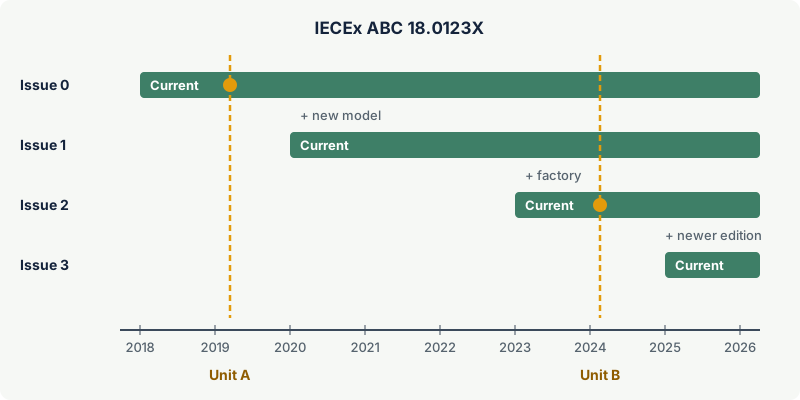
Each change to an IECEx certificate, such as a new model, factory or standard edition, is published as a new issue under the same number. A new issue does not cancel earlier ones: every issue shown as Current online is valid. Use the issue that covers your unit.
An IECEx certificate of conformity keeps one number for its whole life, but every change to it is published as a new issue: Issue 0 is the original, and Issue 1, 2 and so on follow design changes, added factories, a change of audit body or an update to a newer standard edition. A new issue does not cancel the earlier ones. Every issue whose status is shown as Current in the IECEx online certificate system is valid. The issue that matters for a given unit is the one that lists its model, marking and factory and was in force when it was made.
Short answer
- The certificate number (for example
IECEx ABC 18.0123X, with a placeholder body code) names the scheme, the issuing certification body, the year and a serial number. The issue number is shown separately on the certificate. - New issues are created when the manufacturer changes the certified design and the certification body decides an up-issue is needed, when manufacturing locations are added, when the body that carries out surveillance audits changes, or when the manufacturer asks for certification to a newer edition.
- From Issue 1 onward the certificate contains a section Details of certificate changes that describes what changed from the previous issue.
- According to the IECEx FAQ, an up-issued certificate does not cancel or supersede previous issues; they remain Current until cancelled or suspended.
- IECEx certificates have no expiry date. The version in the online system is the master; a PDF or printout is an uncontrolled copy.
Why earlier issues stay valid
An issue records what the certification body confirmed at that moment: the models, ratings, marking, standards and factories listed in it. Equipment built while that issue was Current, and matching its content, remains certified even after later issues appear. A new issue usually adds or changes something: a new model variant, a further factory, an updated standards list. It does not withdraw the earlier assessment.
The certificate history on the first page of each issue lists the earlier issues with their dates, so a reader can see the whole chain.
How to find the issue that covers your equipment
- Read the nameplate. IEC 60079-0 asks for the certificate reference, which incorporates the year of the certificate and a serial number, not the issue number. The plate alone rarely tells you which issue applies.
- Open the certificate online in the IECEx online certificate system and check the status: Current, Suspended or Cancelled.
- Look through the issues for the one that lists your exact model or type code, the marking on the plate and the factory that made the unit.
- Compare dates. The unit's date of manufacture should fall on or after the date of the issue you rely on. A unit made in 2019 cannot rely on a model variant added in 2023.
- Read the conditions (the X conditions or, for components, the U limitations) in that issue, and check the instructions supplied with the unit against them.
Example: A supplier sends the latest issue of a certificate, but the junction box delivered in 2021 has a type code that only appears in Issue 1. That is fine: Issue 1 is still Current and covered the box when it was made. If the supplier sends only Issue 0 for a variant first listed in Issue 2, ask for the correct issue.
What suspension and cancellation mean for issues
The IECEx FAQ explains that a certificate may be suspended by its certification body, for example after audit problems, or cancelled, for example when production ends. The online record then shows the status and date. Products made before the suspension or cancellation date may still be sold if it can be shown that they were made while the certificate was Current. Nothing new may be produced under a suspended certificate until the suspension is lifted.
The ATEX system handles changes differently: a modification of an approved type needs additional approval in the form of an addition to the EU-type examination certificate, which the Commission's ATEX Guidelines describe as either a supplement to the original certificate or a revised edition of it. Ask the manufacturer for the base certificate together with all its supplements.
Common mistakes
- Rejecting a unit because its supplier's PDF is not the latest issue. Older issues remain valid while Current.
- Accepting the latest issue for a variant it does not list. The issue must cover the product.
- Relying on a printout. Status can change at any time; only the online record is controlled.
- Ignoring the change details. They often contain new conditions of use or a changed marking.
Related on excodex
- The IECEx scheme explained: CoC, ExTR, QAR and the online certificate database
- How to verify that an Ex certificate is genuine
- How do I check whether an IECEx certificate is valid online?
- Can equipment certified to an old edition of an Ex standard still be sold or installed?
- Standard space: IECEx
Standards and further reading
- IECEx, frequently asked questions on the Certified Equipment Scheme (issues, status, standards changes, suspension and cancellation): iecex.com
- IEC 60079-0, explosive atmospheres, general requirements (marking with the certificate reference); public text of the 2004 edition: law.resource.org
- Directive 2014/34/EU, Annex III point 7 (modifications to an approved type need an addition to the EU-type examination certificate): legislation.gov.uk
- European Commission, ATEX 2014/34/EU Guidelines, 6th edition (January 2026), section on changes and modifications of EU-type examination certificates: webgate.ec.europa.eu
This article is general technical information prepared by the excodex editorial team. It does not replace the applicable standards, the equipment certificates and instructions, national regulations or the assessment of a competent person.