What does AEx mean on North American hazardous location equipment?
Abstract
AEx is the symbol the US National Electrical Code requires on zone-system equipment (Articles 505 and 506) certified to the US versions of the IEC 60079 standards. It is not a certification mark; Canadian zone equipment uses plain Ex.
AEx is the marking symbol that the US National Electrical Code (NEC, NFPA 70) requires on equipment for the zone system, Article 505 for gases and Article 506 for dusts. It shows that the type of protection was assessed to the US national versions of the IEC 60079 standards, not only to the IEC texts. Canadian zone equipment carries plain Ex, like IEC equipment.
Short answer
AExreplacesExin a US zone marking, for exampleClass I, Zone 1, AEx db IIB T4 GborZone 21, AEx tb IIIC T135°C.- It means the equipment was certified to US standards such as the UL 60079 series, which adopt the IEC 60079 parts with US differences.
- It is a marking element, not a certificate or a certification mark. The usual evidence of acceptance in the US is listing or labelling by a Nationally Recognized Testing Laboratory (NRTL), shown by its mark on the product.
- An IECEx or ATEX marking with
Exalone does not make a product acceptable for onshore US installations. - Canada marks zone equipment
Ex; products certified for both countries often carry both strings.
Where the AEx symbol comes from
The NEC introduced the zone system in its 1996 edition so that US plants could use IEC-style equipment. The US kept its own route to certification, however: zone equipment is tested to American National Standards that adopt the IEC 60079 parts with national differences. UL 60079-0, for example, is described by its publisher as an adoption of IEC 60079-0 issued with US differences.
The A in front of Ex makes that visible on the nameplate. An API recommended practice for offshore electrical systems defines AEx as the required marking prefix for equipment that provides one or more protection types under the harmonised ANSI standards, installed under Article 505. An IAEI article from 2002 puts it more simply: AEx says the product is built to US standards, while Ex means IEC standards, which Canada accepts.
How a US zone marking is built
Article 505 sets the order of the marking for gas equipment. California's occupational safety rules, which follow the NEC, list it as: class, zone, the symbol AEx, the protection technique, the gas group and the temperature class (intrinsically safe apparatus without class, zone and temperature class). Their example is Class I, Zone 0, AEx ia IIC T6.
| Element | Example | Meaning |
|---|---|---|
| Class | Class I | Flammable gases, vapours or mists; optional from the 2020 NEC |
| Zone | Zone 1 | Zone for which the equipment is suitable |
| Symbol | AEx | Certified to US zone-system standards |
| Protection technique | db | Flameproof, level b |
| Gas group | IIB | IEC-style subgroup, not NEC Group A to D |
| Temperature class | T4 | Maximum surface temperature 135 °C |
| EPL | Gb | Equipment protection level, permitted but not required in Article 505 (2017 NEC) |
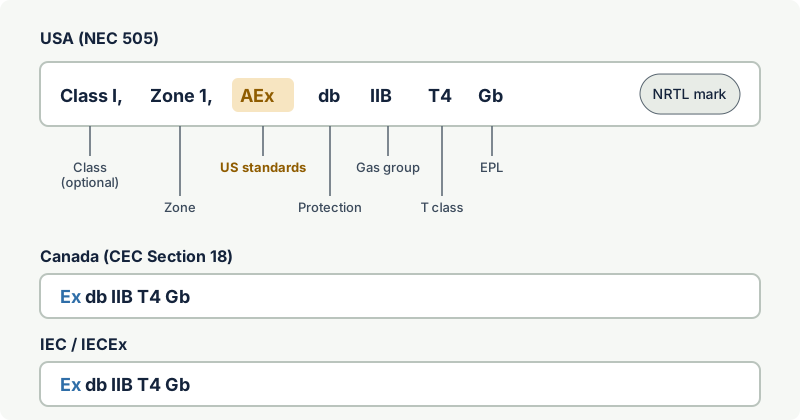
Dust equipment under Article 506 follows the same idea with zones 20, 21 and 22: zone, AEx, protection technique, material group and maximum surface temperature in °C, for example Zone 21, AEx tb IIIC T135°C. There is no class element in Article 506 markings.
AEx, Ex and the certification mark
AEx does not tell you who certified the equipment, and nothing stops a counterfeiter from printing it. Check three things on the nameplate:
- The certification mark of the NRTL, with its country indicator (for example "US" or "C" beside the mark), and the certificate or file number.
- The marking string with
AExfor the US zone system,Exfor Canada, or a Class and Division marking. - Fit with the area: the zone, gas or dust group and temperature class of the classified location.
Many products show several strings: an AEx string for the US, an Ex string for Canada, and often a Division marking too. Which system the area uses decides which string you read; how zone and Division equipment may be mixed is set by the NEC articles adopted locally, so check those before using a zone-marked product in a Division area.
Common mistakes
- Reading AEx as an approval. It is part of the marking; the listing by an NRTL is what shows acceptance.
- Accepting an IECEx or ATEX product because it says Ex. For onshore US work it needs US certification and the AEx marking (vessels under US Coast Guard rules are an exception for IECEx).
- Expecting AEx in Canada. Canadian zone equipment certified to the CSA C22.2 No. 60079 series is marked
Ex. - Comparing gas groups wrongly. In an AEx string the group is IIA, IIB or IIC, not NEC Group A, B, C or D.
Related on excodex
- North American hazardous location approvals: NEC 500/505/506, UL, CSA and FM
- How to read an Ex marking: decoding II 2 G Ex db IIC T4 Gb step by step
- Can ATEX or IECEx equipment be used in the United States?
- How do IEC gas groups IIA, IIB and IIC compare with NEC Groups A, B, C and D?
- Tools: Ex marking check, NEC Articles 500 to 506
Standards and further reading
- NFPA 70, National Electrical Code, Article 505 (Class I zone locations) and Article 506 (zone 20, 21 and 22 locations).
- UL 60079-0, explosive atmospheres, general requirements for equipment (US adoption of IEC 60079-0): webstore.ansi.org
- CSA C22.2 No. 60079 series, Canadian adoptions of the IEC 60079 parts.
- California Code of Regulations, Title 8, section 2540.11, Class I zone locations, marking order and example: dir.ca.gov
- IADC Lexicon, definition of AEx from API RP 14F and RP 14FZ: iadclexicon.org
- IAEI Magazine, comparison of division and zone systems (2002): iaeimagazine.org
- US Coast Guard, The Drill Down No. 26, hazardous location markings and protection techniques: dco.uscg.mil
This article is general technical information prepared by the excodex editorial team. It does not replace the applicable standards, the equipment certificates and instructions, national regulations or the assessment of a competent person.