Can Ex equipment be painted or have extra labels stuck on it after installation?
Abstract
Yes, with limits. The outside of an assembled enclosure may be painted, but never flameproof joint faces, breathers, seals or the marking. Paint and stickers are non-metallic layers that can hold static, so thickness and area limits apply. Follow the manufacturer.
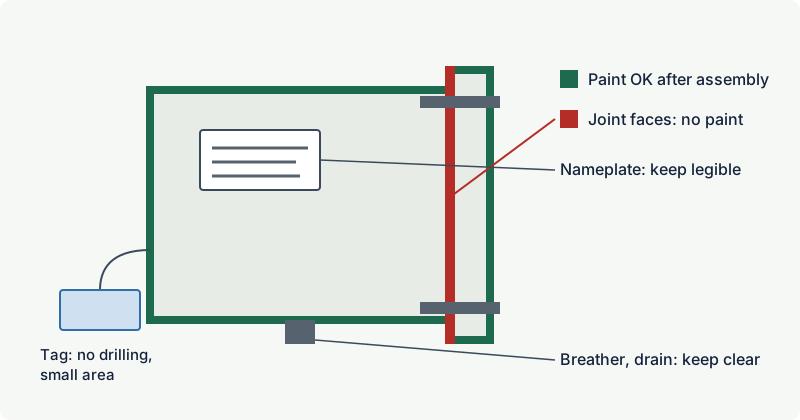
Yes, within limits. The outside of an assembled Ex enclosure may be painted for corrosion protection, but paint must never reach flameproof joint faces, breathing and draining devices, seals or the marking plate. Paint layers and stick-on labels are non-metallic surfaces that can store static charge, so their thickness and area are limited, and the manufacturer's instructions and the certificate's specific conditions of use always take precedence.
Short answer
- Painting the assembled enclosure: permitted for the user. IEC 60079-14 (2007 text) says so explicitly for flameproof enclosures.
- Flameproof joints: never painted. Paint or powder coating on joint faces is not allowed; protect them with non-setting grease or the agent the manufacturer specifies.
- Static charge: in the 2007 edition of IEC 60079-0, a non-metallic layer on a metal surface may be at most 2 mm thick for IIA and IIB and 0.2 mm for IIC, unless another anti-static measure applies.
- Labels: IEC 60079-17 requires that the way an added label is fixed does not reduce the integrity of the equipment. In practice: never cover the marking, never drill or rivet into the enclosure, and keep the non-metallic area small.
- Plastic enclosures: check the instructions first; solvents can attack the material and paint can spoil a conductive surface.
Why paint matters for the type of protection
Flameproof joints. An Ex d enclosure works because hot gases escaping through its narrow, long joints are cooled before they reach the outside. IEC 60079-1:2014 does not allow paint or powder coating on joint surfaces; other coatings are acceptable only where they have been shown not to harm the flameproof properties, and non-hardening corrosion-inhibiting grease may be applied. The 2007 edition of IEC 60079-14 states plainly that flameproof joints shall not be painted, but that the user may paint the enclosure after complete assembly. Grease on the joint faces reduces, but does not eliminate, the amount of paint drawn into the gap. Paint in a joint can also bond the cover so that it is forced or damaged at the next inspection.
Breathing and draining devices. IEC 60079-1 notes that dust or paint can make breathers and drains inoperative. Mask them before painting.
Seals and gaskets. IEC 60079-17 warns that chemicals, especially solvents, can affect plastic and elastomeric parts and with them the ingress protection. Keep paint and thinners off gaskets, gland seals and windows.
Heat dissipation. Enclosures, motor fins and luminaires lose heat through their surfaces, and the temperature class was measured on the equipment as supplied. A heavy build-up of coatings on heat-dissipating surfaces should be agreed with the manufacturer.
Static charge: why thickness and area count
A non-metallic layer on earthed metal can be charged by wind-blown dust, cleaning or rubbing, and a discharge from it could ignite gas. IEC 60079-0 treats paints, films, foils and plates applied to the outside of an enclosure as part of the external non-metallic surface. In the 2007 edition, one way to avoid a hazardous charge is to limit the thickness of a non-metallic layer bonded to a conductive surface:
| EPL | IIA | IIB | IIC |
|---|---|---|---|
| Ga, Gb, Gc | 2 mm | 2 mm | 0.2 mm |
Another way is to limit the area of non-metallic parts, for example 10,000 mm² for IIA and IIB and 2,000 mm² for IIC at EPL Gb or Gc, and less at EPL Ga (2007 values, which may be raised by a factor of four where the non-metallic area is surrounded by earthed conductive frames). These are design criteria the manufacturer used for the equipment as certified, and the current edition may express them differently, so check it. In practice: normal paint films are far below 0.2 mm, but repeated recoating or thick protective systems on IIC equipment are not, and a large plastic sticker adds non-metallic area the certification did not include.
Labels and asset tags in practice
IEC 60079-17 accepts additional identification labels with tag or serial numbers where the original marking is missing or illegible, provided the way the label is attached does not reduce the integrity of the equipment. Good practice:
- Never cover, paint over or remove the Ex marking plate; inspectors read it at every inspection.
- Do not drill, rivet or screw into an Ex enclosure to fix a tag. A tag on a stainless steel wire around a gland, or on the mounting bracket, avoids the enclosure entirely.
- Prefer small metal or engraved tags to large plastic stickers, especially on IIC equipment.
- Do not stick labels across a flameproof joint, cover a breather, or hide warning labels.
- Record the change if the label replaces a lost marking, so the item stays traceable to its certificate.
Common mistakes
- Spray painting a whole skid with covers loose or removed. Paint lands on joint faces. Paint only after complete assembly.
- Painting over the nameplate. The equipment can no longer be identified or inspected against its certificate.
- Blocking breathers and drains. Mask them first.
- Thick recoats on IIC equipment. Several coats can exceed 0.2 mm.
Related on excodex
- Common Ex inspection findings and how to fix them
- Ex installation basics under IEC 60079-14
- Can silicone sealant be used to improve the IP rating of Ex equipment?
- Is corrosion on a flameproof flamepath a reason to take equipment out of service?
- Standards spaces IEC 60079-14 and IEC 60079-17
Standards and further reading
- IEC 60079-14, design, selection and installation of electrical installations; 2007 text (clause on protection of flameproof joints) as AS/NZS 60079.14:2009: https://archive.org/details/as-nzs.60079.14.2009; the current 2024 edition has a clause (8.6) on protective coating of Ex equipment, listed as a technical extension in its change table (preview: https://cdn.standards.iteh.ai/samples/103765/564de58c9bf24efdbf0187e8d3027dfc/IEC-60079-14-2024.pdf)
- IEC 60079-1:2014, flameproof enclosures "d", public text: https://law.resource.org/pub/us/cfr/ibr/inc/iec/iec.60079-1.2014.pdf (now replaced by IEC 60079-1:2026)
- IEC 60079-0:2007, general requirements, electrostatic charges on external non-metallic materials, as IS/IEC 60079-0:2007: https://law.resource.org/pub/in/bis/S05/is.iec.60079.0.2007.pdf (current edition 8, 2026)
- IEC 60079-17:2007, inspection and maintenance, as IS/IEC 60079-17:2007: https://law.resource.org/pub/in/bis/S05/is.iec.60079.17.2007.pdf (current edition 2023)
This article is general technical information prepared by the excodex editorial team. It does not replace the applicable standards, the equipment certificates and instructions, national regulations or the assessment of a competent person.