Is corrosion on a flameproof flamepath a reason to take equipment out of service?
Abstract
It depends on depth. Light staining that cleans off without pitting can be cleaned and re-greased. Pitting, or corrosion that widens the gap or shortens the intact width below the certified dimensions, means the protection is lost: isolate until repaired or replaced.
It can be. Light surface staining that cleans off without leaving pits is a maintenance matter: clean the faces as instructed, protect them with a suitable non-setting grease and refit. Corrosion that has pitted the joint faces, widened the gap or shortened the undamaged width below the dimensions in the certificate documentation means the flameproof protection can no longer be relied on. Such equipment must not stay energised where an explosive atmosphere can occur; isolate it until the part is repaired to IEC 60079-19 or replaced.
Short answer
- Staining only, no pitting, gap within limits: clean with a non-metallic scraper and a non-corrosive cleaner, re-grease, refit with all bolts; record it.
- Pits or scratches across the width, gap above the maximum, or faces eaten back: a defect that affects the type of protection. Isolate or make the area safe, then repair or replace.
- Who decides acceptability: the manufacturer's data and a competent person; dimensional repair belongs to a facility working to IEC 60079-19, normally to the manufacturer's schedule drawings.
- Never fill pits with compound, weld, file or re-machine faces on site, or add a gasket or sealant to stop the leak.
- Corrosion is a signal: shorten the inspection interval for that environment and improve the protection of the faces.
Why corrosion defeats a flamepath
A flameproof (Ex d) enclosure does not keep gas out. It lets an internal explosion happen and relies on the joints between its parts to cool the escaping hot gases so that they cannot ignite the atmosphere outside. That works only because the gap is narrow and the path from inside to outside is long enough, both values set and tested for the gas group. For example, Table 2 of IEC 60079-1:2014 allows a flanged joint 25 mm wide a maximum gap of 0.40 mm for IIA and 0.20 mm for IIB, whatever the enclosure volume; narrower joints and Group IIC can have smaller limits.
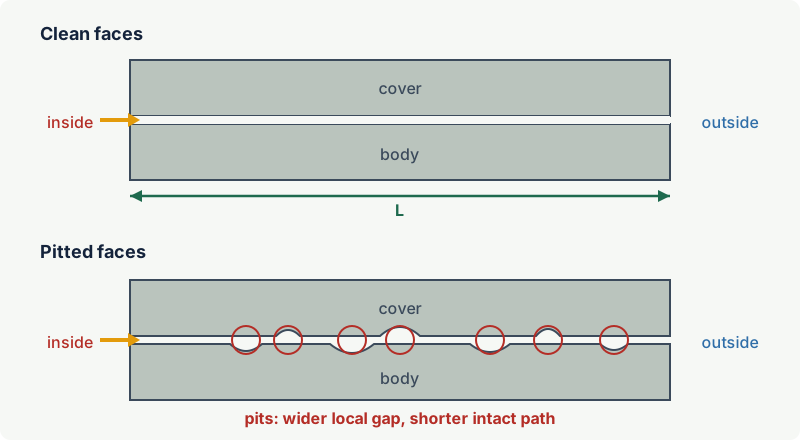
Corrosion attacks both values at once. Pits make the gap locally much wider, and a chain of pits across the face shortens the intact path that the gas must cross. Rust can also lift a cover so that the gap opens, while corrosion products may hide the damage until the faces are cleaned. The certificate assumes the faces are as drawn; it says nothing about a pitted joint.
How to assess what you find
Flange faces are examined at a detailed inspection under IEC 60079-17, with the cover removed and the equipment isolated. A practical sequence:
- Isolate the equipment before opening, as for any detailed inspection of Ex d equipment.
- Clean the faces with a non-metallic scraper and a non-corrosive cleaning fluid, which is what IEC 60079-17 allows for flanges, and keep blind bolt holes free of grease. Do not use wire brushes, emery cloth or grinders on joint faces.
- Look at both faces over the full width. Note pits, scratches running from inside to outside, and any area where the surface has been eaten back.
- Measure the gap with the cover fitted and bolted, and compare it with the maximum given in the manufacturer's documentation (or the standard's table if none is given).
- Decide using the manufacturer's data. If in doubt, treat the joint as defective.
| Finding | Typical action |
|---|---|
| Discolouration or light rust that cleans off, smooth faces, gap within limits | Clean, grease with the specified non-setting grease, refit, record |
| Isolated shallow marks, manufacturer's data say acceptable | Accept as per that data, record, monitor |
| Pitting or scratches across the width | Remove from service in the hazardous area; repair or replace |
| Measured gap above the documented maximum | Remove from service; repair or replace |
| Corroded bolts, bolt holes or threaded entries | Replace fasteners with the specified type; damaged threads go to repair |
Repair or replace
Repair of flamepaths is reclamation work under IEC 60079-19. The 2025 edition (edition 5) requires repair to the schedule drawings where they are available and contains a normative annex on measurements in flameproof equipment during overhaul, repair and reclamation, with guidance on tolerances and on the maximum gap of reclaimed parts. Re-machining changes the dimensions, so it is done only within those limits and by a facility competent for Ex d work. For many small enclosures, a new cover or enclosure from the manufacturer is the quicker and cleaner answer.
Example: At a detailed inspection of a flameproof junction box in a coastal Zone 1 area, the cover flange shows a band of pits about a third of the way across the face. The gap measures within limits, but the pits run across the width. The inspector records a defect affecting the type of protection, the circuit is isolated, and a replacement cover is fitted. The site also switches to the grease named in the manufacturer's instructions and shortens the inspection interval for that unit.
Common mistakes
- Accepting a joint because the feeler gauge passes, while pits run across the width.
- Sanding or grinding the faces to remove rust, which removes metal and widens the gap.
- Painting over the flange or adding silicone to stop further corrosion.
- Leaving equipment energised "until the next shutdown" after a protection-affecting defect is found.
Related on excodex
- Flameproof enclosures (Ex d): how flamepaths stop an internal explosion
- Common Ex inspection findings and how to fix them
- Repair, overhaul and modification of Ex equipment (IEC 60079-19)
- How are flamepath gaps on an Ex d enclosure checked during inspection?
- Can you paint, grease or seal the flange joints of a flameproof enclosure?
Standards and further reading
- IEC 60079-1, flameproof enclosures "d" (2014 edition, replaced by IEC 60079-1:2026): joint dimensions, corrosion protection of joint faces
- IEC 60079-17, inspection and maintenance of electrical installations (edition 6, 2023); the 2007 edition already limited flange cleaning to non-metallic scrapers and non-corrosive cleaning fluids
- IEC 60079-19, equipment repair, overhaul and reclamation (edition 5, 2025), including the normative annex on measurements in flameproof equipment: preview
- IEC 60079-14, installation (edition 6, 2024), protection of flamepaths: preview
- NOPSA (now NOPSEMA), Safety Alert 33, corrosion among recurring hazardous area equipment findings: PDF
This article is general technical information prepared by the excodex editorial team. It does not replace the applicable standards, the equipment certificates and instructions, national regulations or the assessment of a competent person.