Occupational safety International framework and country guides
How and within what time must a workplace accident be reported in the United Kingdom?
Part of: Occupational safety and health in United Kingdom: law, authorities and employer duties
Short answer
Under RIDDOR 2013, deaths, specified injuries and dangerous occurrences must be notified to the enforcing authority without delay and reported within 10 days; injuries keeping a worker off for over 7 days within 15 days. Report online to HSE; keep records 3 years.
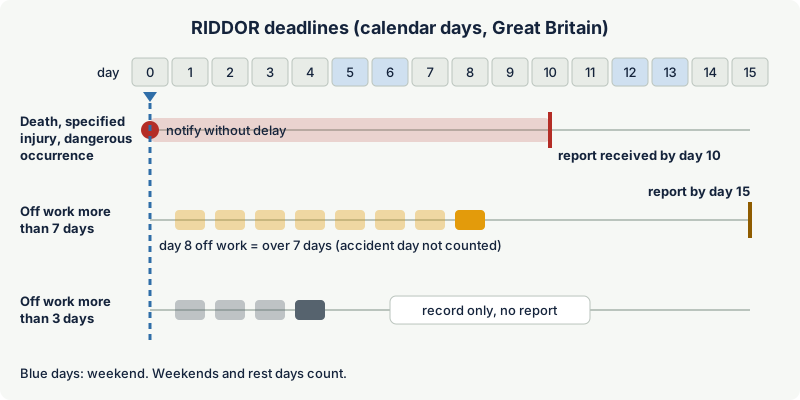
In Great Britain, the employer (the "responsible person") must report under the Reporting of Injuries, Diseases and Dangerous Occurrences Regulations 2013 (RIDDOR). A work-related death, a specified injury to a worker or a dangerous occurrence must be notified without delay and the report must reach the enforcing authority within 10 days; an injury that keeps a worker off normal work for more than seven consecutive days must be reported within 15 days. Reports are made online through HSE, or by telephone for fatal and specified injuries.
Short answer
- Who reports: the responsible person, normally the employer; self-employed people also have reporting duties.
- To whom: the enforcing authority (HSE or the local authority), through HSE's online reporting service. For fatal accidents and specified injuries to workers only, HSE also accepts telephone reports on 0345 300 9923.
- Without delay, received within 10 days: deaths of any person from a work-related accident, specified injuries to workers, members of the public taken from the scene to hospital for treatment, and dangerous occurrences.
- Within 15 days: injuries that incapacitate a worker for more than seven consecutive days, not counting the day of the accident but counting weekends and rest days.
- On diagnosis: listed occupational diseases, occupational cancers and diseases from biological agents, once the employer receives a doctor's diagnosis in writing.
- Record only: injuries causing more than three consecutive days' incapacity; keep all RIDDOR records for at least three years.
- Northern Ireland: report to HSENI under the separate RIDDOR (Northern Ireland) Regulations 1997.
What counts as a specified injury
HSE lists the specified injuries under regulation 4 as: fractures diagnosed by a doctor, other than to fingers, thumbs and toes; amputation of an arm, hand, finger, thumb, leg, foot or toe; injuries likely to cause permanent loss or reduction of sight; crush injuries to the head or torso damaging the brain or internal organs; burns, including scalds, covering more than 10% of the whole body's surface area or causing significant damage to the eyes, respiratory system or other vital organs; scalping requiring hospital treatment; loss of consciousness caused by head injury or asphyxia; and injuries from working in an enclosed space that lead to hypothermia, heat-induced illness, resuscitation or admission to hospital for more than 24 hours.
A death must be reported if it results from a work-related accident, including a death within one year of a reportable injury; suicides are excluded. Self-diagnosed "suspected fractures" are not reportable, and there is no need to make precautionary reports when the extent of an injury is still unclear; the authority should be notified once a specified injury is confirmed.
How to report and what to keep
- Make the scene safe, give first aid and call emergency services where needed.
- Decide whether the event is reportable and in which category; preserve evidence.
- For a death or specified injury, notify at once (online or by telephone); for other categories use the correct online form.
- Record the incident with the particulars required by RIDDOR Schedule 1, and record over-three-day injuries, for example in the accident book kept under social security law.
- Keep the records for at least three years at the workplace or the usual place of business, and send extracts if the authority asks (regulation 12).
Example: A warehouse operative trips on a pallet on Monday and hurts a shoulder. There is no fracture, but the operative cannot do normal work from Tuesday until the Friday of the following week, eleven consecutive days (day 1 is Tuesday). More than seven consecutive days of incapacity means a RIDDOR report is due within 15 days of the accident, by the Tuesday two weeks later. Had the shoulder been fractured, a specified injury report would have been due without delay and in any case within 10 days.
How the UK compares with the EU and Türkiye
The EU Framework Directive 89/391/EEC requires employers to keep a list of accidents causing more than three working days of incapacity and leaves reporting deadlines to national law. In Türkiye, Law No. 6331, Article 14, requires the employer to report work accidents to the Social Security Institution (SGK) within three working days. The UK uses calendar-day deadlines (10 and 15 days) and reports to the safety regulator rather than to a social insurer.
Common mistakes
- Counting only working days for the over-seven-day rule; weekends and rest days count.
- Waiting for the end of the 10 days for a specified injury: the law requires notification without delay.
- Reporting only to the insurer or the accident book. Neither replaces the RIDDOR report.
- Forgetting non-workers. A visitor taken from the scene to hospital for treatment is reportable.
Related on excodex
- Occupational safety and health in United Kingdom: law, authorities and employer duties
- RIDDOR 2013 explained
- Work accident and occupational disease reporting to SGK in Türkiye
- Incident first response, reporting and scene preservation
Standards and further reading
- Reporting of Injuries, Diseases and Dangerous Occurrences Regulations 2013 (SI 2013/1471): https://www.legislation.gov.uk/uksi/2013/1471
- HSE, When do I need to report an incident?: https://www.hse.gov.uk/riddor/when-do-i-report.htm
- HSE, Types of reportable incidents: https://www.hse.gov.uk/riddor/types-of-reportable-incidents.htm
- HSE, Specified injuries: https://www.hse.gov.uk/riddor/specified-injuries.htm
- HSE, Reportable occupational diseases: https://www.hse.gov.uk/riddor/occupational-diseases.htm
- Reporting of Injuries, Diseases and Dangerous Occurrences Regulations (Northern Ireland) 1997: https://www.legislation.gov.uk/nisr/1997/455
This article is general occupational safety and health information prepared by the excodex editorial team. It does not replace the applicable legislation, standards, manufacturers' instructions or the assessment of a competent OSH professional or occupational physician.
More questions on this topic
- What is the main occupational safety and health law in the United Kingdom and who enforces it?
- Must an employer in the United Kingdom appoint a safety professional or an occupational physician?
- Is a written risk assessment mandatory in the United Kingdom, and how often must it be reviewed?
- What OSH training must employers provide to workers in the United Kingdom?
- Are pre-employment and periodic medical examinations required for workers in the United Kingdom?
- What are the penalties for breaking occupational safety rules in the United Kingdom?
- Is a safety committee or a worker safety representative required in the United Kingdom?
- How are explosive atmospheres and Ex equipment regulated in the United Kingdom?
Part of: Occupational safety and health in United Kingdom: law, authorities and employer duties