Occupational safety International framework and country guides
Occupational safety and health in United Kingdom: law, authorities and employer duties
Abstract
In Great Britain the Health and Safety at Work etc. Act 1974 sets the general duties and HSE or local authorities enforce it; Northern Ireland has a parallel 1978 Order enforced by HSENI. Key rules: risk assessment (MHSWR 1999), RIDDOR reporting, DSEAR, COMAH, COSHH.
In the United Kingdom, occupational safety and health law rests on the Health and Safety at Work etc. Act 1974 (HSWA) in Great Britain (England, Scotland and Wales) and on the Health and Safety at Work (Northern Ireland) Order 1978 in Northern Ireland. The Health and Safety Executive (HSE) and local authorities enforce the law in Great Britain, and the Health and Safety Executive for Northern Ireland (HSENI) does so in Northern Ireland. Employers must ensure the health, safety and welfare of their employees so far as is reasonably practicable, assess risks, appoint competent help, consult workers and report serious incidents under RIDDOR.
This guide summarises the legal framework, the enforcing bodies, employer and worker duties, reporting deadlines, penalties and the special regimes for chemicals, explosive atmospheres and major-hazard sites, and compares the UK with the EU framework and Türkiye. Unless stated otherwise, the provisions cited apply in Great Britain; Northern Ireland has parallel but separate legislation.
Key points
- The Health and Safety at Work etc. Act 1974 is the main OSH law in Great Britain; most detailed duties are in regulations made under it, such as the Management of Health and Safety at Work Regulations 1999 (MHSWR).
- HSE enforces in industry, construction and most hazardous work; local authorities enforce in premises such as shops, offices, warehouses, catering and hotels (Health and Safety (Enforcing Authority) Regulations 1998); HSENI covers Northern Ireland.
- Every employer must assess risks; an employer with five or more employees must record the significant findings and must have a written health and safety policy.
- UK law requires "one or more competent persons" to help the employer, but no named safety professional or occupational physician for ordinary workplaces; doctors appointed by HSE are required only for specified medical surveillance (for example asbestos, lead, ionising radiation).
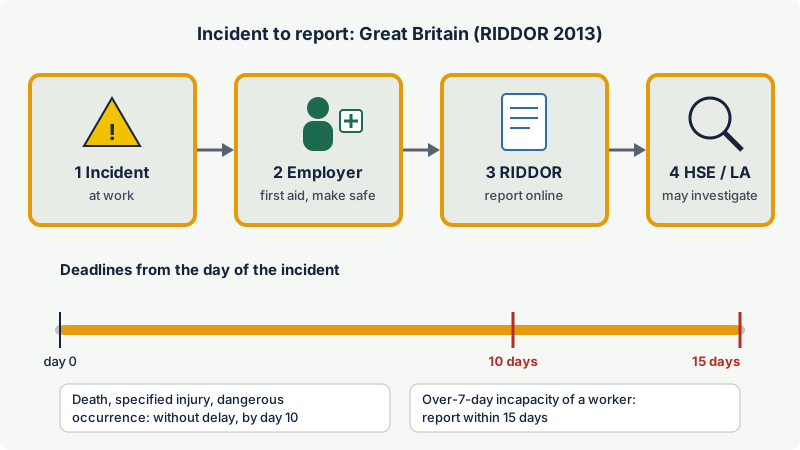
- Under RIDDOR 2013, deaths, specified injuries and dangerous occurrences must be notified without delay and reported within 10 days; over-seven-day injuries within 15 days; records are kept for at least three years.
- Fines for most HSWA offences are unlimited in England and Wales, individuals can be imprisoned for up to two years, and HSE charges a fee for intervention of £188 an hour (HSE rate published April 2026) when it finds a material breach.
Legal framework: the 1974 Act and the regulations made under it
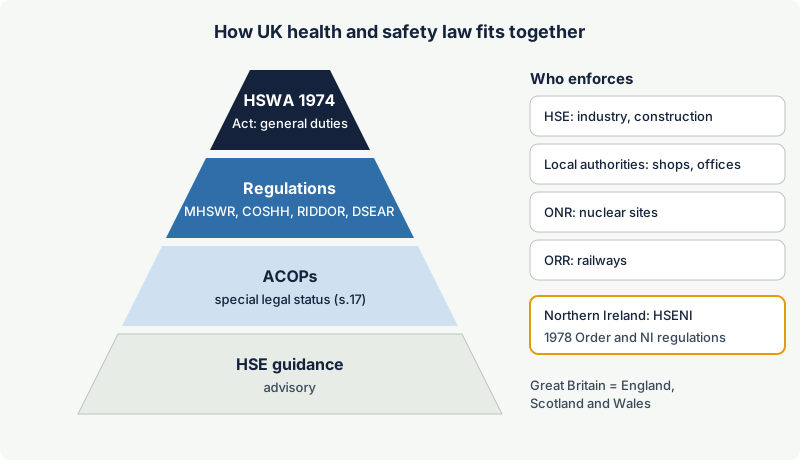
The HSWA is a goal-setting law. Section 2 places a general duty on every employer to ensure, so far as is reasonably practicable, the health, safety and welfare at work of all employees, and lists what this includes: safe plant and systems of work, safe handling and storage of articles and substances, information, instruction, training and supervision, a safe workplace with safe access, and adequate welfare facilities. Section 3 extends the duty to people who are not employees, such as contractors and the public. Section 7 requires employees to take reasonable care of themselves and others and to co-operate with the employer.
"Reasonably practicable" means balancing the risk against the cost, time and trouble of controlling it. Under section 40 of the Act, when a prosecution concerns such a duty, it is for the accused to prove that it was not reasonably practicable to do more. This reverse burden of proof is a distinctive feature of UK law.
The detailed duties are in regulations. Approved Codes of Practice (ACOPs) sit below the regulations: under section 17 of the Act, failing to follow an ACOP is not in itself an offence, but a court may treat the failure as proof of a breach unless the defendant shows that the law was complied with in some other way. HSE guidance below that level is advisory.
| Regulation (Great Britain) | What it covers |
|---|---|
| Management of Health and Safety at Work Regulations 1999 (MHSWR) | Risk assessment, principles of prevention, competent assistance, health surveillance, emergency procedures, training |
| Workplace (Health, Safety and Welfare) Regulations 1992 | Workplace conditions and welfare facilities |
| Provision and Use of Work Equipment Regulations 1998 (PUWER) | Work equipment, maintenance, training |
| Lifting Operations and Lifting Equipment Regulations 1998 (LOLER) | Lifting operations and thorough examination |
| Work at Height Regulations 2005 | Planning and equipment for work at height |
| Control of Substances Hazardous to Health Regulations 2002 (COSHH) | Chemical and biological health risks, exposure control, health surveillance |
| Dangerous Substances and Explosive Atmospheres Regulations 2002 (DSEAR) | Fire and explosion risks, zoning, Ex equipment selection |
| Reporting of Injuries, Diseases and Dangerous Occurrences Regulations 2013 (RIDDOR) | Reporting and recording of incidents |
| Construction (Design and Management) Regulations 2015 (CDM) | Duty holders and planning in construction |
| Control of Major Accident Hazards Regulations 2015 (COMAH) | Major-hazard establishments (Seveso III) |
| Personal Protective Equipment at Work Regulations 1992 | Provision and use of PPE |
Other frequently applied regulations include the Electricity at Work Regulations 1989, the Manual Handling Operations Regulations 1992, the Health and Safety (Display Screen Equipment) Regulations 1992, the Confined Spaces Regulations 1997, the Control of Noise at Work Regulations 2005, the Control of Vibration at Work Regulations 2005, the Control of Asbestos Regulations 2012, the Control of Lead at Work Regulations 2002, the Ionising Radiations Regulations 2017 and the Health and Safety (First-Aid) Regulations 1981. Fire safety in workplaces has its own regime: the Regulatory Reform (Fire Safety) Order 2005 in England and Wales and the Fire (Scotland) Act 2005.
Official titles are in English, and legislation.gov.uk publishes the revised (consolidated) texts. In Northern Ireland the equivalents are separate instruments, for example the Management of Health and Safety at Work Regulations (Northern Ireland) 2000 and the Reporting of Injuries, Diseases and Dangerous Occurrences Regulations (Northern Ireland) 1997. The Northern Ireland texts are broadly similar but not identical, so employers there should check the Northern Ireland version and HSENI guidance.
Who enforces OSH law: HSE, local authorities and other regulators
In Great Britain the enforcing authority depends on the main activity of the premises. Under the Health and Safety (Enforcing Authority) Regulations 1998, local authorities enforce where the main activity is, for example, retail or wholesale storage of goods, office work, catering, residential accommodation, leisure and consumer services; HSE enforces everywhere else, including factories, chemical plants, construction sites, farms and offshore installations. The Office for Nuclear Regulation (ONR) regulates nuclear sites and the Office of Rail and Road (ORR) regulates railway safety.
Under section 20, inspectors can enter premises (at any time if the situation may be dangerous), examine and investigate, direct that things be left undisturbed, take measurements, photographs and samples, and require answers. Two formal notices are central:
- Improvement notice (HSWA section 21): served when an inspector believes a person is contravening the law, or has contravened it in a way likely to continue or be repeated; it requires the contravention to be remedied within a stated period.
- Prohibition notice (section 22): served when an activity involves a risk of serious personal injury; it stops the activity, either immediately or at the end of a stated period, until the matters are remedied.
Where HSE is the enforcing authority and an inspector finds a material breach and notifies it in writing, the dutyholder pays a fee for intervention (FFI) for the inspector's time under regulation 23 of the Health and Safety and Nuclear (Fees) Regulations 2022. HSE lists the FFI rate as £188 an hour (rates page updated 1 April 2026). Prosecutions in England and Wales are brought by HSE or the local authority; in Scotland, decisions to prosecute are made by the Crown Office and Procurator Fiscal Service (COPFS) on the regulator's report.
Employer and worker duties, competent assistance and OSH services
The main duties of an employer in Great Britain are:
- Prepare a written health and safety policy (HSWA section 2(3)), with its organisation and arrangements, and bring it to employees' notice. Employers with fewer than five employees are exempt from the written statement under the Employers' Health and Safety Policy Statements (Exception) Regulations 1975.
- Make a suitable and sufficient risk assessment and record the significant findings if five or more people are employed (MHSWR regulation 3).
- Apply the principles of prevention and put in place arrangements for planning, organisation, control, monitoring and review (MHSWR regulations 4 and 5).
- Appoint one or more competent persons to assist (MHSWR regulation 7), preferring a competent employee over an outside adviser.
- Set up procedures for serious and imminent danger and first-aid arrangements (MHSWR regulation 8; First-Aid Regulations 1981).
- Provide information, instruction, training and supervision, consult workers, display the health and safety law poster or give the leaflet (Health and Safety Information for Employees Regulations 1989), and report incidents under RIDDOR.
- Hold employers' liability insurance where the Employers' Liability (Compulsory Insurance) Act 1969 requires it, which covers most employers with employees.
Workplace fire safety is a separate duty: in England and Wales the fire risk assessment under the Regulatory Reform (Fire Safety) Order 2005 is enforced mainly by the local fire and rescue authority, not by HSE.
OSH services. UK law does not prescribe safety professionals by qualification, worker numbers or hazard class, and does not require an occupational physician for ordinary workplaces. Under MHSWR regulation 7 a person is competent if he or she has sufficient training and experience or knowledge and other qualities; the number of competent persons and the time they have must be adequate for the size of the undertaking and its risks. HSE describes a competent person as someone with the necessary skills, experience and knowledge to manage health and safety; some regulations add training or experience requirements for particular tasks. Doctors appointed by HSE ("appointed doctors") are required only where regulations demand medical surveillance, for example for asbestos, lead and ionising radiation work.
Workers must take reasonable care, co-operate, use equipment and PPE in accordance with training, and report serious dangers and shortcomings (HSWA section 7; MHSWR regulation 14).
Risk assessment, training and health surveillance
A risk assessment is mandatory for every employer and for self-employed people in prescribed higher-risk undertakings (MHSWR regulation 3). The law sets no fixed review interval: the assessment must be reviewed when there is reason to suspect it is no longer valid or when there has been a significant change. HSE guidance adds reviews after accidents or near misses and when workers report problems. Specific assessments are required under other regulations, such as COSHH, DSEAR, noise, manual handling and display screen equipment, and an employer must assess the risks to young persons before employing one.
Training must be given on recruitment and when workers are exposed to new or increased risks (transfer, new equipment, new technology, new systems of work), repeated periodically where appropriate, and given during working hours (MHSWR regulation 13). There are no national minimum hours for general OSH training; specific regulations add duties, for example PUWER regulation 9 for users and supervisors of work equipment and CDM 2015 for site induction on construction sites.
Health surveillance is required where the risk assessment shows it is appropriate (MHSWR regulation 6), and specifically under COSHH (with health records kept for at least 40 years), noise (hearing checks), vibration, asbestos, lead and ionising radiation rules. There is no general legal requirement for pre-employment or periodic medical examinations of all workers. Night workers must be offered a free health assessment (Working Time Regulations 1998, regulation 7), and the Equality Act 2010 (section 60) restricts health questions before a job offer in Great Britain.
Reporting accidents and occupational diseases under RIDDOR
The "responsible person", usually the employer, reports to the enforcing authority, normally online through HSE. For fatal accidents and specified injuries to workers only, HSE also accepts telephone reports on 0345 300 9923.
| Event | Deadline (RIDDOR 2013) |
|---|---|
| Death of any person from a work-related accident; specified injury to a worker; dangerous occurrence; member of the public taken from the scene to hospital for treatment | Notify without delay; report received within 10 days |
| Worker incapacitated for more than seven consecutive days (not counting the day of the accident) | Report within 15 days of the accident |
| Reportable occupational disease, including occupational cancer and diseases from biological agents | As soon as the responsible person receives a written diagnosis |
| Worker unable to do routine work for more than three consecutive days (not counting the day of the accident) | Record only (RIDDOR regulation 12), no report |
Specified injuries include fractures other than to fingers, thumbs and toes, amputations, injuries likely to cause permanent blinding or reduced sight, crush injuries to the head or torso damaging the brain or internal organs, serious burns covering more than 10% of the body or damaging the eyes, respiratory system or other vital organs, scalpings needing hospital treatment, loss of consciousness caused by head injury or asphyxia, and injuries from working in an enclosed space leading to hypothermia, heat illness, resuscitation or more than 24 hours in hospital. A death within one year of a reportable injury is reported as a work-related death; suicides are not reportable. Records must be kept for at least three years (RIDDOR regulation 12). In Northern Ireland, incidents are reported to HSENI under the separate 1997 Northern Ireland regulations.
Example: On Monday 2 March 2026 a fitter in a food factory falls from a platform and breaks a wrist. A fracture of the wrist is a specified injury, so the manager notifies HSE without delay through the online form, and the report must be received by Thursday 12 March (within 10 days). If instead the fitter had only bruising but was off work from 3 to 11 March, that is more than seven consecutive days, and the over-seven-day report would be due by 17 March (within 15 days).
Worker consultation, safety representatives and committees
Consultation is a legal duty in two tracks. Where an employer recognises a trade union, the union may appoint safety representatives under the Safety Representatives and Safety Committees Regulations 1977. They may investigate hazards and accidents, inspect the workplace after written notice (once in any three months, or more often by agreement), and take paid time off for their functions and training. If at least two safety representatives request it in writing, the employer must set up a safety committee within three months (regulation 9).
Where employees are not covered by union representatives, the Health and Safety (Consultation with Employees) Regulations 1996 require the employer to consult them, either directly or through elected representatives of employee safety, on measures affecting their health and safety, competent-person arrangements, information, training and new technology. There is no workforce-size threshold that makes a committee compulsory on its own.
Penalties, liability and directors
Most HSWA offences can be tried in a magistrates' court or in the Crown Court. Under Schedule 3A of the Act (inserted by the Health and Safety (Offences) Act 2008), breaches of the general duties and of regulations can lead to an unlimited fine in England and Wales in either court, and individuals can be imprisoned for up to two years on indictment. In Scotland the summary maximum for most offences is a £20,000 fine. Directors and managers are personally liable where an offence by a company was committed with their consent or connivance or was attributable to their neglect (section 37).
In England and Wales, courts follow the Sentencing Council's definitive guideline for organisations (effective since 1 February 2016), which sets fines by culpability, harm category and turnover. For very high culpability and harm category 1 the starting points are £4 million for a large organisation (turnover £50 million or more), £1.6 million for medium, £450,000 for small and £250,000 for a micro organisation (turnover up to £2 million). Where a gross management failure causes a death, an organisation can also be convicted of corporate manslaughter (corporate homicide in Scotland) under the Corporate Manslaughter and Corporate Homicide Act 2007.
Chemicals, explosive atmospheres, major hazards and PPE marking
Chemicals. The EU CLP Regulation, as assimilated into GB law, applies the UN Globally Harmonized System (GHS) in Great Britain as "GB CLP", with HSE as the GB CLP agency and a GB mandatory classification and labelling list. Substances placed on the market in Northern Ireland follow the EU CLP Regulation.
Explosive atmospheres. DSEAR implements the ATEX workplace directive 1999/92/EC in Great Britain. Employers must assess the risks of dangerous substances, classify hazardous places into Zones 0, 1, 2 (gas) and 20, 21, 22 (dust), select equipment of category 1, 2 or 3 to match the zone, mark entry points where necessary, provide antistatic work clothing and have overall explosion safety verified by a competent person before first use. Equipment is placed on the GB market under the Equipment and Protective Systems Intended for Use in Potentially Explosive Atmospheres Regulations 2016, which HSE enforces. Since 1 October 2024 the Product Safety and Metrology etc. (Amendment) Regulations 2024 recognise the CE marking in Great Britain without an end date, so Ex equipment can carry either the UKCA or the CE marking there. In Northern Ireland EU rules apply: CE marking, with UKNI added when a UK-based notified body assessed the product (UKNI is never used alone).
Major hazards. COMAH 2015 (in force since 1 June 2015) implements most of the Seveso III Directive. The competent authority is HSE (or ONR for nuclear sites) acting jointly with the Environment Agency in England, Natural Resources Wales or the Scottish Environment Protection Agency. All operators notify and keep a major accident prevention policy, reviewed at least every five years; upper-tier operators also prepare a safety report (reviewed at least every five years) and an internal emergency plan reviewed and tested at intervals not exceeding three years. Northern Ireland has the COMAH Regulations (Northern Ireland) 2015.
PPE. Employers must provide suitable PPE free of charge; since 6 April 2022 this duty also covers "limb (b)" workers, not only employees. PPE placed on the GB market can carry UKCA or CE marking under the same 2024 Regulations.
The UK compared with the EU framework and Türkiye
| Topic | United Kingdom (GB) | EU Framework Directive 89/391/EEC | Türkiye (Law No. 6331) |
|---|---|---|---|
| Risk assessment | Mandatory; written record of significant findings with 5 or more employees | Employer must possess an assessment; documentation rules set by member states | Mandatory for all employers (Art. 10) |
| OSH professionals | Competent person(s); no qualification or headcount rule | Designated workers or external services (Art. 7) | OSH specialist (iş güvenliği uzmanı) and workplace physician (işyeri hekimi) required, with limited exceptions for small low-hazard workplaces (Art. 6) |
| Medical examinations | Only where specific regulations require surveillance | Surveillance under national law (Art. 14) | On hiring, job change, return after repeated absence (on request) and at periodic intervals (Art. 15) |
| Accident reporting | RIDDOR: without delay and within 10 days; over-7-day within 15 days | Deadlines set nationally; list of accidents over 3 working days (Art. 9) | Accidents to the Social Security Institution (SGK) within three working days (Art. 14) |
| Committee | On written request of 2 union safety representatives, within 3 months | Consultation and participation (Art. 11) | Required with 50 or more workers and continuous work over six months (Art. 22) |
Common mistakes
- Assuming a written risk assessment is optional in small firms. Every employer must assess risks; only the duty to record significant findings depends on having five or more employees.
- Looking for a mandatory safety officer quota. The UK sets no headcount-based appointment; the test is whether the competent help is adequate for the size and risks of the business.
- Reporting only to the insurer. RIDDOR reports go to the enforcing authority, through HSE's reporting service, within the legal deadlines.
- Counting over-seven-day absence in working days. The seven days exclude the day of the accident but include weekends and rest days.
- Treating ACOPs as optional advice. A court can treat failure to follow an ACOP as proof of a breach unless equivalent compliance is shown.
- Applying GB rules unchanged in Northern Ireland. Northern Ireland has its own Order, regulations and regulator (HSENI).
Frequently asked questions
Does the Health and Safety at Work etc. Act 1974 apply in Northern Ireland?
No. Northern Ireland has the Health and Safety at Work (Northern Ireland) Order 1978 and its own regulations, enforced by HSENI. The rules are similar in structure, but employers must check the Northern Ireland texts.
Do I need a qualified safety adviser by law in the UK?
The law requires competent assistance, not a specific qualification. The competent person can be the owner, an employee or an external adviser, and an in-house competent person must be preferred where one exists.
How often must a risk assessment be reviewed in the UK?
No fixed interval is set in MHSWR. Review is required when the assessment may no longer be valid or there is a significant change, and HSE advises review after accidents, near misses and workplace changes.
Can HSE stop work immediately?
Yes. An inspector who considers that an activity involves a risk of serious personal injury can serve a prohibition notice taking effect immediately. Not complying with a notice is a criminal offence.
Is the CE marking still accepted for ATEX equipment and PPE in Great Britain?
Yes. The Product Safety and Metrology etc. (Amendment) Regulations 2024, in force since 1 October 2024, recognise CE marking alongside UKCA, with no end date, for equipment for explosive atmospheres and for PPE placed on the GB market. The product must still meet the EU requirements that the CE marking claims.
Related on excodex
- UK Health and Safety at Work etc. Act 1974: duties and HSE enforcement
- Key UK health and safety regulations
- RIDDOR 2013 explained
- How and within what time must a workplace accident be reported in the United Kingdom?
- OSH law compared: appointments, committees and reporting deadlines
- What is the difference between ATEX and DSEAR in the UK?
Standards and further reading
- Health and Safety at Work etc. Act 1974 (c. 37), sections 2, 3, 7, 17, 21, 22, 37, 40 and Schedule 3A: https://www.legislation.gov.uk/ukpga/1974/37
- Management of Health and Safety at Work Regulations 1999 (SI 1999/3242): https://www.legislation.gov.uk/uksi/1999/3242
- Reporting of Injuries, Diseases and Dangerous Occurrences Regulations 2013 (SI 2013/1471): https://www.legislation.gov.uk/uksi/2013/1471
- Safety Representatives and Safety Committees Regulations 1977 (SI 1977/500) and Health and Safety (Consultation with Employees) Regulations 1996 (SI 1996/1513)
- Dangerous Substances and Explosive Atmospheres Regulations 2002 (SI 2002/2776) and Equipment and Protective Systems Intended for Use in Potentially Explosive Atmospheres Regulations 2016 (SI 2016/1107)
- Control of Major Accident Hazards Regulations 2015 (SI 2015/483): https://www.legislation.gov.uk/uksi/2015/483
- Health and Safety at Work (Northern Ireland) Order 1978: https://www.legislation.gov.uk/nisi/1978/1039
- HSE, RIDDOR: when do I need to report an incident?: https://www.hse.gov.uk/riddor/when-do-i-report.htm
- HSE, fees and charges, current rates: https://www.hse.gov.uk/enforce/charging/rates.htm
- HSE, Enforcement Policy Statement: https://www.hse.gov.uk/pubns/hse41.pdf
- HSE, ATEX equipment and explosive atmospheres: https://www.hse.gov.uk/fireandexplosion/atex.htm
- HSE, Introduction to COMAH: https://www.hse.gov.uk/comah/introduction.htm
- HSE, The GB CLP Regulation: https://www.hse.gov.uk/chemical-classification/legal/clp-regulation.htm
- Health and Safety (Enforcing Authority) Regulations 1998 (SI 1998/494), Schedule 1: https://www.legislation.gov.uk/uksi/1998/494/schedule/1
- Health and Safety and Nuclear (Fees) Regulations 2022 (SI 2022/1378), regulation 23: https://www.legislation.gov.uk/uksi/2022/1378/regulation/23
- Employers' Health and Safety Policy Statements (Exception) Regulations 1975 (SI 1975/1584): https://www.legislation.gov.uk/uksi/1975/1584/made
- Product Safety and Metrology etc. (Amendment) Regulations 2024 (SI 2024/696): https://www.legislation.gov.uk/uksi/2024/696/introduction/made
- GOV.UK, Using the UKNI marking: https://www.gov.uk/guidance/using-the-ukni-marking
- HSE, What is competence?: https://www.hse.gov.uk/competence/what-is-competence.htm
- HSE, Insurance (employers' liability insurance overview): https://www.hse.gov.uk/simple-health-safety/insurance/index.htm
- Regulatory Reform (Fire Safety) Order 2005 (SI 2005/1541), article 25 (enforcing authorities): https://www.legislation.gov.uk/uksi/2005/1541/article/25
- Sentencing Council, Health and safety offences guideline for organisations: https://www.sentencingcouncil.org.uk/offences/crown-court/item/organisations-breach-of-duty-of-employer-towards-employees-and-non-employees-breach-of-duty-of-self-employed-to-others-breach-of-health-and-safety-regulations/
- Health and Safety Executive for Northern Ireland: https://www.hseni.gov.uk/
- Law No. 6331 on Occupational Health and Safety (6331 sayılı İş Sağlığı ve Güvenliği Kanunu), Articles 6, 10, 14, 15 and 22: https://www.mevzuat.gov.tr/mevzuat?MevzuatNo=6331&MevzuatTur=1&MevzuatTertip=5
This article is general occupational safety and health information prepared by the excodex editorial team. It does not replace the applicable legislation, standards, manufacturers' instructions or the assessment of a competent OSH professional or occupational physician.
Questions on this topic
- What is the main occupational safety and health law in the United Kingdom and who enforces it?
- Must an employer in the United Kingdom appoint a safety professional or an occupational physician?
- Is a written risk assessment mandatory in the United Kingdom, and how often must it be reviewed?
- How and within what time must a workplace accident be reported in the United Kingdom?
- What OSH training must employers provide to workers in the United Kingdom?
- Are pre-employment and periodic medical examinations required for workers in the United Kingdom?
- What are the penalties for breaking occupational safety rules in the United Kingdom?
- Is a safety committee or a worker safety representative required in the United Kingdom?
- How are explosive atmospheres and Ex equipment regulated in the United Kingdom?
- Which rules apply to major-hazard chemical sites in the United Kingdom?