Occupational safety International framework and country guides
How are explosive atmospheres and Ex equipment regulated in the United Kingdom?
Part of: Occupational safety and health in United Kingdom: law, authorities and employer duties
Short answer
Workplaces fall under DSEAR 2002 (Great Britain): assess risks, classify zones, use matching equipment categories, verify explosion safety. Ex equipment is supplied under the EPS Regulations 2016 with UKCA or CE marking. HSE or local authorities enforce DSEAR; HSE enforces EPS.
Two sets of rules apply. The Dangerous Substances and Explosive Atmospheres Regulations 2002 (DSEAR) place duties on employers in Great Britain to control fire and explosion risks, classify hazardous areas into zones and use suitable equipment. The Equipment and Protective Systems Intended for Use in Potentially Explosive Atmospheres Regulations 2016 (EPS Regulations) govern how Ex equipment is designed, certified and marked when it is placed on the GB market. DSEAR is enforced by HSE or the local authority, depending on the type of premises, and HSE enforces the EPS Regulations; in Great Britain the equipment can carry either the UKCA or the CE marking.
Short answer
- Workplace duties (DSEAR): risk assessment of dangerous substances, elimination or control of risks, zoning of hazardous places, equipment selection by zone, Ex signs at entry points, antistatic work clothing, emergency arrangements, information and training.
- Zones: 0, 1, 2 for gas, vapour or mist; 20, 21, 22 for combustible dust (DSEAR Schedule 2).
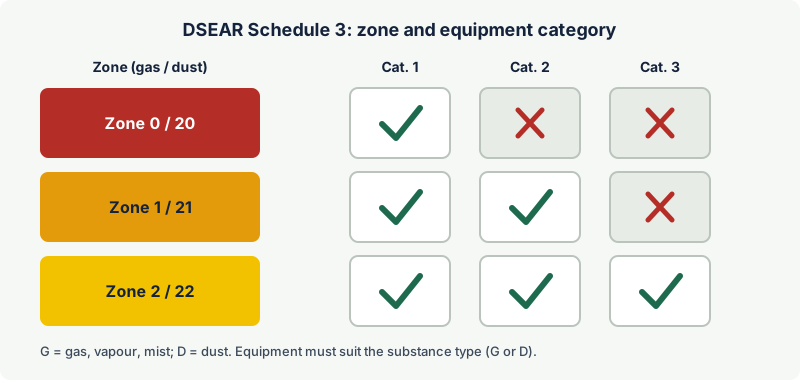
- Equipment categories: category 1 in Zone 0/20; category 1 or 2 in Zone 1/21; category 1, 2 or 3 in Zone 2/22 (Schedule 3).
- Before first use of a workplace with zones, overall explosion safety must be verified by a competent person (regulation 7(4)).
- Records: employers with five or more employees must record the significant findings, including zones and verification (regulation 5(4)).
- Equipment supply: the EPS Regulations 2016 (in force 8 December 2016) apply in Great Britain; UKCA or CE marking is accepted under legislation in force since 1 October 2024. In Northern Ireland, CE, or UKNI with CE, applies, and DSEAR has a separate Northern Ireland version (2003).
What DSEAR requires of employers
DSEAR implements the ATEX workplace directive 1999/92/EC in Great Britain and also covers substances corrosive to metals. The risk assessment under regulation 5 must consider the hazardous properties of each substance, the safety data sheet, the work processes and quantities, the likelihood and persistence of an explosive atmosphere, the likelihood of effective ignition sources including electrostatic discharges, the scale of possible effects and connected places. It must be reviewed regularly and whenever it may no longer be valid or there has been a significant change. No new work activity with a dangerous substance may start until the assessment is made and the measures are in place.
Regulation 7 requires the employer to classify places where an explosive atmosphere may occur into hazardous and non-hazardous places, and the hazardous places into zones by the frequency and duration of the explosive atmosphere. The employer then applies Schedule 3 to equipment and protective systems, marks entry points with the Ex sign where necessary, provides antistatic clothing and arranges verification of overall explosion safety before first use. HSE notes that equipment already in use before July 2003 may continue in use if the risk assessment shows it is safe.
How Ex equipment is certified and marked in Great Britain
The EPS Regulations 2016 transpose the ATEX equipment directive 2014/34/EU in Great Britain. Manufacturers (or importers, where the manufacturer is outside the UK) must meet the essential health and safety requirements and follow the conformity procedures; for higher-risk categories this involves a third-party conformity assessment body, while some equipment for less hazardous areas can be self-certified. Certified equipment carries the conformity mark and the Ex symbol. The Department for Business and Trade owns the policy and HSE enforces the Regulations.
Since 1 October 2024, legislation has continued recognition of the CE marking, so businesses can place equipment on the GB market with either UKCA marking (certified by a UK approved body, sometimes informally called "UKEX") or CE marking (certified by an EU notified body). For Northern Ireland, the government table lists CE, or UKNI together with CE.
Example: A UK food plant is replacing motors in a flour handling area classified as Zone 22. Flour is a non-conductive combustible dust, and under DSEAR Schedule 3 the plant may use category 1, 2 or 3 equipment suitable for dust. A motor marked CE and Ex with category 3D, from an EU-certified supplier, is acceptable in Great Britain, as is a UKCA-marked equivalent. The plant updates its DSEAR record, checks the motor's maximum surface temperature against the ignition temperatures of the flour cloud and layer, and has the installation inspected before use.
Installation, inspection and competence
DSEAR does not name technical standards. In practice, the IEC/EN 60079 series (published in the UK as BS EN standards) is used for area classification, selection, installation, inspection and maintenance of electrical equipment, for example EN 60079-10-1 (gas area classification), EN 60079-14 (installation) and EN 60079-17 (inspection and maintenance). People who classify areas, install or inspect Ex equipment must be competent, but UK law does not prescribe a specific personnel certification scheme.
Related on excodex
- Occupational safety and health in United Kingdom: law, authorities and employer duties
- What is the difference between ATEX and DSEAR in the UK?
- Is UKEX marking required in Great Britain?
- ATEX equipment categories 1, 2 and 3 and how they relate to EPLs
- Hazardous area zones explained: Zone 0, Zone 1 and Zone 2
Standards and further reading
- Dangerous Substances and Explosive Atmospheres Regulations 2002 (SI 2002/2776): https://www.legislation.gov.uk/uksi/2002/2776
- Equipment and Protective Systems Intended for Use in Potentially Explosive Atmospheres Regulations 2016 (SI 2016/1107): https://www.legislation.gov.uk/uksi/2016/1107
- Dangerous Substances and Explosive Atmospheres Regulations (Northern Ireland) 2003: https://www.legislation.gov.uk/nisr/2003/152
- HSE, DSEAR quick guide: https://www.hse.gov.uk/fireandexplosion/dsear.htm
- HSE, ATEX equipment and explosive atmospheres: https://www.hse.gov.uk/fireandexplosion/atex.htm
- GOV.UK, Product regulations by sector and current approaches to product marking (UKCA and CE), published 31 March 2026: https://www.gov.uk/government/publications/product-regulations-by-sector-and-current-approaches-to-product-marking-ukca-and-ce-regimes/product-regulations-by-sector-and-current-approaches-to-product-marking-ukca-and-ce-regimes
- IEC/EN 60079 series: explosive atmospheres, including area classification (part 10-1), installation (part 14) and inspection and maintenance (part 17)
This article is general occupational safety and health information prepared by the excodex editorial team. It does not replace the applicable legislation, standards, manufacturers' instructions or the assessment of a competent OSH professional or occupational physician.
More questions on this topic
- What is the main occupational safety and health law in the United Kingdom and who enforces it?
- Must an employer in the United Kingdom appoint a safety professional or an occupational physician?
- Is a written risk assessment mandatory in the United Kingdom, and how often must it be reviewed?
- How and within what time must a workplace accident be reported in the United Kingdom?
- What OSH training must employers provide to workers in the United Kingdom?
- Are pre-employment and periodic medical examinations required for workers in the United Kingdom?
- What are the penalties for breaking occupational safety rules in the United Kingdom?
- Is a safety committee or a worker safety representative required in the United Kingdom?
Part of: Occupational safety and health in United Kingdom: law, authorities and employer duties