Occupational safety International framework and country guides
Is a written risk assessment mandatory in Uzbekistan, and how often must it be reviewed?
Part of: Occupational safety and health in Uzbekistan: law, authorities and employer duties
Short answer
Yes. Since 2025 every Uzbek employer must identify hazards and assess occupational risks in a written "hazard matrix" within its OSH management system (CM Resolution No. 454). No fixed review interval is set, but the system must be audited at least once a year.
Yes. The Labour Code obliges every employer to create and run an OSH management system (Art. 359), and the Model Regulation approved by Cabinet of Ministers (CM) Resolution No. 454 of 21 July 2025 makes written hazard identification and occupational risk assessment, recorded in a "hazard matrix", a core part of that system. No fixed renewal period is set for the matrix itself, but the system must pass an internal audit at least once a year.
Short answer
- Legal basis: Labour Code Art. 359 (duty to have an OSH management system) and CM Resolution No. 454 of 2025, in force since 22 July 2025, which implements ILO Convention No. 155.
- Form: a "hazard matrix" (Xavflar matritsasi) per unit, using a 5 x 5 probability and severity scale, approved by the chief engineer and agreed with the trade union and the OSH service.
- Review: the matrix is kept until the next analysis; the OSH management system is audited internally at least once a year, and documents are kept for five years.
- Simplified version: organisations up to occupational risk class 10 may run a simplified OSH management system.
- Separate duty: workplaces with compensations, early-retirement rights, workers with disabilities or on hazardous production facilities also need an attestation of working conditions at least once every five years (Law ZRU-410, Art. 14).
How the Uzbek method works
The appendix to the Model Regulation sets a single method. Unit heads list each activity, the hazard (the object or situation that can cause harm), the possible harm and the persons exposed.
Probability (1 to 5) comes from five yes/no questions: is the workers' competence sufficient, does the equipment meet requirements, is there a documented working method, are key parameters measured and monitored, and do environmental factors such as lighting, noise protection and heat meet requirements. Five negative answers give 5 points, four give 4, three give 3, two give 2, and one or none give 1.
Severity (1 to 5) runs from a minor injury (1), through an injury with at least one day of lost working capacity or a move to lighter work (2), moderately severe injury needing hospital (3), group or severe injury (4), to a possible fatality (5).
The product of the two scores is read on the matrix. Only the lowest combinations count as controlled risk; all others are uncontrolled risk and need prompt measures, recorded in a plan with the action, cost, owner, deadline and expected result.
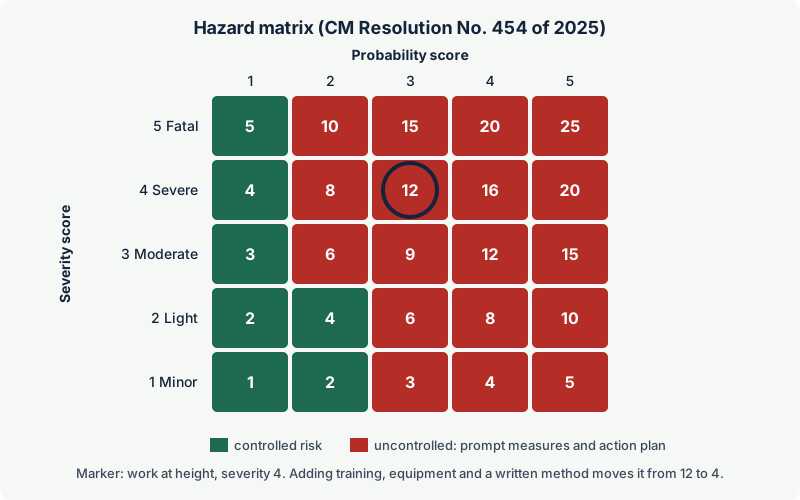
The matrix also has a "control method" column pointing to the OSH instruction or procedure that controls each risk; if none exists, the conclusion column says "not controlled". Keep the two columns apart: the risk level comes from the score table, while the conclusion records whether a control method exists. The worked example printed in the regulation marks a score of 8 as "controlled" in the conclusion column because a harness instruction exists, even though the score table classes 8 at severity 4 as uncontrolled. The OSH service then checks, together with the worker representatives, that the matrix is filled in correctly.
When to review it
The regulation does not give a calendar interval such as Türkiye's two, four or six years by hazard class. It says the matrix is kept until the next risk analysis and that the internal audit, carried out by the OSH service on the employer's decision, takes place at least once a year. Non-conformities found in audits lead to warning notices and corrective plans, and the regulation expects prevention methods to draw on past accidents and emergencies.
A defensible practice is therefore to:
- Re-check every matrix at the annual internal audit.
- Update the relevant matrix before a new process, equipment or substance is introduced.
- Update it after any accident, near miss, occupational disease or inspector's order.
- Keep superseded matrices for five years with the other system documents.
Example: A maintenance team works at height on a pipe rack. Two of the five questions get "no" (no written method, harnesses not inspected), so probability is 2; a fall could be severe, so severity is 4 and the score is 8. Under the regulation's table that is uncontrolled. Writing a method statement and introducing a harness inspection routine turns both answers to "yes", probability falls to 1 and the score to 4, a controlled risk.
Common mistakes
- Treating the workplace attestation as the risk assessment. Attestation measures working conditions for compensation purposes; the hazard matrix is a separate, broader duty.
- Leaving the trade union out. The matrix and the action plan must be agreed with the union or other worker representatives.
- Writing "controlled" because a risk looks low. Use the regulation's scores, and say "not controlled" where no instruction or procedure exists.
Related on excodex
- Occupational safety and health in Uzbekistan: law, authorities and employer duties
- Workplace risk assessment: process, team, records and review
- What OSH training must employers provide in Uzbekistan?
- Turkish risk assessment regulation: team, renewal and records
Standards and further reading
- CM Resolution No. 454 of 21 July 2025 "On introducing the OSH management system", Model Regulation and appendix on hazard identification and risk assessment: https://lex.uz/docs/7640822
- Labour Code of the Republic of Uzbekistan (2022), Arts. 359 and 361: https://lex.uz/docs/6257288
- Law No. ZRU-410 of 22 September 2016 "On Labour Protection", Arts. 14 and 15: https://lex.uz/docs/3031427
- ISO 45001, Occupational health and safety management systems (requirements with guidance for use)
This article is general occupational safety and health information prepared by the excodex editorial team. It does not replace the applicable legislation, standards, manufacturers' instructions or the assessment of a competent OSH professional or occupational physician.
More questions on this topic
- What is the main occupational safety and health law in Uzbekistan and who enforces it?
- Must an employer in Uzbekistan appoint a safety professional or an occupational physician?
- How and within what time must a workplace accident be reported in Uzbekistan?
- What OSH training must employers provide to workers in Uzbekistan?
- Are pre-employment and periodic medical examinations required for workers in Uzbekistan?
- What are the penalties for breaking occupational safety rules in Uzbekistan?
- Is a safety committee or a worker safety representative required in Uzbekistan?
- How are explosive atmospheres and Ex equipment regulated in Uzbekistan?
Part of: Occupational safety and health in Uzbekistan: law, authorities and employer duties