Occupational safety International framework and country guides
How and within what time must a workplace accident be reported in Uzbekistan?
Part of: Occupational safety and health in Uzbekistan: law, authorities and employer duties
Short answer
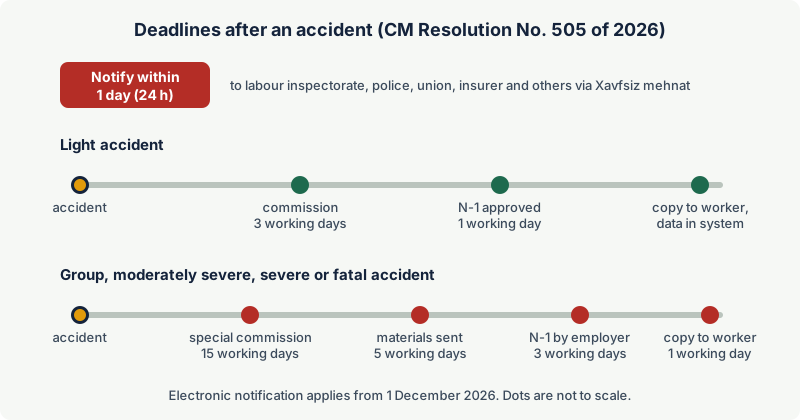
Within one day. Under CM Resolution No. 505 of 2026 the employer must notify the territorial labour inspectorate, police, union, insurer and other bodies within 24 hours, from 1 December 2026 through the "Xavfsiz mehnat" electronic system, then investigate and issue an N-1 act.
Within one day (bir sutka). Under the Regulation approved by Cabinet of Ministers (CM) Resolution No. 505 of 22 September 2026, the employer must send a notice of every accident at work within one day to the territorial State Labour Inspectorate and the other bodies listed below; from 1 December 2026 this is done through the "Xavfsiz mehnat" electronic system. The accident is then investigated and recorded in an N-1 act.
Short answer
- Rules: CM Resolution No. 505 of 22 September 2026, in force since 23 September 2026; it replaced CM Resolution No. 286 of 6 June 1997.
- Who reports first: the victim or a witness tells the unit head at once; the unit head informs the employer and the trade union at once.
- Employer deadline: notice within one day to the bodies listed below; medical institutions also notify the inspectorate and the union within one day.
- Channel: the "Xavfsiz mehnat" electronic information system, operated by the Ministry of Employment and Poverty Reduction, from 1 December 2026. The regulation names no other channel for the weeks before that date, so until the system is live notify the same bodies in writing by the fastest means and keep proof of sending (practical advice, not a rule in the text).
- Late death: if the injured worker later dies of the accident, a new notice is due within one day.
- Missing the deadline is itself a breach of OSH law and leads to liability.
Who must be notified
The employer's one-day notice goes to:
- The territorial State Labour Inspectorate.
- The superior economic body, if there is one.
- The territorial internal affairs (police) body where the accident happened.
- The Ministry of Employment and Poverty Reduction.
- The territorial association of trade unions.
- The territorial body of the Committee for Industrial, Radiation and Nuclear Safety, the mining and geology inspectorate or Uzenergoinspeksiya, if the site is under their supervision.
- The Ministry of Emergency Situations, if the accident was caused by fire, explosion, a technological accident or a natural disaster.
- The insurer under the employer's compulsory civil liability insurance contract.
The employer must also inform the victim's family, give first aid, prevent the situation from getting worse and keep the scene unchanged until the commission arrives, unless that would endanger others.
Investigation and the N-1 act
| Accident type | Who investigates | Deadline | Output |
|---|---|---|---|
| Light (no group, not severe) | Commission appointed by the employer's order, with the OSH service and a worker representative | 3 working days | N-1 act if at least one day of working capacity is lost or lighter work is needed; employer approves it within 1 working day |
| Group (2 or more workers), moderately severe, severe, or fatal with up to 3 deaths | Special commission chaired by a state technical labour inspector of the territorial employment body, with employer, union and insurer | 15 working days | Special investigation act; employer draws up N-1 acts within 3 working days of receiving it |
| Fatal with 3 to 11 deaths (bands as worded in the regulation) | Special commission formed by the Ministry, chaired by its chief or senior state technical inspector | 15 working days | As above |
| 11 or more deaths | Commission set up by order of the Cabinet of Ministers | Not fixed in the regulation | As above |
People directly or indirectly involved in the causes, people with a conflict of interest and managers directly responsible for safety may not sit on the employer's commission. The special commission's file includes an N-1 form for each victim; the chairing inspector sends the materials to the police, the employer and any supervising inspectorate within five working days, and the employer then issues the N-1 acts within three working days of receiving the special investigation act. The employer enters each N-1 act into the system within three working days and must discuss the causes with the workforce and adopt corrective measures.
Example: On a Monday at 15:00 two workers are burned in a flash fire in a paint shop. Because two workers are involved it is a group accident. The employer notifies the inspectorate, police, ministry, union, insurer and the Ministry of Emergency Situations before 15:00 on Tuesday. The territorial inspector chairs the special commission, which has 15 working days; the employer then has three working days to issue an N-1 act for each worker.
Disputes and hidden accidents
If the employer refuses to recognise an accident or to draw up an N-1 act, the worker or family can go to the trade union committee, which has ten working days to look into it, then to the State Labour Inspectorate and finally to court. Accidents that were not notified can be investigated by an inspector on the basis of complaints, police information or reports in the media and social networks. Hiding accidents can be reported to the authorities by the union, and breaches of OSH law are fined under Art. 49 of the Code of Administrative Responsibility.
Common mistakes
- Using the old 1997 regulation. It was repealed on 23 September 2026.
- Waiting for the hospital diagnosis. The one-day notice runs from the accident; the severity can be updated later.
- Investigating a serious accident internally only. Group, severe and fatal accidents need the special commission led by the state inspector.
Related on excodex
- Occupational safety and health in Uzbekistan: law, authorities and employer duties
- What are the penalties for breaking occupational safety rules in Uzbekistan?
- Accident reporting deadlines in Türkiye, the EU, the UK and the US
- Incident first response, reporting and scene preservation
Standards and further reading
- CM Resolution No. 505 of 22 September 2026 on notification, investigation and recording of work accidents and compensation of damage (Annex 1, Regulation; Annex 3, repealed acts): https://lex.uz/docs/8503049
- Labour Code of the Republic of Uzbekistan (2022), Arts. 365 and 366: https://lex.uz/docs/6257288
- Code of Administrative Responsibility, Art. 49: https://lex.uz/docs/97664
This article is general occupational safety and health information prepared by the excodex editorial team. It does not replace the applicable legislation, standards, manufacturers' instructions or the assessment of a competent OSH professional or occupational physician.
More questions on this topic
- What is the main occupational safety and health law in Uzbekistan and who enforces it?
- Must an employer in Uzbekistan appoint a safety professional or an occupational physician?
- Is a written risk assessment mandatory in Uzbekistan, and how often must it be reviewed?
- What OSH training must employers provide to workers in Uzbekistan?
- Are pre-employment and periodic medical examinations required for workers in Uzbekistan?
- What are the penalties for breaking occupational safety rules in Uzbekistan?
- Is a safety committee or a worker safety representative required in Uzbekistan?
- How are explosive atmospheres and Ex equipment regulated in Uzbekistan?
Part of: Occupational safety and health in Uzbekistan: law, authorities and employer duties