Occupational safety International framework and country guides
Occupational safety and health in Uzbekistan: law, authorities and employer duties
Abstract
Uzbekistan regulates OSH through the Labour Protection Law ZRU-410 (2016) and Chapter 20 of the 2022 Labour Code. The State Labour Inspectorate of the Ministry of Employment and Poverty Reduction enforces it; accidents must be notified within one day.
Occupational safety and health (OSH) in Uzbekistan rests on the Law "On Labour Protection" (Mehnatni muhofaza qilish to'g'risida, Russian: Об охране труда), No. ZRU-410 of 22 September 2016, and on Chapter 20 of the Labour Code (Mehnat kodeksi) of 28 October 2022, in force since 30 April 2023. The State Labour Inspectorate (Davlat mehnat inspeksiyasi) of the Ministry of Employment and Poverty Reduction (Kambag'allikni qisqartirish va bandlik vazirligi) enforces them, while hazardous production facilities are supervised by the Committee for Industrial, Radiation and Nuclear Safety under the Cabinet of Ministers. Since 2025 and 2026, new Cabinet of Ministers (CM) resolutions have rewritten the rules on OSH management systems, OSH services, training and accident reporting.
This guide covers the authorities, duties, OSH staffing, training, medical examinations, accident reporting, penalties, chemicals and Ex equipment, and compares Uzbekistan with the EU and Türkiye. Legal texts were checked on lex.uz, the national legislation database, on 5 November 2026.
Key points
- The core OSH acts are Law No. ZRU-410 of 22 September 2016 and Labour Code Articles 351 to 366, which add the duty to create and run an OSH management system (Art. 359).
- State technical labour inspectors of the Ministry of Employment and Poverty Reduction inspect, issue binding orders and can suspend work or equipment that endangers life or health.
- Production employers with 50 or more workers must have an OSH service or OSH specialist (Law ZRU-410, Art. 12); CM Resolution No. 819 of 24 December 2025 sets the size of the service by headcount and occupational risk class and requires a specialist even below 50 workers in risk classes 10 to 20.
- Every accident at work must be notified within one day (bir sutka) to the territorial labour inspectorate and other bodies; from 1 December 2026 this is done through the "Xavfsiz mehnat" electronic system (CM Resolution No. 505 of 22 September 2026).
- Risk assessment uses a 5 x 5 "hazard matrix" set by the model OSH management system of CM Resolution No. 454 of 21 July 2025, with an internal audit at least yearly.
- Officials who break OSH law face fines of 5 to 10 times the base calculation amount (BCA) under Art. 49 of the Code of Administrative Responsibility; a BCA is 440,000 sum from 1 September 2026, so the range is 2.2 to 4.4 million sum (2026).
- Ex equipment needs a national certificate of conformity under the technical regulation approved by CM Resolution No. 2 of 6 January 2025; Uzbekistan is not an EAEU member, so the EAC mark alone does not show conformity.
The legal framework
The 2016 Labour Protection Law sets the principles and the duties of employers (Art. 23) and workers (Art. 22), medical examinations (Art. 24), training (Art. 25), accident investigation (Art. 26), state supervision (Art. 28) and trade union rights (Art. 31). Its consolidated text on lex.uz was last amended on 18 May 2022 and still names the predecessor ministry; the Labour Code, amended as late as October 2026, uses the current ministry name.
The Labour Code repeats and updates most of these duties in Chapter 20 ("Mehnatni muhofaza qilish"). It also gives every worker the right to refuse work that threatens life or health, with average pay kept (Art. 358), and forbids heavy, harmful or dangerous work for persons under 18 (Art. 354).
Below the law sit CM resolutions and ministerial orders. The ones an employer meets first are:
| Topic | Act (Uzbek title shortened) | Status checked |
|---|---|---|
| OSH management system and risk assessment | CM Resolution No. 454 of 21 July 2025, Model Regulation on the OSH management system | In force from 22 July 2025 |
| OSH service, training, OSH instructions, OSH representative | CM Resolution No. 819 of 24 December 2025, four regulations | In force from 25 December 2025 |
| Accident notification, investigation and compensation | CM Resolution No. 505 of 22 September 2026; replaces Resolution No. 286 of 6 June 1997 | In force from 23 September 2026 |
| Medical examinations | Ministry of Health Regulation, registration No. 2387 of 29 August 2012 | Amended 7 May 2026 |
| Industrial safety | Law No. ZRU-57 of 28 September 2006 "On industrial safety of hazardous production facilities" | Last amended 21 April 2021 |
| Ex equipment | CM Resolution No. 2 of 6 January 2025, technical regulation on equipment for explosive atmospheres | Applies six months after its official publication on 7 January 2025 |
Uzbekistan has passed laws ratifying ILO Conventions No. 81 (labour inspection, Law ZRU-556 of 27 August 2019), No. 187 (promotional framework for OSH, Law ZRU-693 of 4 June 2021) and No. 155 (OSH and the working environment, Law ZRU-969 of 2 October 2024). The ILO registration dates, which decide when each convention binds internationally, are on the ILO NORMLEX country page, which could not be opened for this guide.
Who enforces OSH in Uzbekistan
| Authority | Role |
|---|---|
| Ministry of Employment and Poverty Reduction, State Labour Inspectorate | Labour and OSH law in all workplaces; state technical labour inspectors; chairs special accident investigations |
| Committee for Industrial, Radiation and Nuclear Safety under the Cabinet of Ministers (Sanoat, radiatsiya va yadro xavfsizligi qo'mitasi) | Hazardous production facilities, register, industrial safety expertise and declarations |
| Inspectorate for supervision of mining and geology (under the Ministry of Mining Industry and Geology) | Mining, subsoil use, blasting |
| Uzenergoinspeksiya (Inspectorate for control of the use of electricity, oil products and gas, under the Cabinet of Ministers) | Electrical installations and energy facilities |
| Committee for Sanitary and Epidemiological Wellbeing and Public Health under the Ministry of Health | Hygiene limits, medical examinations, occupational diseases |
| Ministry of Emergency Situations | Fire safety, emergencies |
| Uzbek Agency for Technical Regulation (O'zbekiston texnik jihatdan tartibga solish agentligi) | Technical regulations and product certification |
| Federation of Trade Unions of Uzbekistan and its bodies | Public control of OSH, participation in investigations |
State technical labour inspectors may demand documents, take part in or run special accident investigations, give binding written orders, ban non-compliant personal and collective protective equipment, impose administrative fines and suspend an organisation's activity or the use of equipment that endangers workers (Law ZRU-410, Art. 28). Inspections are planned or unscheduled and follow the procedure set by legislation (Labour Code, Art. 536).
What employers and workers must do
Employer duties
Labour Code Art. 359 lists the employer's duties. The main ones are:
- Make working conditions at every workplace comply with OSH rules and create and run an OSH management system.
- Keep workers safe when using buildings, equipment, processes and materials, and monitor harmful and dangerous production factors.
- Inform workers about working conditions, risks of occupational disease, compensations and protective equipment.
- Organise the OSH service (and a road safety service where required) as the law sets.
- Provide milk or equivalent food, therapeutic and preventive meals, salted water in hot shops, personal and collective protective equipment free of charge, under the set norms.
- Instruct, train and test workers; never let an untrained worker start work.
- Carry out the attestation of workplaces by working conditions where workers get compensations or early retirement rights, where persons with disabilities work and at hazardous production facilities (Labour Code, Art. 361); the law requires it at least once every five years (Law ZRU-410, Art. 14).
- Organise pre-employment and periodic medical examinations.
- Prevent emergencies, give first aid, follow inspectors' orders, insure workers and the employer's civil liability, and investigate and record accidents and occupational diseases.
Personal and collective protective equipment must meet OSH requirements and hold a certificate of conformity (Labour Code, Art. 352). Workers must follow OSH rules, use protective equipment correctly, attend instruction, training and medical examinations, and tell the employer at once about any immediate danger or accident (Art. 355).
Risk assessment and the OSH management system
CM Resolution No. 454 of 2025 implements ILO Convention No. 155. Each organisation adopts its own OSH management system regulation, agreed with the worker representatives. Unit heads identify hazards and fill in a "hazard matrix" (Xavflar matritsasi): probability is scored 1 to 5 from five yes/no questions (competence, equipment, documented method, monitoring, working environment), severity 1 to 5 from minor injury to fatality, and the product gives the risk level. The OSH service checks the matrix with the worker representatives, and uncontrolled risks go into an action plan with money, owner and deadline.
The internal audit of the system is carried out at least once a year by the OSH service, and system documents are kept for five years. No fixed renewal interval is set for the matrix itself, so review it at each internal audit and after accidents or changes. Organisations up to occupational risk class 10 may use a simplified system.
OSH service, training and medical examinations
OSH service and specialists
Law ZRU-410, Art. 12 requires an OSH service or an OSH specialist in every production organisation with 50 or more workers; below 50 the law leaves it to the employer. The service reports directly to the head of the organisation. CM Resolution No. 819 of 2025 adds staffing norms that combine headcount and the occupational risk class used for employer liability insurance (classes 1 to 20), and they reach below the 50-worker line: an organisation with fewer than 50 workers in classes 10 to 20 must create an OSH specialist post.
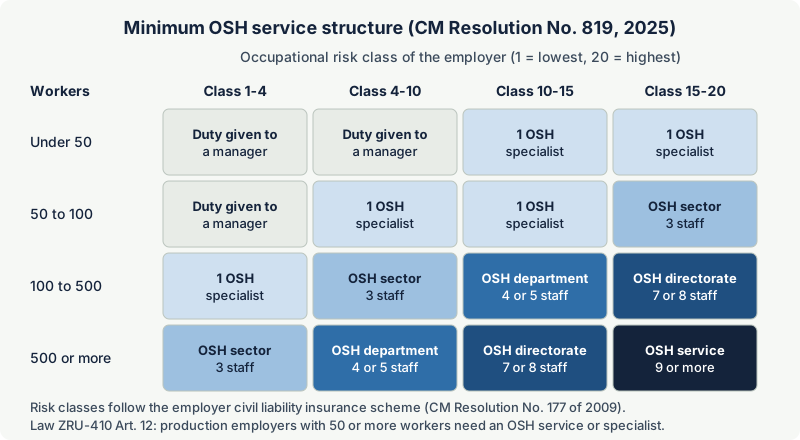
The grid gives the low-risk cells for 50 to 100 workers to "one of the managers", while Art. 12 of the law speaks of 50 workers in production. Where the two seem to differ, plan for the stricter reading and confirm with the territorial inspectorate. The service functions may also be contracted to registered "professional participants of the OSH services market" (Art. 13).
The 2025 regulation also sets qualifications: the head of the OSH service needs higher engineering education, three years of experience in the field and an OSH specialist qualification certificate. It also requires one member of the service to have higher medical education in occupational hygiene, without saying how this applies to a single-specialist service.
Uzbek law does not require an occupational physician on the Turkish model. Medical examinations are done by the medical institution that serves the organisation or by the territorial one; the chair of the medical commission must be a doctor trained in occupational pathology or occupational diseases.
Training
Under the 2025 training regulation (Annex 2 to Resolution No. 819):
- Induction instruction for every new worker, seconded worker, contractor and student, in groups of no more than 12, before the contract is signed.
- Workplace instruction: initial, periodic at least every six months (every three months in harmful or dangerous work) and unscheduled after changes, accidents, breaches or long breaks.
- Work placement (stajirovka) of at least three shifts before independent work in high-hazard jobs.
- Knowledge testing of unit heads, specialists and workers at least every three years, every year in high-hazard production.
- A standing examination commission whose members take a course of at least 36 academic hours every three years; OSH specialists take at least 72 hours of upskilling every three years.
Medical examinations
The Labour Code (Art. 360) requires pre-employment and periodic examinations for workers under 18, workers of pension age, persons with disabilities, workers in adverse conditions, night work and transport, food, trade and childcare. The Ministry of Health list gives the interval per factor: for example every two years for inorganic nitrogen compounds such as ammonia, and for industrial noise above the 80 dB limit every two years from 81 to 99 dB and every year from 100 dB. Workers pay nothing and keep their pay; the employer must remove from work anyone who has not had the required examination or ignores the medical commission's recommendations (Art. 360).
Accident reporting, inspection and penalties
CM Resolution No. 505 of 2026 replaced the 1997 accident regulation. The victim or a witness tells the unit head at once, and the unit head informs the employer and the trade union. The employer must give first aid, stop the hazard spreading, keep the scene as it was where safe, and notify within one day: the territorial State Labour Inspectorate, any superior body, the local internal affairs body, the Ministry, the territorial trade union association, the industrial safety, mining or energy inspectorate if the site is under its supervision, the Ministry of Emergency Situations after fire, explosion, technological accident or natural disaster, and the employer's liability insurer. A missed notification is itself a breach of OSH law.
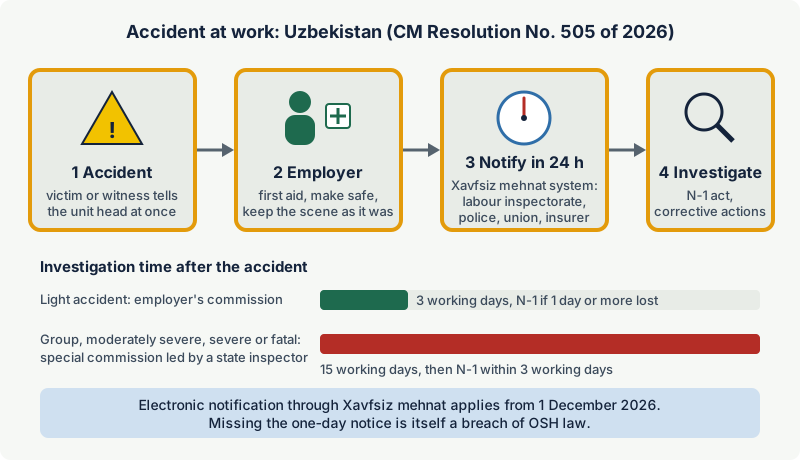
Light accidents are investigated in three working days by a commission set up by the employer, without managers directly responsible for safety there. An N-1 act is drawn up if the worker loses at least one day of working capacity or must move to lighter work on medical advice; the employer approves it within one working day and gives the worker a copy. Group accidents (two or more workers), moderately severe, severe and fatal accidents get a special investigation, completed in 15 working days, chaired by a state technical labour inspector of the territorial labour body (up to three deaths) or of the Ministry (three to eleven deaths); eleven or more deaths go to a commission formed by the Cabinet of Ministers.
Example: A 120-worker chemical plant in Navoiy, registered as a hazardous production facility, has a fitter fall from a platform at 10:00 on a Tuesday; the hospital classifies the injury as severe. The unit head arranges first aid and keeps the scene untouched. The employer notifies the territorial inspectorate, the Ministry, the police, the territorial union association, the insurer and the industrial safety committee's territorial body through the electronic system before 10:00 on Wednesday. The inspector chairs the special commission, which finishes within 15 working days; the employer then draws up the N-1 act within three working days, gives the worker a copy within one working day and issues an order on corrective actions.
Penalties
| Breach | Legal basis | Sanction (BCA = 440,000 sum from 1 September 2026) |
|---|---|---|
| Official breaks labour or OSH law | Code of Administrative Responsibility, Art. 49 | 5 to 10 BCA; repeat within a year 10 to 15 BCA |
| Breach against a minor | Art. 49, part 3 | 10 to 20 BCA |
| Failure to take out compulsory employer civil liability insurance | Art. 49-2 | Citizens 7 to 10 BCA, officials 10 to 15 BCA; repeat 10 to 15 and 15 to 30 BCA |
| Industrial safety breach at a supervised facility | Art. 97 | Citizens 1 to 3 BCA, officials 3 to 5 BCA; repeat 3 to 5 and 5 to 10 BCA |
| Breach of OSH rules by the responsible person causing moderately severe or severe injury | Criminal Code, Art. 257, part 1 | Fine of 25 to 50 BCA, ban on holding a post up to 5 years, correctional work up to 3 years, restriction of liberty 1 to 3 years or prison up to 3 years |
| Same breach causing death or other grave consequences | Art. 257, part 2 | Restriction of liberty 2 to 5 years or prison up to 5 years, with a ban on holding a post |
Breaches of mining, construction or blasting safety rules have their own criminal article with the same sanctions (Criminal Code, Art. 258). The BCA is set by presidential decree (Decree UP-115 of 23 June 2026 for the current figure) and is raised from time to time, so recalculate the amounts at the date of the breach. The employer must also compensate damage to the worker's health in full under the Labour Protection Law (Art. 33) and the compensation rules approved with Resolution No. 505.
Worker representation
Uzbekistan has no OSH committee with a headcount threshold on the Turkish model. Worker participation runs through three channels:
- An OSH representative (mehnatni muhofaza qilish bo'yicha vakil) elected by open vote at the primary trade union meeting, or at a meeting of another worker representative body, for at least one year. Managers responsible for working conditions and OSH service staff cannot stand. The representative has at least two hours a week of paid time, the right to suspend work in case of danger and protection against discipline or dismissal without prior union consent (Law ZRU-410, Art. 31, and the 2025 regulation in Annex 4 to Resolution No. 819).
- The three-stage administrative and public control run jointly by the employer and the union: daily at shift level, every 15 days at unit level, and at organisation level by a standing commission set up by order of the head of the organisation, which includes the chief engineer, the OSH service head and the union chair (Annex 1 to Resolution No. 819).
- The bipartite commission on social and labour issues at enterprise level (Labour Code, Art. 49), which covers labour matters in general.
Chemicals, explosive atmospheres and major-hazard sites
Chemicals
No general act on workplace classification and labelling under the UN Globally Harmonized System (GHS), comparable with the EU CLP Regulation, was found on lex.uz. The 2026 rules on handling highly flammable and explosive chemicals (CM Resolution No. 326 of 25 June 2026, applying three months after publication) require a safety data sheet for each substance, accessible to workers, and use the GHS and ADR dangerous goods classes in their transport chapter. Harmful substances may not be used without approved exposure limits (Law ZRU-410, Art. 19).
Explosive atmospheres and Ex equipment
The technical regulation approved by CM Resolution No. 2 of 2025 covers equipment for explosive gas and dust atmospheres. It sets hazardous area classes 0, 1, 2 and 20, 21, 22, equipment groups I to III, three protection levels ("very high", "high" and "enhanced"), the familiar Ex protection types and temperature classes T1 to T6. Its area definitions follow older CIS wording (class 0, for example, is an atmosphere present continuously or for at least one hour), so check zone drawings made to IEC 60079-10 against them. Before placing on the market, equipment needs a certificate of conformity under scheme 1C (serial production, three years), 3C (batch) or 4C (single item), Ex marking and markings in the state language. Rules for operating Ex equipment are set by the Committee for Industrial, Radiation and Nuclear Safety. The ATEX book explains the zone concept and other national Ex schemes.
Major-hazard sites
A facility is a hazardous production facility if it handles flammable, toxic (hazard classes I to III) or explosive substances, pressure equipment above 0.07 MPa, fixed lifting appliances, molten metals or mining (Law ZRU-57, Art. 4). It must be entered in the state register, use certified technical devices, pass industrial safety expertise, keep production control, plan emergency response and, above the threshold quantities in CM Resolution No. 271 of 10 December 2008 (for example 25 tonnes of chlorine, 500 tonnes of ammonia, 200 tonnes of flammable gases), prepare an industrial safety declaration. A new law on hazardous and potentially hazardous facilities was adopted by the Legislative Chamber on 21 April 2026; its signature and entry into force could not be confirmed on 5 November 2026.
Uzbekistan compared with the EU and Türkiye
| Topic | Uzbekistan | EU (Directive 89/391/EEC) | Türkiye (Law No. 6331) |
|---|---|---|---|
| Main OSH law | Law ZRU-410 (2016) and Labour Code Ch. 20 (2022) | Framework Directive plus national laws | Law No. 6331 (2012) |
| OSH staff | OSH service or specialist from 50 production workers; size by headcount and risk class | Designated workers or competent services (Art. 7), details set nationally | OSH specialist and workplace physician, in-house or external, for every employer; limited self-provision in small less hazardous workplaces (Art. 6) |
| Committee | Elected OSH representative; standing commission for the third stage of joint control | Consultation and participation required (Art. 11), form set nationally | 50 or more workers and permanent work over six months (Art. 22) |
| Risk assessment | Hazard matrix within the OSH management system; internal audit yearly | Employer must possess a risk assessment (Art. 9) | Required for every employer (Art. 10); review intervals by hazard class in the risk assessment regulation |
| Accident report | Within one day, electronic system from 1 December 2026 | Set nationally | Social Security Institution within 3 working days (Art. 14) |
| Ex equipment | National certificate under 2025 technical regulation | ATEX Directive 2014/34/EU, CE and Ex marks | ATEX rules transposed, CE marking |
Common mistakes
- Relying on the 1997 accident regulation. Resolution No. 286 of 1997 was repealed on 23 September 2026; use Resolution No. 505 and its N-1 form.
- Treating the EAC or ATEX certificate as enough. Uzbekistan applies its own Ex technical regulation and certification; ask the certification body which foreign test reports it accepts.
- Counting only the 50-worker rule. The 2025 staffing norms depend on risk class too; a 120-worker plant in a high class may need a full OSH department.
- Forgetting periodic instruction. Workplace instruction is due every six months, and every three months in harmful or dangerous work.
- Quoting fines without the BCA date. Fines are multiples of the BCA, which changes by decree; state the figure for the date of the breach.
Frequently asked questions
Does Uzbek OSH law apply to foreign companies and expatriate workers?
Yes. The Labour Protection Law applies to all employers and workers in Uzbekistan, and the accident regulation expressly covers foreign nationals employed in the country unless an interstate agreement says otherwise. An accident to a worker sent to another organisation is investigated by the host organisation with a representative of the sending employer; a contractor working on a site section handed over to it investigates its own accidents.
Can a worker refuse dangerous work?
Yes. Under Labour Code Art. 358 a worker who informs the employer at once may refuse work that threatens life or health until the danger is removed, keeping average pay; meanwhile the employer must offer other work (Art. 356). Justified refusal cannot lead to disciplinary action, but if no danger is found the employer may start an internal inquiry.
Is ISO 45001 certification mandatory?
No. The law requires an OSH management system based on the 2025 Model Regulation, not a certified one. An ISO 45001 system can be used if it also contains the national elements such as the hazard matrix, the internal audit and the required records.
Who pays for medical examinations and protective equipment?
The employer. Workers bear no cost for OSH measures, medical examinations or protective equipment, including its storage, washing, cleaning, repair and disinfection (Labour Code, Arts. 353, 360 and 363).
Related on excodex
- What is the main OSH law in Uzbekistan and who enforces it?
- How must a workplace accident be reported in Uzbekistan?
- How are explosive atmospheres and Ex equipment regulated in Uzbekistan?
- OSH law comparison: appointments and reporting deadlines
- OSH in Kazakhstan
- ILO OSH conventions and their fundamental status
Standards and further reading
- Law of the Republic of Uzbekistan No. ZRU-410 of 22 September 2016 "On Labour Protection" (new edition): https://lex.uz/docs/3031427
- Labour Code of the Republic of Uzbekistan, approved by Law No. ZRU-798 of 28 October 2022, in force 30 April 2023, Chapter 20 and Arts. 534 to 540: https://lex.uz/docs/6257288
- CM Resolution No. 454 of 21 July 2025 on introducing the OSH management system: https://lex.uz/docs/7640822
- CM Resolution No. 819 of 24 December 2025 approving regulations on the OSH service, training, OSH instructions and the OSH representative: https://lex.uz/docs/7942768
- CM Resolution No. 505 of 22 September 2026 on notification, investigation and recording of work accidents and compensation: https://lex.uz/docs/8503049
- Ministry of Health Regulation on medical examinations of workers, registration No. 2387 of 29 August 2012: https://lex.uz/docs/2046010
- Code of Administrative Responsibility, Arts. 49 and 97: https://lex.uz/docs/97664
- Criminal Code, Art. 257: https://lex.uz/docs/111453
- Presidential Decree UP-115 of 23 June 2026 (BCA from 1 September 2026): https://lex.uz/ru/docs/8283680
- Law No. ZRU-57 of 28 September 2006 on industrial safety of hazardous production facilities: https://lex.uz/ru/docs/1061184
- CM Resolution No. 271 of 10 December 2008 (identification, threshold quantities, industrial safety declaration): https://lex.uz/ru/docs/1413933
- CM Resolution No. 2 of 6 January 2025, technical regulation on equipment used in explosive atmospheres: https://lex.uz/docs/7300333
- CM Resolution No. 326 of 25 June 2026, rules on handling highly flammable and explosive chemicals: https://lex.uz/docs/8288643
- Laws ratifying ILO Conventions No. 155 (ZRU-969, 2024), No. 187 (ZRU-693, 2021) and No. 81 (ZRU-556, 2019): https://lex.uz/ru/docs/7125655, https://lex.uz/ru/docs/5443936, https://lex.uz/ru/docs/4490211
- Resolution of the Legislative Chamber No. 1978-V of 21 April 2026 on the new industrial safety law: https://lex.uz/ru/docs/8200039
This article is general occupational safety and health information prepared by the excodex editorial team. It does not replace the applicable legislation, standards, manufacturers' instructions or the assessment of a competent OSH professional or occupational physician.
Questions on this topic
- What is the main occupational safety and health law in Uzbekistan and who enforces it?
- Must an employer in Uzbekistan appoint a safety professional or an occupational physician?
- Is a written risk assessment mandatory in Uzbekistan, and how often must it be reviewed?
- How and within what time must a workplace accident be reported in Uzbekistan?
- What OSH training must employers provide to workers in Uzbekistan?
- Are pre-employment and periodic medical examinations required for workers in Uzbekistan?
- What are the penalties for breaking occupational safety rules in Uzbekistan?
- Is a safety committee or a worker safety representative required in Uzbekistan?
- How are explosive atmospheres and Ex equipment regulated in Uzbekistan?
- Which rules apply to major-hazard chemical sites in Uzbekistan?